Graduate School of Systems Life Sciences, Kyushu University, Fukuoka, Japan.
Department of Virology II, National Institute of Infectious Diseases, Tokyo, Japan.
PLoS Biol. 2020 Jul 30;18(7):e3000562. doi: 10.1371/journal.pbio.3000562. eCollection 2020 Jul.
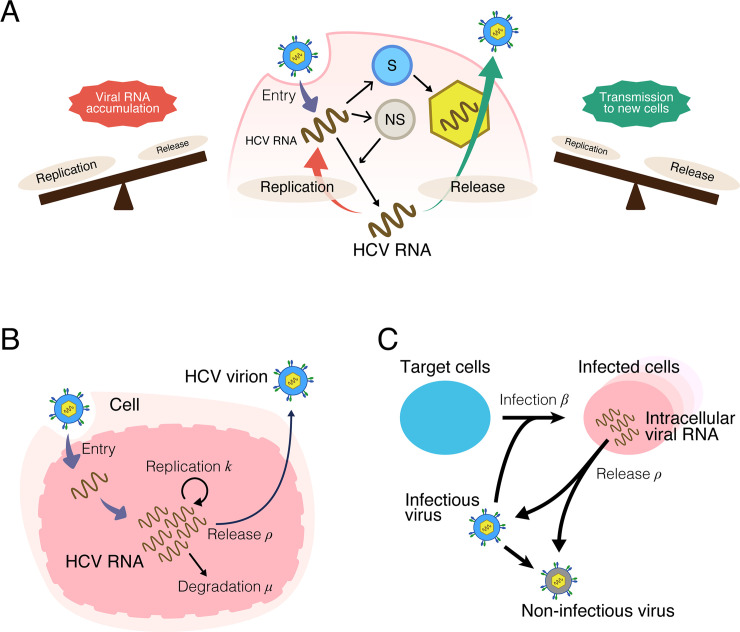
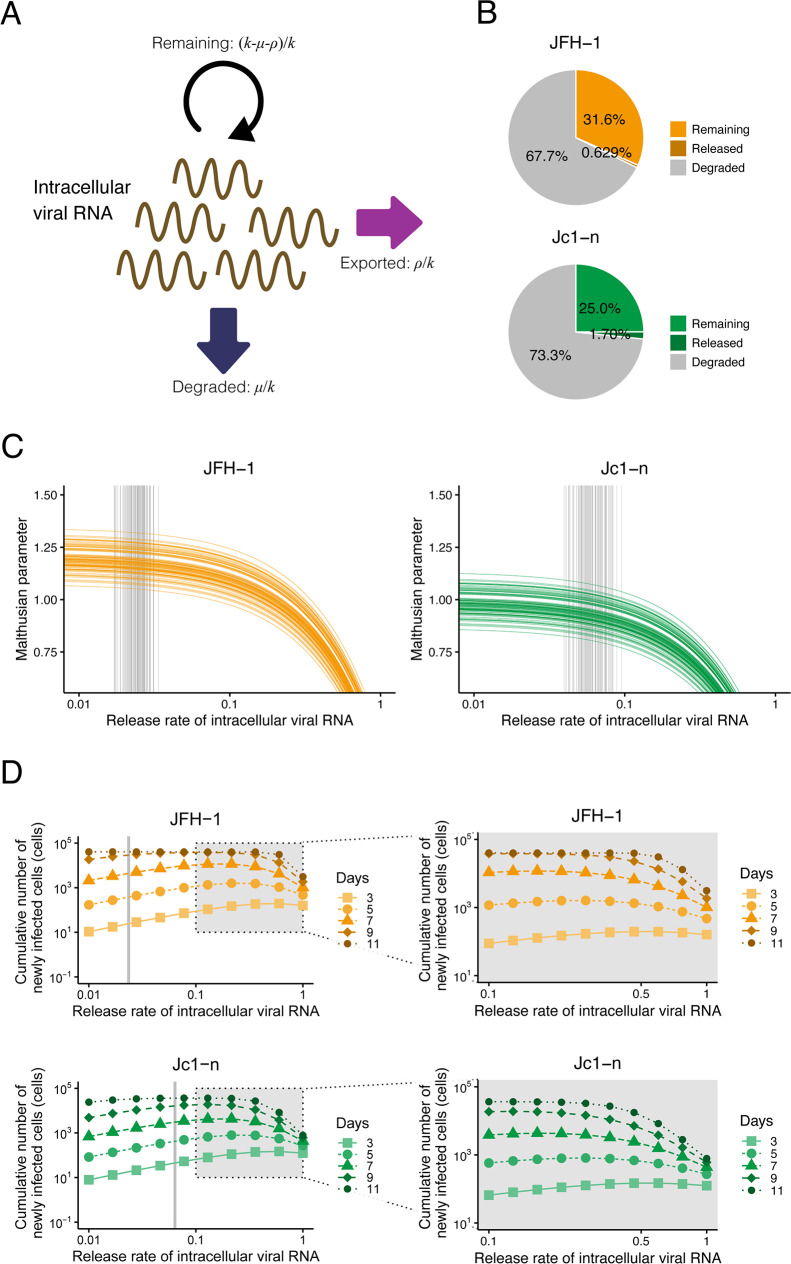
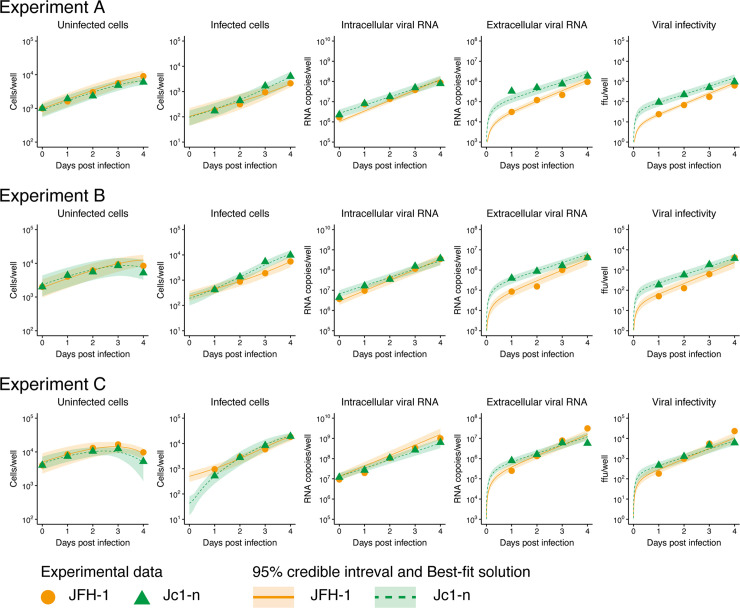
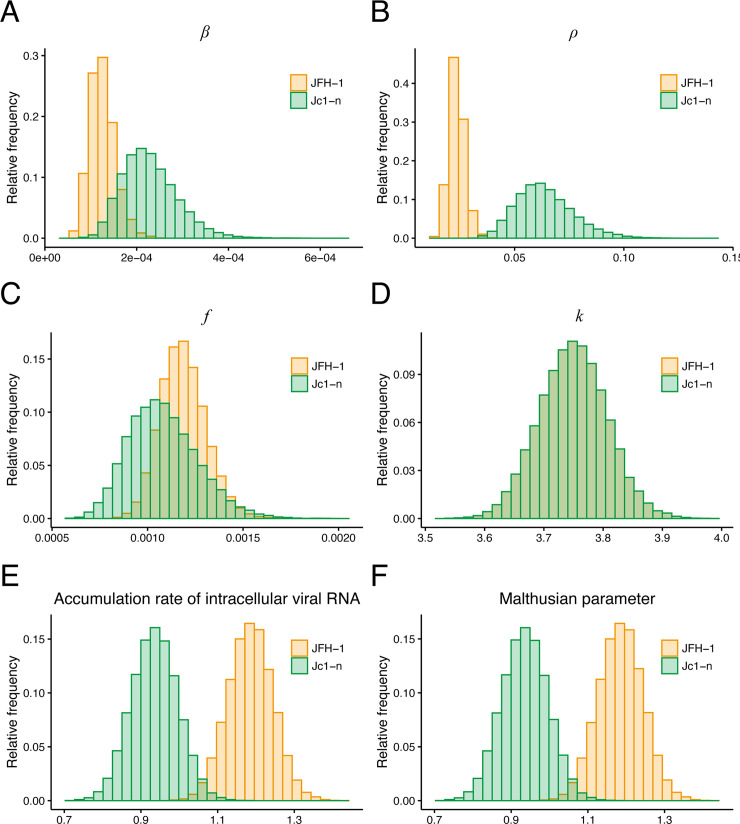
Virus proliferation involves gene replication inside infected cells and transmission to new target cells. Once positive-strand RNA virus has infected a cell, the viral genome serves as a template for copying ("stay-strategy") or is packaged into a progeny virion that will be released extracellularly ("leave-strategy"). The balance between genome replication and virion release determines virus production and transmission efficacy. The ensuing trade-off has not yet been well characterized. In this study, we use hepatitis C virus (HCV) as a model system to study the balance of the two strategies. Combining viral infection cell culture assays with mathematical modeling, we characterize the dynamics of two different HCV strains (JFH-1, a clinical isolate, and Jc1-n, a laboratory strain), which have different viral release characteristics. We found that 0.63% and 1.70% of JFH-1 and Jc1-n intracellular viral RNAs, respectively, are used for producing and releasing progeny virions. Analysis of the Malthusian parameter of the HCV genome (i.e., initial proliferation rate) and the number of de novo infections (i.e., initial transmissibility) suggests that the leave-strategy provides a higher level of initial transmission for Jc1-n, whereas, in contrast, the stay-strategy provides a higher initial proliferation rate for JFH-1. Thus, theoretical-experimental analysis of viral dynamics enables us to better understand the proliferation strategies of viruses, which contributes to the efficient control of virus transmission. Ours is the first study to analyze the stay-leave trade-off during the viral life cycle and the significance of the replication-release switching mechanism for viral proliferation.
病毒增殖涉及感染细胞内的基因复制和向新靶细胞的传播。一旦正链 RNA 病毒感染了细胞,病毒基因组就作为复制的模板(“停留策略”),或被包装成将被释放到细胞外的子代病毒颗粒(“离开策略”)。基因组复制和病毒颗粒释放之间的平衡决定了病毒的产生和传播效率。这种平衡的权衡尚未得到很好的描述。在这项研究中,我们使用丙型肝炎病毒(HCV)作为模型系统来研究这两种策略的平衡。我们将病毒感染细胞培养测定与数学建模相结合,对两种具有不同病毒释放特征的不同 HCV 株(JFH-1,一种临床分离株,和 Jc1-n,一种实验室株)进行了特征描述。我们发现,JFH-1 和 Jc1-n 的细胞内病毒 RNA 分别有 0.63%和 1.70%用于产生和释放子代病毒颗粒。对 HCV 基因组的马尔萨斯参数(即初始增殖率)和从头感染数量(即初始传染性)的分析表明,离开策略为 Jc1-n 提供了更高水平的初始传播,而相比之下,停留策略为 JFH-1 提供了更高的初始增殖率。因此,病毒动力学的理论-实验分析使我们能够更好地理解病毒的增殖策略,有助于有效地控制病毒传播。我们的研究首次分析了病毒生命周期中的停留-离开权衡,以及复制-释放转换机制对病毒增殖的意义。