Institute for Experimental and Translational Cardiovascular Imaging, DZHK Centre for Cardiovascular Imaging, University Hospital Frankfurt, Frankfurt am Main, Germany.
Department of Biomedical Sciences and Morphological and Functional Imaging, University of Messina, Messina, Italy.
JAMA Cardiol. 2020 Nov 1;5(11):1265-1273. doi: 10.1001/jamacardio.2020.3557.
Coronavirus disease 2019 (COVID-19) continues to cause considerable morbidity and mortality worldwide. Case reports of hospitalized patients suggest that COVID-19 prominently affects the cardiovascular system, but the overall impact remains unknown.
To evaluate the presence of myocardial injury in unselected patients recently recovered from COVID-19 illness.
DESIGN, SETTING, AND PARTICIPANTS: In this prospective observational cohort study, 100 patients recently recovered from COVID-19 illness were identified from the University Hospital Frankfurt COVID-19 Registry between April and June 2020.
Recent recovery from severe acute respiratory syndrome coronavirus 2 infection, as determined by reverse transcription-polymerase chain reaction on swab test of the upper respiratory tract.
Demographic characteristics, cardiac blood markers, and cardiovascular magnetic resonance (CMR) imaging were obtained. Comparisons were made with age-matched and sex-matched control groups of healthy volunteers (n = 50) and risk factor-matched patients (n = 57).
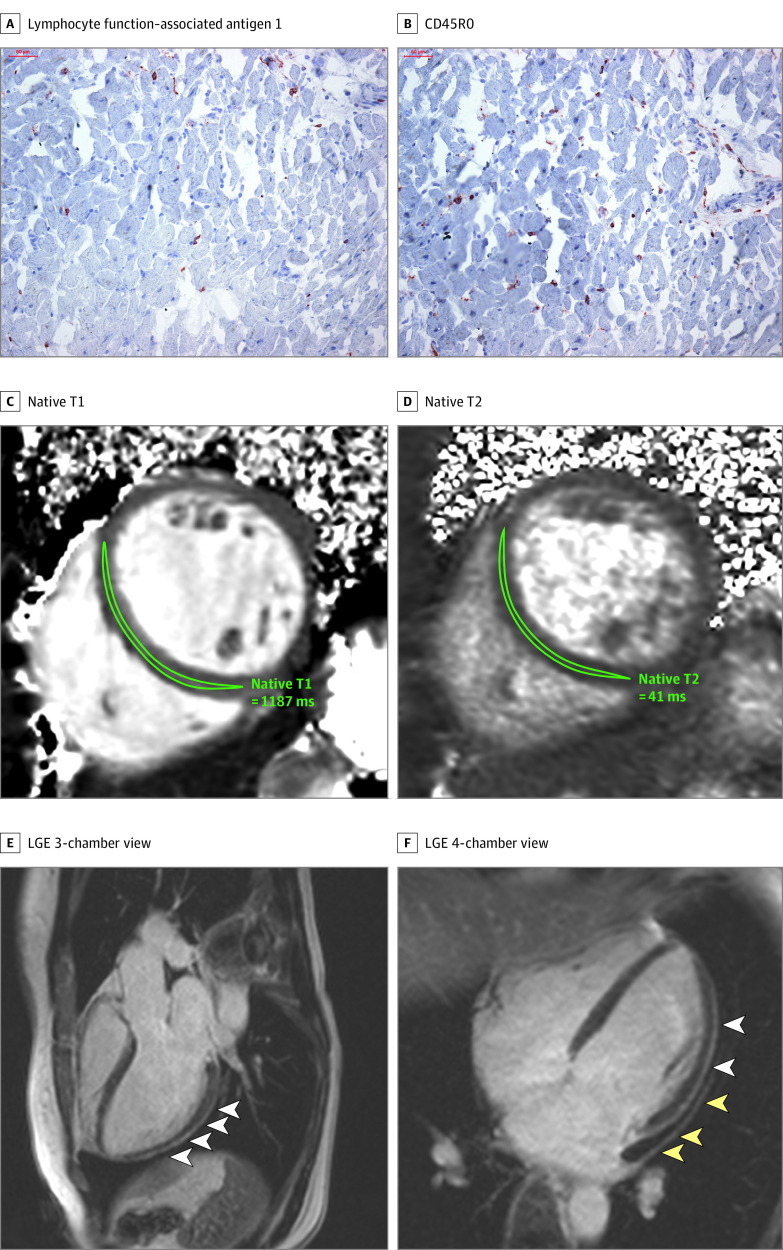
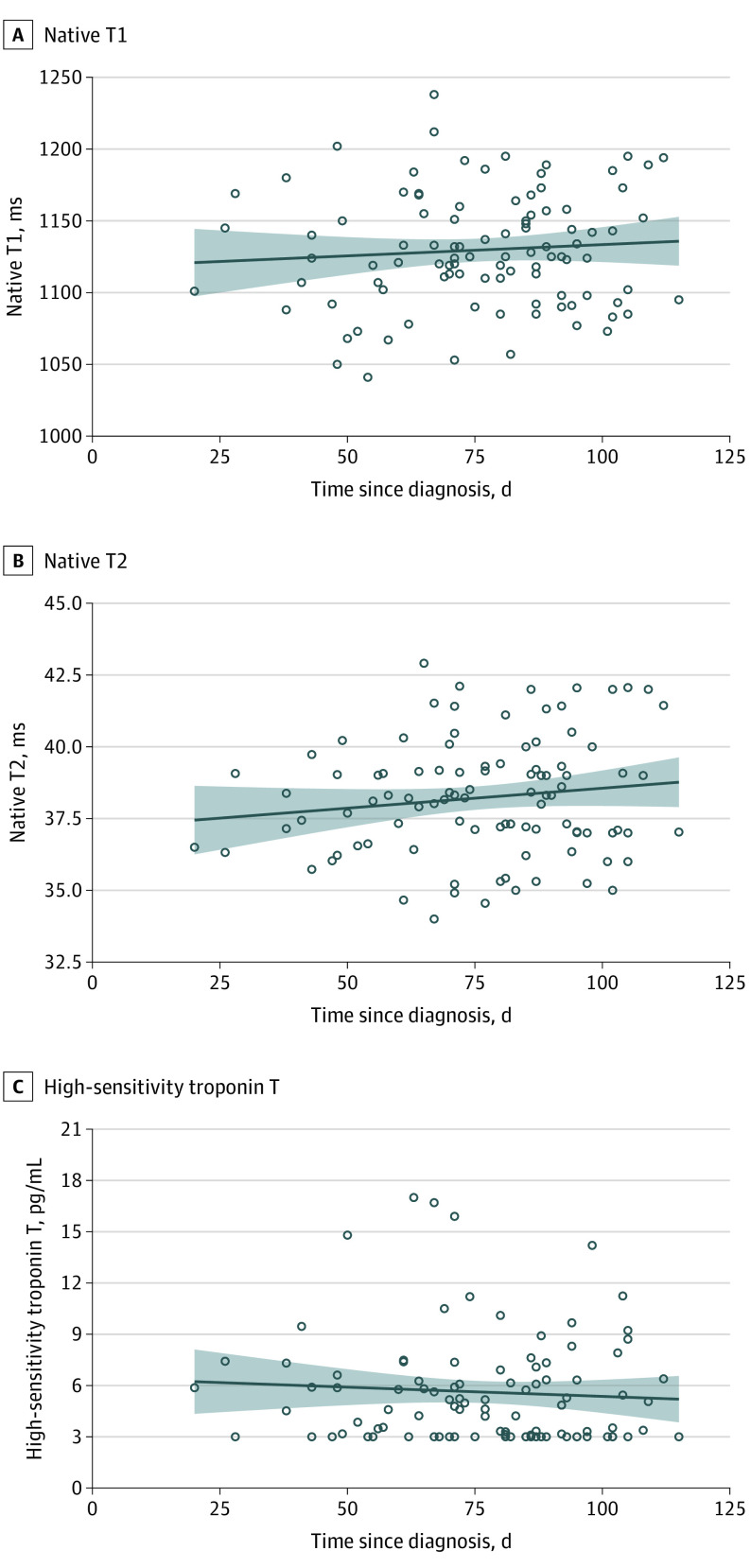
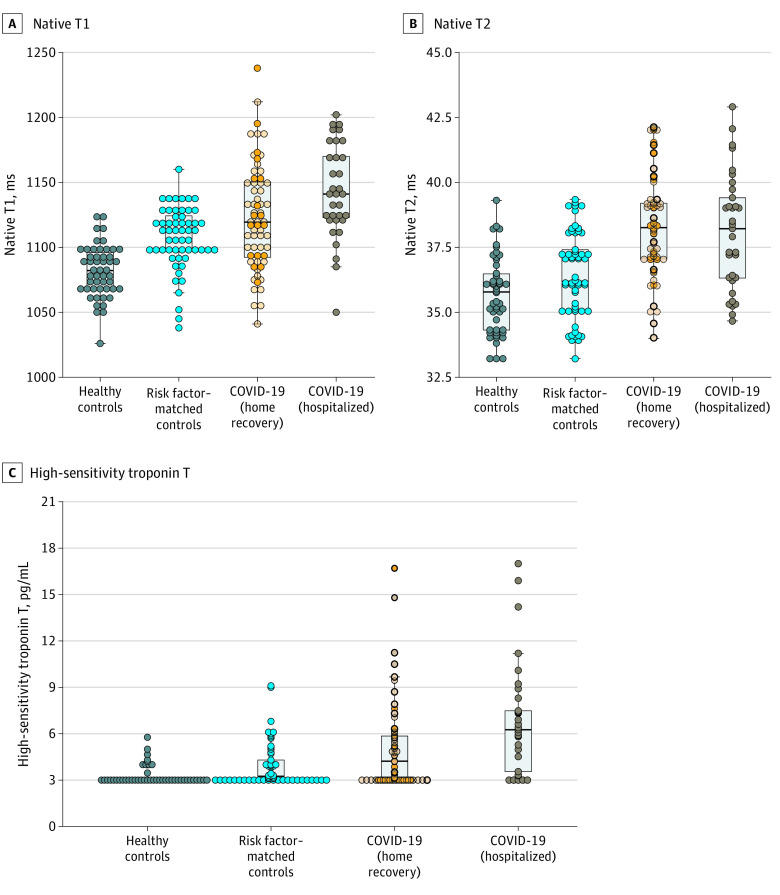
Of the 100 included patients, 53 (53%) were male, and the mean (SD) age was 49 (14) years. The median (IQR) time interval between COVID-19 diagnosis and CMR was 71 (64-92) days. Of the 100 patients recently recovered from COVID-19, 67 (67%) recovered at home, while 33 (33%) required hospitalization. At the time of CMR, high-sensitivity troponin T (hsTnT) was detectable (greater than 3 pg/mL) in 71 patients recently recovered from COVID-19 (71%) and significantly elevated (greater than 13.9 pg/mL) in 5 patients (5%). Compared with healthy controls and risk factor-matched controls, patients recently recovered from COVID-19 had lower left ventricular ejection fraction, higher left ventricle volumes, and raised native T1 and T2. A total of 78 patients recently recovered from COVID-19 (78%) had abnormal CMR findings, including raised myocardial native T1 (n = 73), raised myocardial native T2 (n = 60), myocardial late gadolinium enhancement (n = 32), or pericardial enhancement (n = 22). There was a small but significant difference between patients who recovered at home vs in the hospital for native T1 mapping (median [IQR], 1119 [1092-1150] ms vs 1141 [1121-1175] ms; P = .008) and hsTnT (4.2 [3.0-5.9] pg/dL vs 6.3 [3.4-7.9] pg/dL; P = .002) but not for native T2 mapping. None of these measures were correlated with time from COVID-19 diagnosis (native T1: r = 0.07; P = .47; native T2: r = 0.14; P = .15; hsTnT: r = -0.07; P = .50). High-sensitivity troponin T was significantly correlated with native T1 mapping (r = 0.33; P < .001) and native T2 mapping (r = 0.18; P = .01). Endomyocardial biopsy in patients with severe findings revealed active lymphocytic inflammation. Native T1 and T2 were the measures with the best discriminatory ability to detect COVID-19-related myocardial pathology.
In this study of a cohort of German patients recently recovered from COVID-19 infection, CMR revealed cardiac involvement in 78 patients (78%) and ongoing myocardial inflammation in 60 patients (60%), independent of preexisting conditions, severity and overall course of the acute illness, and time from the original diagnosis. These findings indicate the need for ongoing investigation of the long-term cardiovascular consequences of COVID-19.
2019 年冠状病毒病(COVID-19)继续在全球造成相当大的发病率和死亡率。住院患者的病例报告表明,COVID-19 主要影响心血管系统,但总体影响仍不清楚。
评估最近从 COVID-19 疾病中康复的未选择患者是否存在心肌损伤。
设计、设置和参与者: 在这项前瞻性观察队列研究中,从 2020 年 4 月至 6 月期间法兰克福大学 COVID-19 登记处确定了 100 名最近从 COVID-19 疾病中康复的患者。
通过上呼吸道拭子检测逆转录-聚合酶链反应确定严重急性呼吸综合征冠状病毒 2 感染的近期康复。
获得了人口统计学特征、心脏血液标志物和心血管磁共振(CMR)成像。将其与年龄匹配和性别匹配的健康志愿者对照组(n=50)和风险因素匹配的患者对照组(n=57)进行比较。
在纳入的 100 名患者中,53 名(53%)为男性,平均(SD)年龄为 49(14)岁。COVID-19 诊断与 CMR 之间的中位数(IQR)时间间隔为 71(64-92)天。在 100 名最近从 COVID-19 中康复的患者中,67 名(67%)在家中康复,而 33 名(33%)需要住院治疗。在 CMR 时,71 名(71%)最近从 COVID-19 中康复的患者可检测到高敏肌钙蛋白 T(hsTnT)(大于 3 pg/mL),5 名患者(5%)明显升高(大于 13.9 pg/mL)。与健康对照组和风险因素匹配对照组相比,最近从 COVID-19 中康复的患者左心室射血分数较低,左心室容积较高,心肌固有 T1 和 T2 升高。78 名(78%)最近从 COVID-19 中康复的患者存在异常 CMR 发现,包括升高的心肌固有 T1(n=73)、升高的心肌固有 T2(n=60)、心肌晚期钆增强(n=32)或心包增强(n=22)。在家中康复与在医院康复的患者之间,在心肌固有 T1 图谱(中位数[IQR],1119[1092-1150] ms 与 1141[1121-1175] ms;P=0.008)和 hsTnT(4.2[3.0-5.9] pg/dL 与 6.3[3.4-7.9] pg/dL;P=0.002)方面存在差异,但在心肌固有 T2 图谱方面无差异。这些措施均与 COVID-19 诊断后的时间(固有 T1:r=0.07;P=0.47;固有 T2:r=0.14;P=0.15;hsTnT:r=-0.07;P=0.50)无关。高敏肌钙蛋白 T 与心肌固有 T1 图谱(r=0.33;P<0.001)和心肌固有 T2 图谱(r=0.18;P=0.01)显著相关。在有严重发现的患者中进行的心肌活检显示出活跃的淋巴细胞炎症。固有 T1 和 T2 是检测 COVID-19 相关心肌病理学的最佳鉴别能力的措施。
在这项对德国最近从 COVID-19 感染中康复的患者队列的研究中,CMR 显示 78 名患者(78%)存在心脏受累,60 名患者(60%)存在持续的心肌炎症,与既往疾病、急性疾病的严重程度和总体病程以及原始诊断后的时间无关。这些发现表明需要进一步研究 COVID-19 的长期心血管后果。