• 文献检索
  • 文档翻译
  • 深度研究
  • 学术资讯
  • Suppr Zotero 插件Zotero 插件
  • 邀请有礼
  • 套餐&价格
  • 历史记录
应用&插件
Suppr Zotero 插件Zotero 插件浏览器插件Mac 客户端Windows 客户端微信小程序
定价
高级版会员购买积分包购买API积分包
服务
文献检索文档翻译深度研究API 文档MCP 服务
关于我们
关于 Suppr公司介绍联系我们用户协议隐私条款
关注我们

Suppr 超能文献

核心技术专利:CN118964589B侵权必究
粤ICP备2023148730 号-1Suppr @ 2026

文献检索

告别复杂PubMed语法,用中文像聊天一样搜索,搜遍4000万医学文献。AI智能推荐,让科研检索更轻松。

立即免费搜索

文件翻译

保留排版,准确专业,支持PDF/Word/PPT等文件格式,支持 12+语言互译。

免费翻译文档

深度研究

AI帮你快速写综述,25分钟生成高质量综述,智能提取关键信息,辅助科研写作。

立即免费体验

洞穴虾(Atyidae:Typhlatya)的分布模式、碳源和生态位分化。

Distribution patterns, carbon sources and niche partitioning in cave shrimps (Atyidae: Typhlatya).

机构信息

Posgrado en Ciencias Biológicas, Unidad de Posgrado, Edificio A, 1er piso, Circuito de Posgrados, Ciudad Universitaria, Coyoacán, C.P. 04510, Ciudad de México, Mexico.

Unidad Multidisciplinaria de Docencia e Investigación, Facultad de Ciencias, Universidad Nacional Autónoma de México, Puerto de Abrigo S/N, C.P. 97355, Sisal, Yucatán, Mexico.

出版信息

Sci Rep. 2020 Jul 30;10(1):12812. doi: 10.1038/s41598-020-69562-2.

DOI:10.1038/s41598-020-69562-2
PMID:32732979
原文链接:https://pmc.ncbi.nlm.nih.gov/articles/PMC7393362/
Abstract

Cave shrimps of the Typhlatya genus are common and widespread in fresh, brackish and marine groundwater throughout the Yucatan Peninsula (Mexico). These species are ideal models to test niche partitioning within sympatric species in oligotrophic systems. Nevertheless, their food sources remain unidentified, and despite their frequency and functional importance, distribution and abundance patterns of these species within caves have not been fully recognized. Here, we describe the abundance of three Typhlatya species in different temporal and spatial scales, investigate changes in water conditions, and potential sources of carbon as an indication of food origin. Species composition and abundance varied markedly in space and time revealing patterns that differed from one system to another and in relation to environmental parameters. Isotope analysis showed that each species reflects a particular δC and ΔC fingerprint, suggesting they feed in different proportions from the available carbon sources. Overall, our findings suggest a niche partitioning of habitat and feeding sources amongst the three Typhlatya species investigated, where environmental characteristics and physiological differences could play an important role governing their distribution patterns.

摘要

洞穴虾属 Typhlatya 的虾类在尤卡坦半岛(墨西哥)的淡水、半咸水和海水地下水环境中普遍存在。这些物种是在贫营养系统中测试同域物种生态位分化的理想模型。然而,它们的食物来源仍然未知,尽管它们的频率和功能重要性很高,但这些物种在洞穴内的分布和丰度模式尚未得到充分认识。在这里,我们描述了三种 Typhlatya 物种在不同时间和空间尺度上的丰度,研究了水条件的变化以及碳的潜在来源,以指示食物的起源。物种组成和丰度在空间和时间上有明显的变化,揭示了不同系统之间以及与环境参数相关的不同模式。同位素分析表明,每个物种都反映了特定的 δC 和 ΔC 特征指纹,表明它们从可用的碳源中以不同的比例进食。总的来说,我们的研究结果表明,在所研究的三种 Typhlatya 物种中存在栖息地和食物来源的生态位分化,其中环境特征和生理差异可能在控制它们的分布模式方面发挥重要作用。

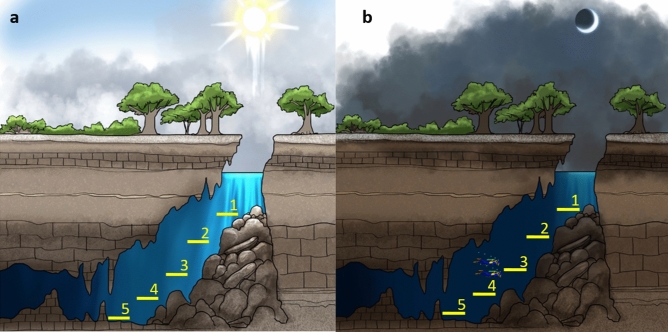
https://cdn.ncbi.nlm.nih.gov/pmc/blobs/e79b/7393362/d7560e636a0d/41598_2020_69562_Fig8_HTML.jpg
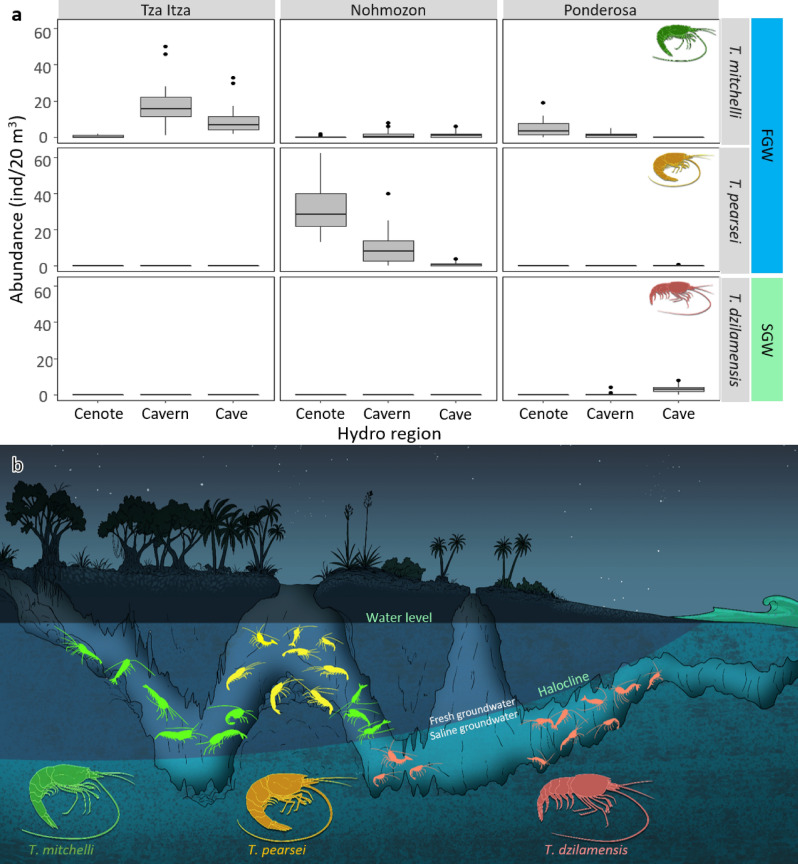
https://cdn.ncbi.nlm.nih.gov/pmc/blobs/e79b/7393362/75bbaaad5559/41598_2020_69562_Fig1_HTML.jpg
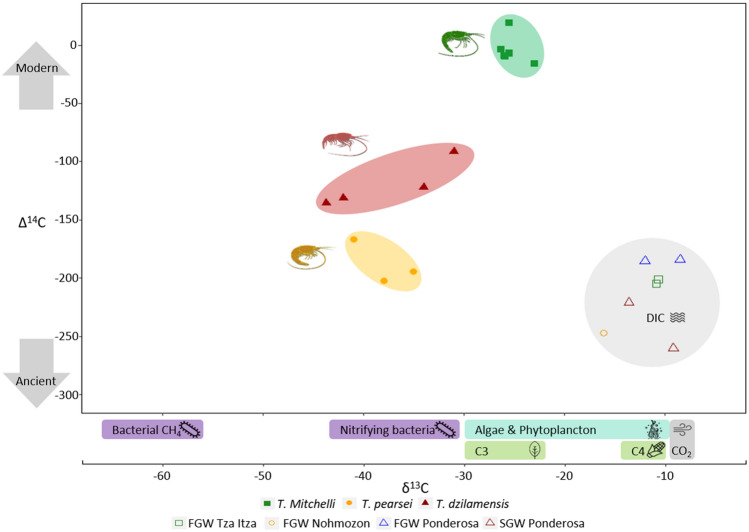
https://cdn.ncbi.nlm.nih.gov/pmc/blobs/e79b/7393362/e2e4db33e2dc/41598_2020_69562_Fig2_HTML.jpg
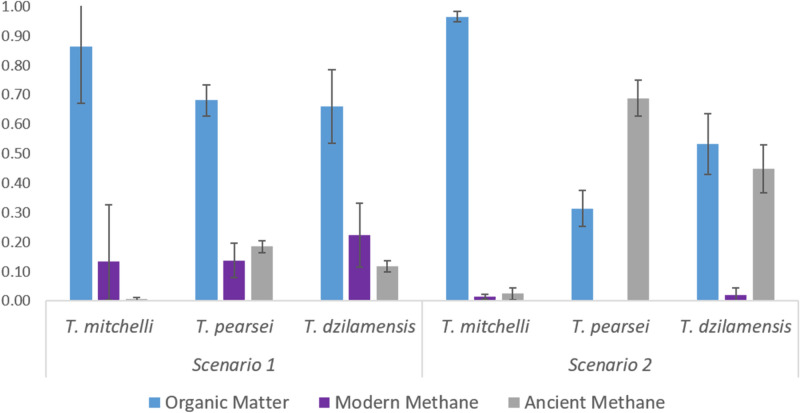
https://cdn.ncbi.nlm.nih.gov/pmc/blobs/e79b/7393362/2cf33895cdf0/41598_2020_69562_Fig3_HTML.jpg
https://cdn.ncbi.nlm.nih.gov/pmc/blobs/e79b/7393362/0e0f734eb112/41598_2020_69562_Fig4_HTML.jpg
https://cdn.ncbi.nlm.nih.gov/pmc/blobs/e79b/7393362/be52384e70da/41598_2020_69562_Fig5_HTML.jpg
https://cdn.ncbi.nlm.nih.gov/pmc/blobs/e79b/7393362/6662edf4f191/41598_2020_69562_Fig6_HTML.jpg
https://cdn.ncbi.nlm.nih.gov/pmc/blobs/e79b/7393362/5433f516bfb1/41598_2020_69562_Fig7_HTML.jpg
https://cdn.ncbi.nlm.nih.gov/pmc/blobs/e79b/7393362/d7560e636a0d/41598_2020_69562_Fig8_HTML.jpg
https://cdn.ncbi.nlm.nih.gov/pmc/blobs/e79b/7393362/75bbaaad5559/41598_2020_69562_Fig1_HTML.jpg
https://cdn.ncbi.nlm.nih.gov/pmc/blobs/e79b/7393362/e2e4db33e2dc/41598_2020_69562_Fig2_HTML.jpg
https://cdn.ncbi.nlm.nih.gov/pmc/blobs/e79b/7393362/2cf33895cdf0/41598_2020_69562_Fig3_HTML.jpg
https://cdn.ncbi.nlm.nih.gov/pmc/blobs/e79b/7393362/0e0f734eb112/41598_2020_69562_Fig4_HTML.jpg
https://cdn.ncbi.nlm.nih.gov/pmc/blobs/e79b/7393362/be52384e70da/41598_2020_69562_Fig5_HTML.jpg
https://cdn.ncbi.nlm.nih.gov/pmc/blobs/e79b/7393362/6662edf4f191/41598_2020_69562_Fig6_HTML.jpg
https://cdn.ncbi.nlm.nih.gov/pmc/blobs/e79b/7393362/5433f516bfb1/41598_2020_69562_Fig7_HTML.jpg
https://cdn.ncbi.nlm.nih.gov/pmc/blobs/e79b/7393362/d7560e636a0d/41598_2020_69562_Fig8_HTML.jpg

相似文献

1
Distribution patterns, carbon sources and niche partitioning in cave shrimps (Atyidae: Typhlatya).洞穴虾(Atyidae:Typhlatya)的分布模式、碳源和生态位分化。
Sci Rep. 2020 Jul 30;10(1):12812. doi: 10.1038/s41598-020-69562-2.
2
An integrative re-evaluation of Typhlatya shrimp within the karst aquifer of the Yucatán Peninsula, Mexico.墨西哥尤卡坦半岛喀斯特含水层中 Typhlatya 虾的综合再评估
Sci Rep. 2022 Mar 29;12(1):5302. doi: 10.1038/s41598-022-08779-9.
3
Are haloclines distributional barriers in anchialine ecosystems? Physiological response of cave shrimps to salinity.卤跃层是否是潮下带生态系统的分布屏障?洞穴虾对盐度的生理响应。
PLoS One. 2024 Jul 25;19(7):e0305909. doi: 10.1371/journal.pone.0305909. eCollection 2024.
4
Shrimps down under: evolutionary relationships of subterranean crustaceans from Western Australia (Decapoda: Atyidae: Stygiocaris).澳大利亚地下的虾类:西澳大利亚地下甲壳类动物的进化关系(十足目:匙指虾科:穴居沼虾属)
PLoS One. 2008 Feb 20;3(2):e1618. doi: 10.1371/journal.pone.0001618.
5
Isotopic niche partitioning in two sympatric howler monkey species.两种共生吼猴的同位素生态位分化。
Am J Phys Anthropol. 2020 Jul;172(3):438-446. doi: 10.1002/ajpa.24028. Epub 2020 Feb 24.
6
Isotopic niche variation from the Holocene to today reveals minimal partitioning and individualistic dynamics among four sympatric desert mice.从全新世到今天的同位素生态位变化揭示了四种同域沙漠鼠之间最小的分区和个体动态。
J Anim Ecol. 2018 Jan;87(1):173-186. doi: 10.1111/1365-2656.12771. Epub 2017 Nov 16.
7
Disparate responses to salinity across species and organizational levels in anchialine shrimps.不同种属和组织层次的盐水虾对盐度的不同反应。
J Exp Biol. 2019 Dec 12;222(Pt 24):jeb211920. doi: 10.1242/jeb.211920.
8
The complete mitochondrial genome of the cave shrimp (Decapoda, Atyidae) and its systematic position.洞穴虾(十足目,匙指虾科)的完整线粒体基因组及其系统发育位置。
Mitochondrial DNA B Resour. 2016 Nov 12;1(1):847-848. doi: 10.1080/23802359.2016.1238756.
9
Competition-driven niche segregation on a landscape scale: Evidence for escaping from syntopy towards allotopy in two coexisting sibling passerine species.竞争驱动的景观尺度生态位隔离:两种共存的雀形目鸟类从同域分布到异域分布的证据。
J Anim Ecol. 2018 May;87(3):774-789. doi: 10.1111/1365-2656.12808. Epub 2018 Mar 6.
10
Mitochondrial OXPHOS genes provides insights into genetics basis of hypoxia adaptation in anchialine cave shrimps.线粒体氧化磷酸化基因揭示了沿岸洞穴虾缺氧适应的遗传基础。
Genes Genomics. 2018 Nov;40(11):1169-1180. doi: 10.1007/s13258-018-0674-4. Epub 2018 Mar 6.

引用本文的文献

1
Trophic ecology in an anchialine cave: A stable isotope study.咸淡水洞穴中的营养生态学:一项稳定同位素研究。
PLoS One. 2025 Jan 3;20(1):e0315821. doi: 10.1371/journal.pone.0315821. eCollection 2025.
2
Are haloclines distributional barriers in anchialine ecosystems? Physiological response of cave shrimps to salinity.卤跃层是否是潮下带生态系统的分布屏障?洞穴虾对盐度的生理响应。
PLoS One. 2024 Jul 25;19(7):e0305909. doi: 10.1371/journal.pone.0305909. eCollection 2024.
3
A pilot study of stable isotope fractionation in Bombyx mori rearing.

本文引用的文献

1
New distribution records of subterranean crustaceans from cenotes in Yucatan (Mexico).墨西哥尤卡坦半岛溶洞中地下甲壳类动物的新分布记录
Zookeys. 2020 Feb 12;911:21-49. doi: 10.3897/zookeys.911.47694. eCollection 2020.
2
Osmoregulation in the Hawaiian anchialine shrimp Halocaridina rubra (Crustacea: Atyidae): expression of ion transporters, mitochondria-rich cell proliferation and hemolymph osmolality during salinity transfers.夏威夷沿岸咸淡水虾类红拟海虾(甲壳纲:阿蒂虾科)的渗透调节:盐度转移过程中离子转运蛋白的表达、富含线粒体细胞的增殖及血淋巴渗透压
J Exp Biol. 2014 Jul 1;217(Pt 13):2309-20. doi: 10.1242/jeb.103051. Epub 2014 Apr 17.
3
家蚕饲养中稳定同位素分馏的初步研究。
Sci Rep. 2023 Apr 24;13(1):6643. doi: 10.1038/s41598-023-33790-z.
4
Self-consistent dispersal puts tight constraints on the spatiotemporal organization of species-rich metacommunities.自我一致的扩散对物种丰富的复合群落的时空组织施加了严格的约束。
Proc Natl Acad Sci U S A. 2022 Jun 28;119(26):e2200390119. doi: 10.1073/pnas.2200390119. Epub 2022 Jun 21.
5
An integrative re-evaluation of Typhlatya shrimp within the karst aquifer of the Yucatán Peninsula, Mexico.墨西哥尤卡坦半岛喀斯特含水层中 Typhlatya 虾的综合再评估
Sci Rep. 2022 Mar 29;12(1):5302. doi: 10.1038/s41598-022-08779-9.
6
Collecting eco-evolutionary data in the dark: Impediments to subterranean research and how to overcome them.在黑暗中收集生态进化数据:地下研究的障碍及如何克服这些障碍。
Ecol Evol. 2021 May 1;11(11):5911-5926. doi: 10.1002/ece3.7556. eCollection 2021 Jun.
Biological clocks and visual systems in cave-adapted animals at the dawn of speleogenomics.
洞穴适应动物的生物钟和视觉系统在洞穴基因组学的黎明时期。
Integr Comp Biol. 2013 Jul;53(1):50-67. doi: 10.1093/icb/ict058. Epub 2013 May 28.
4
Evolutionary convergence on sleep loss in cavefish populations.洞穴鱼种群中因睡眠缺失导致的进化趋同。
Curr Biol. 2011 Apr 26;21(8):671-6. doi: 10.1016/j.cub.2011.03.020. Epub 2011 Apr 7.
5
The ecologry of anchihaline caves.洞穴的生态环境。
Trends Ecol Evol. 1996 May;11(5):221-5. doi: 10.1016/0169-5347(96)20031-x.
6
Shrimps down under: evolutionary relationships of subterranean crustaceans from Western Australia (Decapoda: Atyidae: Stygiocaris).澳大利亚地下的虾类:西澳大利亚地下甲壳类动物的进化关系(十足目:匙指虾科:穴居沼虾属)
PLoS One. 2008 Feb 20;3(2):e1618. doi: 10.1371/journal.pone.0001618.
7
Can stable isotope ratios provide for community-wide measures of trophic structure?稳定同位素比率能否用于衡量整个群落的营养结构?
Ecology. 2007 Jan;88(1):42-8. doi: 10.1890/0012-9658(2007)88[42:csirpf]2.0.co;2.
8
Improvements in mass spectrometers for the measurement of small differences in isotope abundance ratios.用于测量同位素丰度比微小差异的质谱仪的改进。
Rev Sci Instrum. 1950 Aug;21(8):724-30. doi: 10.1063/1.1745698.
9
Source partitioning using stable isotopes: coping with too many sources.利用稳定同位素进行源分配:应对过多的源
Oecologia. 2003 Jul;136(2):261-9. doi: 10.1007/s00442-003-1218-3. Epub 2003 May 21.