Istituto Zooprofilattico Sperimentale della Sicilia (IZSSi), Palermo, Italy.
National Research Council of Italy-Institute of Anthropic Impacts and Sustainability in Marine Environment (IAS-CNR), Palermo, Italy.
Front Public Health. 2020 Jul 7;8:273. doi: 10.3389/fpubh.2020.00273. eCollection 2020.
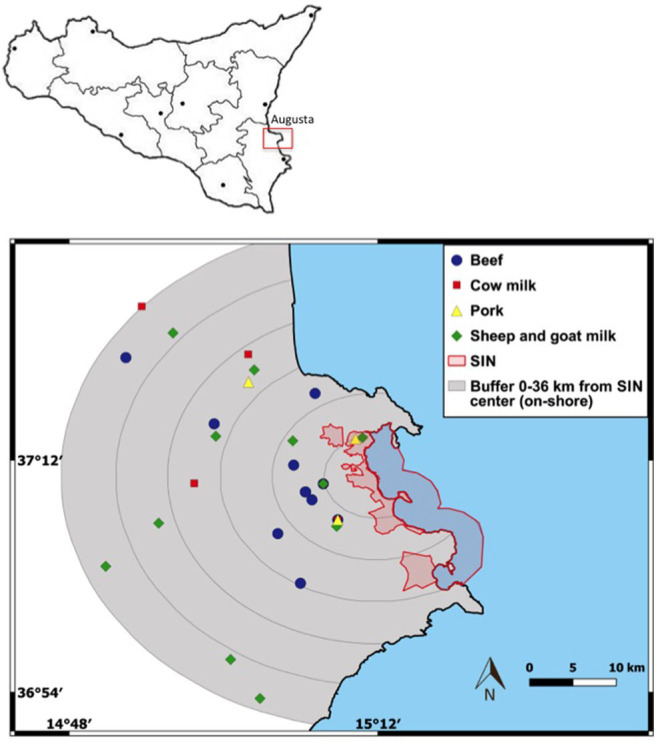
Heavy metals and PAHs were measured in animal foodstuffs from Augusta-Melilli-Priolo area in order to evaluate the potential human health risk associated to their consumption. All heavy metals were detected in seafood products while most of them were <LOD in beef, pork and milks samples. Particularly, seafood products registered higher values of total arsenic (As), mercury (Hg) and lead (Pb) than other food categories, while beef and pork showed higher content of zinc (Zn). Cadmium (Cd) and Pb were below the tolerable limits reported by the European Union in foodstuffs (1) while mercury exceed the threshold value in seafood products. Among the PAHs, chrysene (Chr) was detected in all the terrestrial foodstuffs with higher concentrations found in raw milks. Small quantity of benz(a)anthracene (BaA) were also found in this food. The health risk for consumers was assessed for five age categories of consumers calculating the estimated weekly intake (EWI), the target hazard quotient (THQ) and the cancer risk (CR) for each contaminant. Moreover, the margin of exposure (MOE) was estimated for PAHs. The EWI related to seafood products intake exceeded the Provisional Tolerable Weekly Intake (PTWI) recommended by the European Food Safety Authority. The THQ was >1 for baby, children and teenagers, indicating a non-carcinogenic risk for these age categories by seafood ingestion. The CR overcame 110 for almost age categories (except "baby") and for elderly, by seafood and beef ingestions respectively. Moreover, the MOE for PAHs showed a certain cancer risk for "baby" related to cow milk ingestion.
为了评估与食用相关的潜在人体健康风险,本研究对来自 Augusta-Melilli-Priolo 地区的动物食品中的重金属和多环芳烃进行了检测。所有重金属均在海鲜产品中检出,而大部分重金属在牛肉、猪肉和牛奶样本中的含量均低于检测限。特别是,海鲜产品的总砷(As)、汞(Hg)和铅(Pb)含量均高于其他食品类别,而牛肉和猪肉的锌(Zn)含量较高。在牛肉和猪肉中,镉(Cd)和 Pb 的含量低于欧盟在食品中规定的耐受限量(1),而 Hg 的含量则超过了海鲜产品的阈值。在所检测的多环芳烃中,苊(Chr)存在于所有陆生食品中,其中生奶中的浓度最高。在这些食品中还检测到少量苯并(a)蒽(BaA)。通过计算消费者每周估计摄入量(EWI)、目标危害系数(THQ)和每种污染物的癌症风险(CR),对 5 个年龄段的消费者进行了健康风险评估。此外,还对多环芳烃进行了暴露量与参考剂量比(MOE)评估。与海鲜产品摄入相关的 EWI 超过了欧洲食品安全局推荐的暂定每周耐受摄入量(PTWI)。THQ 对于婴儿、儿童和青少年大于 1,表明这些年龄段因食用海鲜而存在非致癌风险。CR 对于几乎所有年龄段(除了“婴儿”)和老年人来说,均大于 110,这意味着他们因食用海鲜和牛肉而存在致癌风险。此外,多环芳烃的 MOE 表明,与牛奶摄入有关,婴儿存在一定的癌症风险。