Saponaro Federica, Sestito Simona, Runfola Massimiliano, Rapposelli Simona, Chiellini Grazia
Department of Pathology, University of Pisa, Pisa, Italy.
Department of Pharmacy, University of Pisa, Pisa, Italy.
Front Med (Lausanne). 2020 Jul 9;7:331. doi: 10.3389/fmed.2020.00331. eCollection 2020.
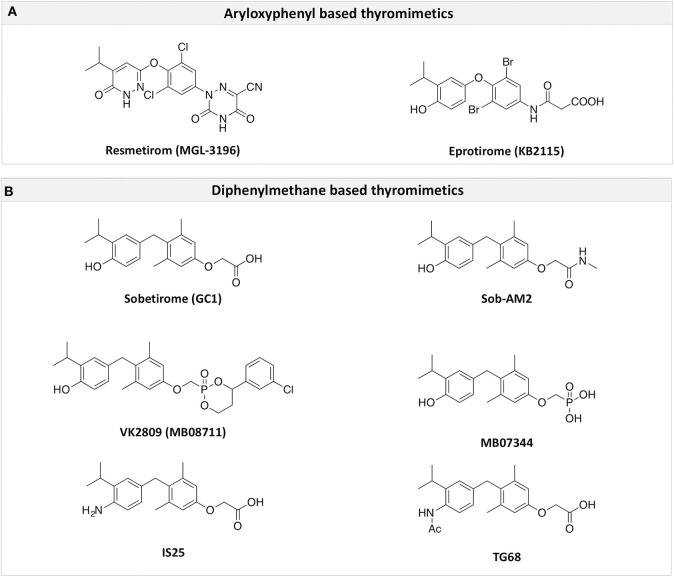
Thyroid hormones (THs) elicit significant effects on numerous physiological processes, such as growth, development, and metabolism. A lack of thyroid hormones is not compatible with normal health. Most THs effects are mediated by two different thyroid hormone receptor (TR) isoforms, namely TRα and TRβ, with the TRβ isoform known to be responsible for the main beneficial effects of TH on liver. In brain, despite the crucial role of TRα isoform in neuronal development, TRβ has been proposed to play a role in the remyelination processes. Consequently, over the past two decades, much effort has been applied in developing thyroid hormone analogs capable of uncoupling beneficial actions on liver (triglyceride and cholesterol lowering) and central nervous system (CNS) (oligodendrocyte proliferation) from deleterious effects on the heart, muscle and bone. Sobetirome (GC-1) and subsequently Eprotirome (KB2115) were the first examples of TRβ selective thyromimetics, with Sobetirome differing from the structure of thyronines because of the absence of halogens, biaryl ether oxygen, and amino-acidic side chain. Even though both thyromimetics showed encouraging actions against hypercholesterolemia, non-alcoholic steatohepatitis (NASH) and in the stimulation of hepatocytes proliferation, they were stopped after Phase 1 and Phase 2-3 clinical trials, respectively. In recent years, advances in molecular and structural biology have facilitated the design of new selective thyroid hormone mimetics that exhibit TR isoform-selective binding, and/or liver- and tissue-selective uptake, with Resmetirom (MGL-3196) and Hep-Direct prodrug VK2809 (MB07811) probably representing two of the most promising lipid lowering agents, currently under phase 2-3 clinical trials. More recently the application of a comprehensive panel of ADME-Toxicity assays enabled the selection of novel thyromimetic IS25 and its prodrug TG68, as very powerful lipid lowering agents both and . In addition to dyslipidemia and other liver pathologies, THs analogs could also be of value for the treatment of neurodegenerative diseases, such as multiple sclerosis (MS). Sob-AM2, a CNS- selective prodrug of Sobetirome has been shown to promote significant myelin repair in the brain and spinal cord of mouse demyelinating models and it is rapidly moving into clinical trials in humans. Taken together all these findings support the great potential of selective thyromimetics in targeting a large variety of human pathologies characterized by altered metabolism and/or cellular differentiation.
甲状腺激素(THs)对众多生理过程产生显著影响,如生长、发育和代谢。甲状腺激素缺乏与正常健康状况不相符。大多数THs的作用是由两种不同的甲状腺激素受体(TR)亚型介导的,即TRα和TRβ,已知TRβ亚型负责TH对肝脏的主要有益作用。在大脑中,尽管TRα亚型在神经元发育中起关键作用,但有人提出TRβ在髓鞘再生过程中发挥作用。因此,在过去二十年中,人们付出了很多努力来开发能够将对肝脏(降低甘油三酯和胆固醇)和中枢神经系统(CNS)(少突胶质细胞增殖)的有益作用与对心脏、肌肉和骨骼的有害作用分离的甲状腺激素类似物。索贝替罗(GC-1)以及随后的依普罗替罗(KB2115)是TRβ选择性甲状腺激素模拟物的首批实例,索贝替罗与甲状腺素结构不同,因为它没有卤素、联苯醚氧和氨基酸侧链。尽管这两种甲状腺激素模拟物在对抗高胆固醇血症、非酒精性脂肪性肝炎(NASH)以及刺激肝细胞增殖方面都显示出令人鼓舞的作用,但它们分别在1期和2-3期临床试验后停止研发。近年来,分子和结构生物学的进展促进了新型选择性甲状腺激素模拟物的设计,这些模拟物表现出TR亚型选择性结合和/或肝脏及组织选择性摄取,瑞美替隆(MGL-3196)和肝脏直接前药VK2809(MB07811)可能是目前处于2-3期临床试验阶段最有前景的两种降脂药物。最近,一系列全面的ADME-毒性试验的应用使得新型甲状腺激素模拟物IS25及其前药TG68被选为非常有效的降脂药物。除了血脂异常和其他肝脏疾病外,THs类似物在治疗神经退行性疾病如多发性硬化症(MS)方面也可能具有价值。索贝替罗的中枢神经系统选择性前药Sob-AM2已被证明能促进小鼠脱髓鞘模型脑和脊髓中的显著髓鞘修复,并且它正在迅速进入人体临床试验。综上所述,所有这些发现支持了选择性甲状腺激素模拟物在针对多种以代谢改变和/或细胞分化异常为特征的人类疾病方面的巨大潜力。