Post graduate Medical School, University of Palermo, Palermo, Italy.
University College of Dublin, Mater Misericordiae University Hospital, Dublin, Ireland.
Curr Cardiol Rev. 2021;17(1):74-77. doi: 10.2174/1573403X16666200731162614.
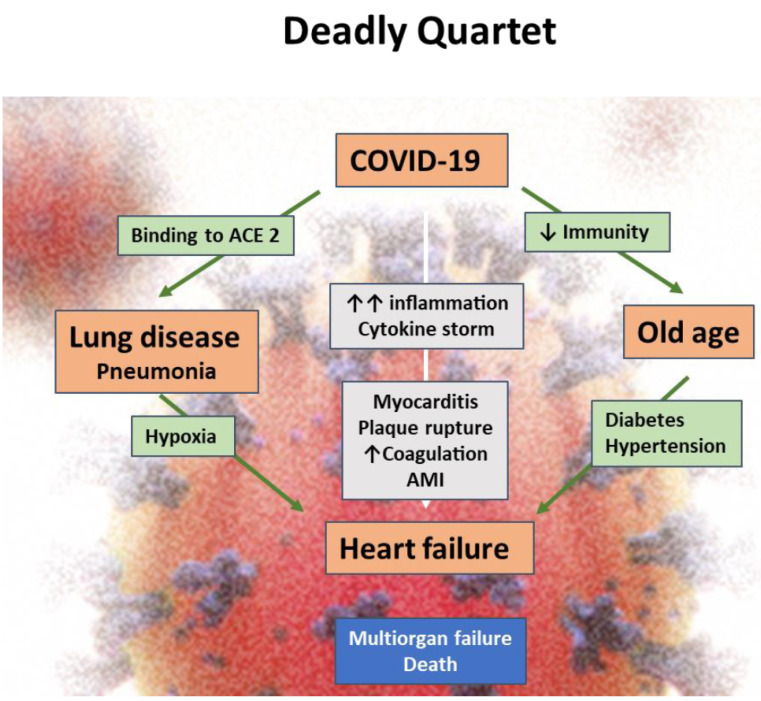
Since its outbreak in China at the end of 2019, the new coronavirus disease (COVID-19) was characterized by both easy spreading and high mortality. The latter proved to be way more elevated in the North of Italy -with a peak of 18.4% in region Lombardia and even 31% in the city of Bergamo and surrounding county- than in the rest of the world. In an attempt to conceptualize the reasons for such a dramatic situation, four key elements have been identified: COVID-19 itself, old age, lung disease, and heart failure. Their harmful combination has been named "The deadly quartet". The underlying risk factors, among which a lot of them are distinctive features of the population in northern Italy, have been summarized as "unmodifiable", "partially modifiable", and "modifiable", for the sake of clarity. Up-to-date scientific evidence in this field has been described in the form of a narrative and easy-to-read review.
自 2019 年底在中国爆发以来,新型冠状病毒病(COVID-19)具有传播容易和死亡率高的特点。后者在意大利北部被证明要高得多——伦巴第大区的峰值达到 18.4%,甚至贝加莫市及其周边县达到 31%——而在世界其他地区则没有那么高。为了理解这种戏剧性情况的原因,已经确定了四个关键因素:COVID-19 本身、年龄、肺部疾病和心力衰竭。它们的有害组合被命名为“致命四重奏”。潜在的风险因素,其中很多都是意大利北部人口的特征,为了清晰起见,被总结为“不可改变的”、“部分可改变的”和“可改变的”。该领域的最新科学证据以叙述性和易于阅读的综述形式呈现。