Veyre Florian, Poulain-Veyre Corinne, Esparcieux Aurélie, Monsarrat Nicolas, Aouifi Abdellah, Lapeze Joel, Chatelard Philippe
Université Claude-Bernard Lyon 1, Domaine Rockefeller, Lyon, France.
Médecine Vasculaire, Vienne, France.
Ann Vasc Surg. 2020 Nov;69:85-88. doi: 10.1016/j.avsg.2020.07.013. Epub 2020 Jul 28.
Few cases of arterial thromboembolisms have been reported after novel coronavirus disease 2019 (COVID-19) in case of severe infection or in elderly patients. We report a case of femoral arterial thrombosis in a young patient after nonsevere infection.
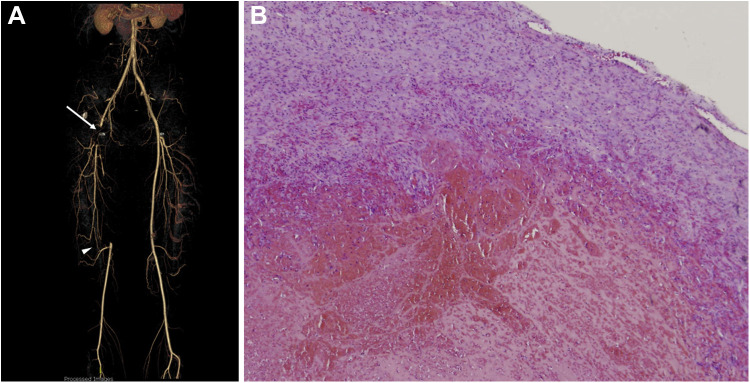
A common femoral artery thrombosis extended in the first third of superficial and profunda femoral arteries associated with tibial posterior and popliteal artery thrombosis was diagnosed in a 24-year-old man complaining of right lower limb pain for one month. The evolution was good after anticoagulation and antiaggregant treatments and thrombectomy. Etiologic assessment was negative except for nonsevere COVID-19.
COVID-19 accesses host cells via angiotensin-converting enzyme 2 protein, abundant in the lungs, which is also expressed by endothelial cells and is associated with important inflammatory syndrome and coagulopathy, leading to vascular lesions. Thrombosis prevalence is not fully established and seems to be higher in case of major inflammation and in the intensive care unit (ICU). Arterial thromboembolisms are described in many vascular territories, each time in elderly patients, or in case of severe infection. We described a femoral arterial thrombosis in a young patient with negative etiological assessment except nonsevere COVID-19. Treatment consists in anticoagulation and antiaggregant drugs and thrombectomy. Preventing venous thromboembolism treatment is recommended in case of severe infection or in the ICU, but there is no clear recommendation for arterial thromboembolism prevention. This case should lead us to be very careful of the arterial event risk even if the infection is nonsevere and the patient is young.
新型冠状病毒肺炎(COVID-19)重症感染或老年患者中,动脉血栓栓塞病例报道较少。我们报告1例非重症感染后年轻患者发生股动脉血栓形成的病例。
一名24岁男性,因右下肢疼痛1个月就诊,诊断为股总动脉血栓形成并累及股浅动脉和股深动脉前三分之一,同时合并胫后动脉和腘动脉血栓形成。抗凝、抗血小板治疗及血栓切除术治疗后病情好转。除非重症COVID-19外,病因评估均为阴性。
COVID-19通过血管紧张素转换酶2蛋白进入宿主细胞,该蛋白在肺中丰富表达,内皮细胞也表达,且与重要的炎症综合征和凝血病相关,导致血管病变。血栓形成的发生率尚未完全明确,在严重炎症和重症监护病房(ICU)中似乎更高。动脉血栓栓塞在许多血管区域均有描述,每次均发生在老年患者或重症感染患者中。我们描述了1例年轻患者发生股动脉血栓形成,除非重症COVID-19外病因评估均为阴性。治疗包括抗凝、抗血小板药物及血栓切除术。对于重症感染或ICU患者,推荐预防静脉血栓栓塞治疗,但对于动脉血栓栓塞预防尚无明确推荐。即使感染不严重且患者年轻,该病例也应使我们对动脉事件风险保持高度警惕。