Doussot Alexandre, Ciceron Floriane, Cerutti Emilie, Salomon du Mont Lucie, Thines Laurent, Capellier Gilles, Pretalli Jean-Baptiste, Evrard Philippe, Vettoretti Lucie, Garbuio Patrick, Brunel Anne-Sophie, Pili-Floury Sebastien, Lakkis Zaher
Department of Digestive Surgical Oncology - Liver Transplant Unit, University Hospital of Besançon, Besançon, France.
Department of Anesthesiology and Intensive Care, University Hospital of Besançon, Besancon, France.
Ann Surg. 2020 Dec;272(6):e311-e315. doi: 10.1097/SLA.0000000000004265.
The aim of this study was to define whether rapidly reallocating health care workers not experienced with PP for performing PP in ICU is feasible and safe.
In the setting of severe acute respiratory distress syndrome (ARDS), the use of prone and supine positioning procedures (PP) has been associated with improved oxygenation resulting in decreased mortality. Nevertheless, applying PP is time consuming for ICU staffs that are at risk of mental of physical exhaustion, especially with the constant surge of admitted COVID-19 patients with severe ARDS.
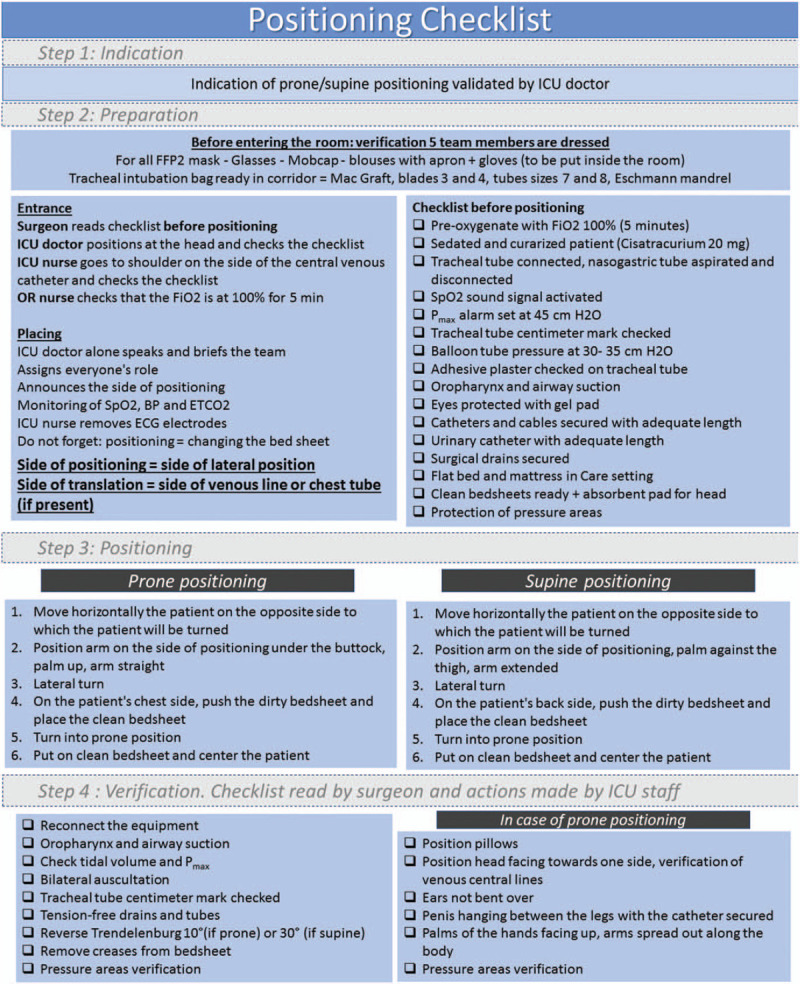
This prospective cohort study conducted at a single regional university hospital between March 27 and April 15, 2020. Among 117 patients admitted to ICU, 67 patients (57.3%) presented with proven SARS-CoV-2 infection with severe ARDS requiring PP. After accelerated simulation training, 109 volunteers including surgeons, physicians, nurses and physiotherapists, multiple dedicated teams performed daily multiple PP following a systematic checklist. Patient demographics and PP data were collected. Patient safety and health care workers safety were assessed.
Among 117 patients admitted to ICU, 67 patients (57.3%) required PP. Overall, 53 (79%) were male, with a median age of 68.5 years and median body mass index of 29.3 kg/m. A total of 384 PP were performed. Overall, complication occurred in 34 PP (8.8%) and led to PP cancelation in 4 patients (1%). Regarding health care workers safety, four health care workers presented with potential COVID-19 related symptoms and none was positive.
To overcome the surge of critically ill COVID-19 patients, reallocating health care workers to targeted medical tasks beyond their respective expertise such as PP was safe.
本研究旨在确定将不具备俯卧位通气经验的医护人员迅速重新分配至重症监护病房(ICU)进行俯卧位通气是否可行且安全。
在严重急性呼吸窘迫综合征(ARDS)的情况下,采用俯卧位和仰卧位通气程序(PP)与改善氧合相关,从而降低死亡率。然而,对于有身心疲惫风险的ICU工作人员来说,实施PP很耗时,尤其是在不断涌入患有严重ARDS的COVID-19患者的情况下。
这项前瞻性队列研究于2020年3月27日至4月15日在一家地区性大学医院进行。在117名入住ICU的患者中,67名患者(57.3%)被证实感染SARS-CoV-2且患有需要进行PP的严重ARDS。经过加速模拟培训后,包括外科医生、内科医生、护士和物理治疗师在内的109名志愿者,多个专门团队按照系统检查表每天进行多次PP。收集患者人口统计学和PP数据。评估患者安全和医护人员安全。
在117名入住ICU的患者中,67名患者(57.3%)需要进行PP。总体而言,53名(79%)为男性,中位年龄为68.5岁,中位体重指数为29.3kg/m²。共进行了384次PP。总体而言,34次PP(8.8%)出现并发症,4名患者(1%)的PP因此取消。关于医护人员安全,4名医护人员出现了与COVID-19相关的潜在症状,但均未呈阳性。
为了应对COVID-19重症患者的激增,将医护人员重新分配至其各自专业领域之外的针对性医疗任务(如PP)是安全的。