Department of Life and Environmental Sciences, Università Politecnica delle Marche, Via Brecce Bianche, Ancona 60100, Italy.
Department of Clinical and Molecular Sciences, DISCLIMO, Università Politecnica delle Marche, Ancona 60100, Italy.
Aging (Albany NY). 2020 Jul 31;12(15):15514-15531. doi: 10.18632/aging.103742.
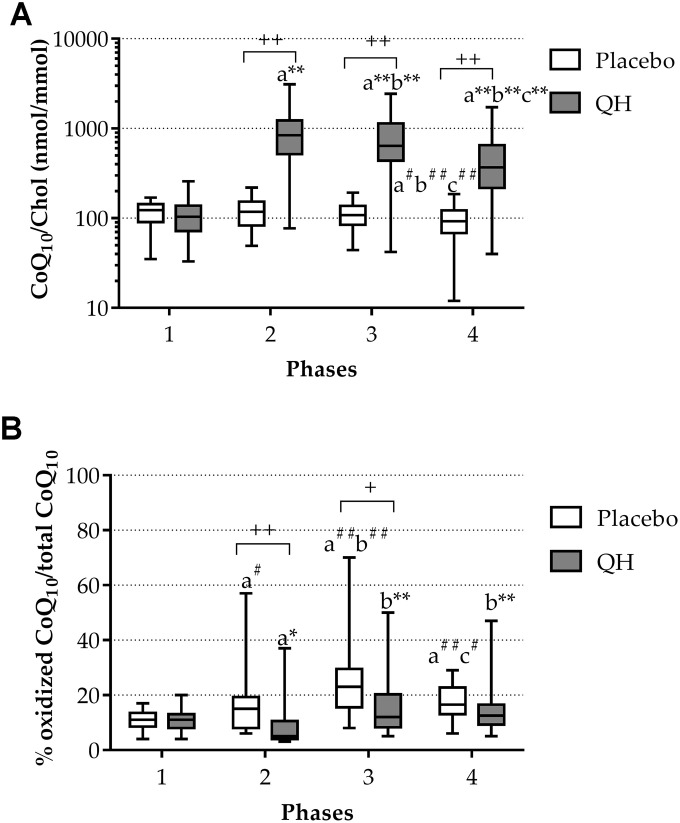
Epidemiological data show a rise in the mean age of patients affected by heart disease undergoing cardiac surgery. Senescent myocardium reduces the tolerance to ischemic stress and there are indications about age-associated deficit in post-operative cardiac performance. Coenzyme Q10 (CoQ10), and more specifically its reduced form ubiquinol (QH), improve several conditions related to bioenergetic deficit or increased exposure to oxidative stress. This trial (Eudra-CT 2009-015826-13) evaluated the clinical and biochemical effects of ubiquinol in 50 elderly patients affected by severe aortic stenosis undergoing aortic valve replacement and randomized to either placebo or 400 mg/day ubiquinol from 7 days before to 5 days after surgery. Plasma and cardiac tissue CoQ10 levels and oxidative status, circulating troponin I, CK-MB (primary endpoints), IL-6 and S100B were assessed. Moreover, main cardiac adverse effects, NYHA class, contractility and myocardial hypertrophy (secondary endpoints) were evaluated during a 6-month follow-up visit. Ubiquinol treatment counteracted the post-operative plasma CoQ10 decline (p<0.0001) and oxidation (p=0.038) and curbed the post-operative increase in troponin I (QH, 1.90 [1.47-2.48] ng/dL; placebo, 4.03 [2.45-6.63] ng/dL; p=0.007) related to cardiac surgery. Moreover, ubiquinol prevented the adverse outcomes that might have been associated with defective left ventricular ejection fraction recovery in elderly patients.
流行病学数据显示,接受心脏手术的心脏病患者的平均年龄呈上升趋势。衰老的心肌降低了对缺血应激的耐受性,并且有迹象表明与年龄相关的术后心脏功能缺陷。辅酶 Q10(CoQ10),特别是其还原形式泛醇(QH),可改善与生物能量缺陷或氧化应激增加相关的多种情况。这项试验(Eudra-CT 2009-015826-13)评估了泛醇在 50 名接受主动脉瓣置换术的严重主动脉瓣狭窄老年患者中的临床和生化作用,并将他们随机分为安慰剂组或每天 400mg 泛醇组,从手术前 7 天开始至手术后 5 天结束。评估了血浆和心肌组织 CoQ10 水平和氧化状态、循环肌钙蛋白 I、CK-MB(主要终点)、IL-6 和 S100B。此外,在 6 个月的随访期间评估了主要心脏不良事件、NYHA 分级、收缩性和心肌肥厚(次要终点)。泛醇治疗可抵抗术后血浆 CoQ10 的下降(p<0.0001)和氧化(p=0.038),并抑制术后肌钙蛋白 I 的增加(QH,1.90[1.47-2.48]ng/dL;安慰剂,4.03[2.45-6.63]ng/dL;p=0.007)与心脏手术有关。此外,泛醇预防了可能与老年患者左心室射血分数恢复不良相关的不良结局。