Kouhpaikar Hamideh, Sadeghian Mohammad Hadi, Rafatpanah Houshang, Kazemi Mohaddeseh, Iranshahi Mehrdad, Delbari Zahra, Khodadadi Faezeh, Ayatollahi Hossein, Rassouli Fatemeh B
Cancer Molecular Pathology Research Center, Department of Hematology and Blood Bank, Faculty of Medicine, Mashhad University of Medical Sciences, Mashhad, Iran.
Inflammation and Inflammatory Diseases Research Center, Faculty of Medicine, Mashhad University of Medical Sciences, Mashhad, Iran.
Iran J Basic Med Sci. 2020 May;23(5):616-622. doi: 10.22038/ijbms.2020.40650.9610.
Adult T-cell leukemia/lymphoma (ATLL) is an aggressive lymphoid malignancy with low survival rate and distinct geographical distribution. In search for novel chemotherapeutics against ATLL, we investigated the combinatorial effects of parthenolide, a sesquiterpene lactone with valuable pharmaceutical activities, and arsenic trioxide (ATO) .
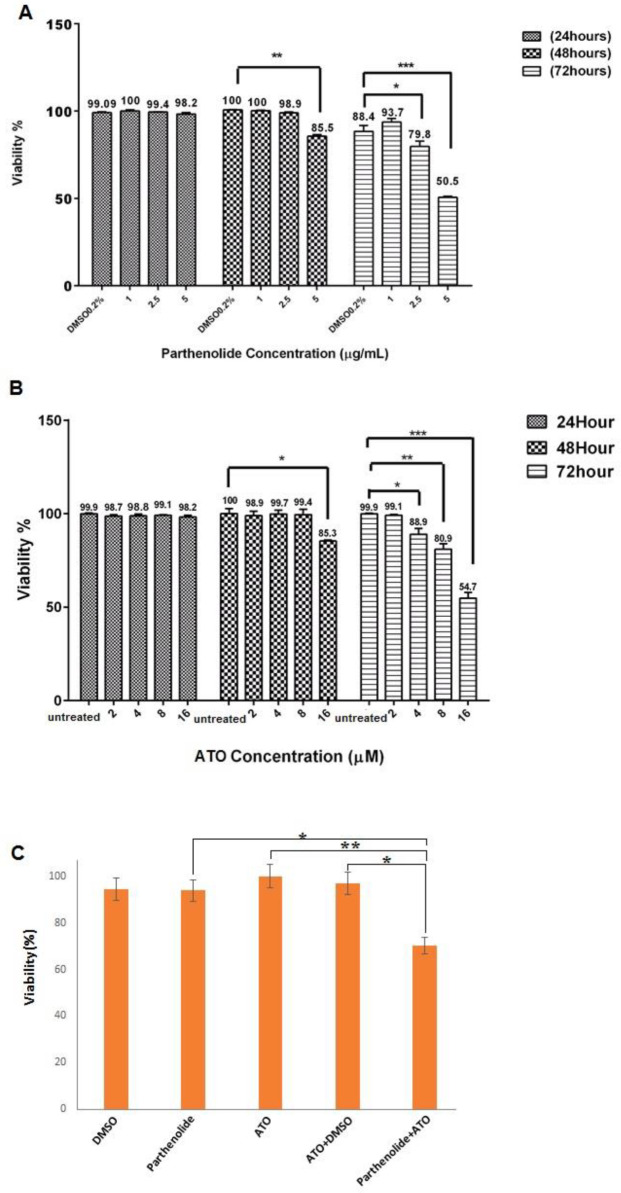
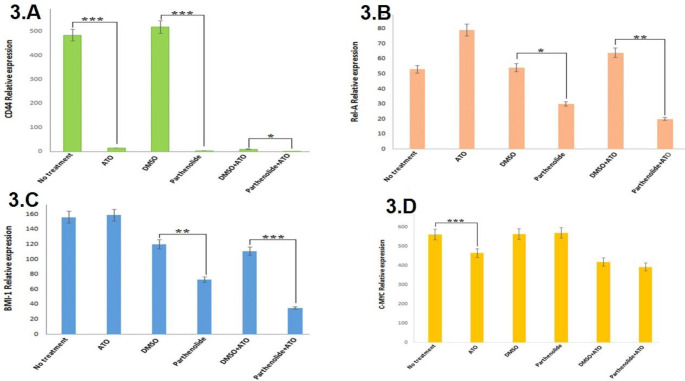
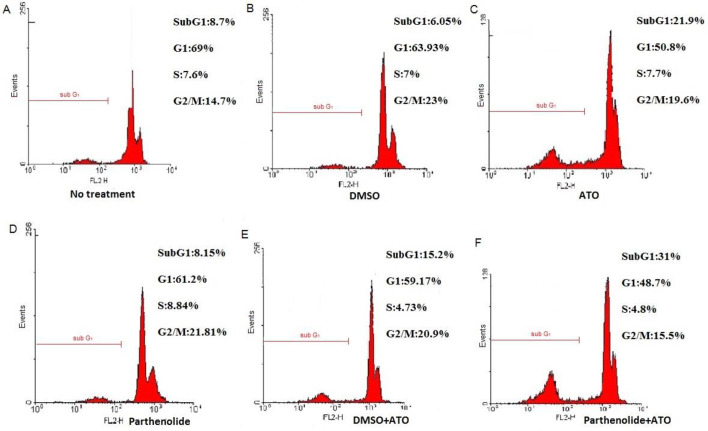
MT2 cells, an ATLL cell line, were treated with increasing concentrations of parthenolide (1.25, 2.5, and 5 μg/ml) and ATO (2, 4, 8, and 16 µM) to determine their IC. Then, cells were treated with a combination of sub-IC concentrations of parthenolide (1 μg/ml) and ATO (2 µM) for 72 hr. Cell viability and cell cycle changes were assessed by Alamar blue and PI staining, respectively. To understand the mechanisms responsible for observed effects, expression of , and were investigated by real-time PCR.
Assessment of cell viability indicated that parthenolide significantly increased the toxicity of ATO, as confirmed by accumulation of MT2 cells in the sub G1 phase of the cell cycle. Moreover, molecular analysis revealed significant down-regulation of , and upon combinatorial administration of parthenolide and ATO in comparison with relevant controls.
Taken together, present results showed that parthenolide significantly enhanced the toxicity of ATO in MT2 cells. Therefore, the future possible clinical impact of our study could be combinatorial use of parthenolide and ATO as a novel and more effective approach for ATLL.
成人T细胞白血病/淋巴瘤(ATLL)是一种侵袭性淋巴恶性肿瘤,生存率低且具有明显的地域分布差异。为了寻找针对ATLL的新型化疗药物,我们研究了倍半萜内酯类化合物、具有重要药用活性的小白菊内酯(parthenolide)和三氧化二砷(ATO)的联合作用。
用递增浓度的小白菊内酯(1.25、2.5和5μg/ml)和ATO(2、4、8和16μM)处理ATLL细胞系MT2细胞,以确定它们的半数抑制浓度(IC)。然后,用低于半数抑制浓度的小白菊内酯(1μg/ml)和ATO(2μM)联合处理细胞72小时。分别通过alamar蓝法和碘化丙啶(PI)染色评估细胞活力和细胞周期变化。为了了解观察到的效应的机制,通过实时聚合酶链反应(PCR)研究了相关基因的表达。
细胞活力评估表明,小白菊内酯显著增加了ATO的毒性,MT2细胞在细胞周期的亚G1期积累证实了这一点。此外,分子分析显示,与相关对照相比,联合给予小白菊内酯和ATO后,相关基因的表达显著下调。
综上所述,目前的结果表明小白菊内酯显著增强了ATO对MT2细胞的毒性。因此,我们这项研究未来可能的临床意义在于,联合使用小白菊内酯和ATO作为一种治疗ATLL的新型且更有效的方法。