Badiudeen Thariq, Forsythe Elizabeth A, Bennett Graham, Li Hongliang, Yu Xichun, Beel Marci, Nuss Zachary, Blick Kenneth E, Okamoto Luis E, Arnold Amy C, Paranjape Sachin Y, Black Bonnie K, Maxey Connor, Kem David C, Raj Satish R
Department of Cardiac Sciences, Libin Cardiovascular Institute of Alberta, University of Calgary, Calgary, T2N 4N1, Canada.
Department of Medicine, University of Oklahoma Health Sciences Center, Oklahoma City, OK, 73104, USA.
J Transl Autoimmun. 2019 Jun 20;2:100006. doi: 10.1016/j.jtauto.2019.100006. eCollection 2019 Dec.
Activating autoantibodies (AAb) to adrenergic receptors (AR) have previously been reported in patients with postural tachycardia syndrome (POTS). These AAb may contribute to a final common pathway for overlapping disease processes, reflecting a possible autoimmune contribution to POTS pathophysiology. In prior studies, measurement of AAb activity was inferred from costly, low-throughput, and laborious physiological assays. In the present study, we developed and validated an alternative cell-based bioassay for measuring AAb activity in serum by means of pre-treatment with monoamine oxidase (MAO).
A total of 37 POTS patients and 61 sex-matched healthy control participants were included. Serum was pre-treated with MAO to remove endogenous catecholamines that could falsely inflate AR activation by AAb. A receptor-transfected cell-based bioassay was used to detect presence of α1AR-AAb and β1AR-AAb in serum.
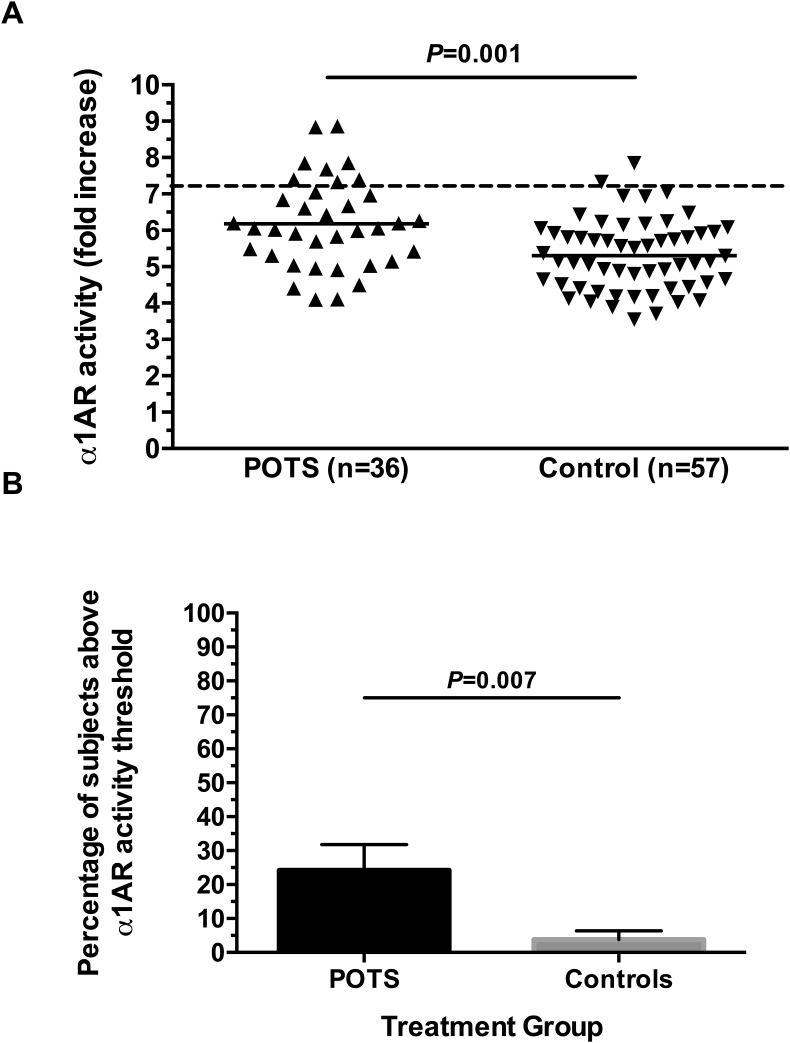
MAO effectively degraded catecholamines as demonstrated by suppression of norepinephrine-induced α1AR activation in POTS (6.4 ± 0.7 vs. 5.5 ± 0.9; = 0.044) and in controls (4.1 ± 0.5 vs. 3.9 ± 0.6; = 0.001). Mean activity values were greater in the POTS vs. Controls for α1AR-AAb (6.2 ± 1.2 vs. 5.3 ± 1.0; < 0.001) and β1AR-AAb (5.7 ± 1.8 vs. 4.1 ± 0.9; < 0.001). Compared to controls, more POTS patients were positive for α1AR-AAb activity (22% vs 4%; P = 0.007) and β1AR-AAb activity (52% vs. 2%; P < 0.001).
The co-presence of norepinephrine in serum samples can artifactually elevate α1AR and β1AR activity, which can be avoided by serum pre-treatment with MAO. Using this novel bioassay, we show that POTS patients have increased α1AR-AAb and β1AR-AAb activity compared to healthy controls in the largest POTS cohort reported to-date.
既往研究报道,体位性心动过速综合征(POTS)患者体内存在肾上腺素能受体(AR)激活自身抗体(AAb)。这些AAb可能是重叠疾病过程的最终共同通路,提示自身免疫可能参与POTS的病理生理过程。在既往研究中,AAb活性的测定是通过昂贵、低通量且费力的生理学检测方法推断得出。在本研究中,我们开发并验证了一种基于细胞的生物检测方法,通过单胺氧化酶(MAO)预处理来测定血清中的AAb活性。
共纳入37例POTS患者和61例性别匹配的健康对照者。血清经MAO预处理以去除内源性儿茶酚胺,内源性儿茶酚胺可导致AAb对AR激活的错误高估。采用基于受体转染细胞的生物检测方法检测血清中α1AR-AAb和β1AR-AAb的存在情况。
MAO有效降解了儿茶酚胺,这在POTS患者(6.4 ± 0.7 vs. 5.5 ± 0.9;P = 0.044)和对照组(4.1 ± 0.5 vs. 3.9 ± 0.6;P = 0.001)中均表现为去甲肾上腺素诱导的α1AR激活受到抑制。POTS患者中α1AR-AAb(6.2 ± 1.2 vs. 5.3 ± 1.0;P < 0.001)和β1AR-AAb(5.7 ± 1.8 vs. 4.1 ± 0.9;P < 0.001)的平均活性值高于对照组。与对照组相比,更多POTS患者的α1AR-AAb活性呈阳性(22% vs 4%;P = 0.007),β1AR-AAb活性呈阳性(52% vs. 2%;P < 0.001)。
血清样本中去甲肾上腺素的共存可人为升高α1AR和β1AR活性,通过MAO预处理血清可避免这种情况。使用这种新型生物检测方法,我们发现,在迄今为止报道的最大规模POTS队列中,与健康对照相比,POTS患者的α1AR-AAb和β1AR-AAb活性增加。