Newe Ya'ar Research Center, Agricultural Research Organization, Ramat Yishay, Israel.
Faculty of Biotechnology and Food Engineering, Technion-Israel Institute of Technology, Haifa, Israel.
Sci Rep. 2020 Aug 3;10(1):13019. doi: 10.1038/s41598-020-69509-7.
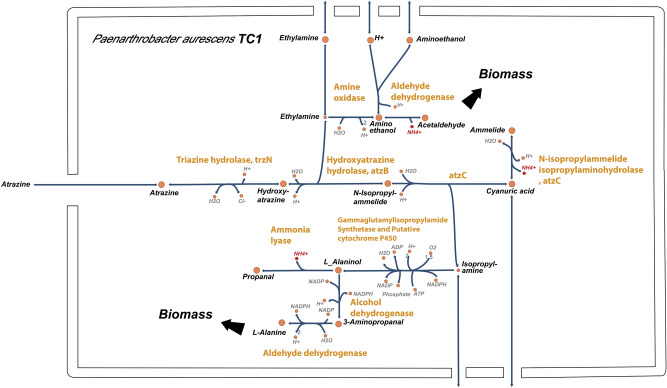
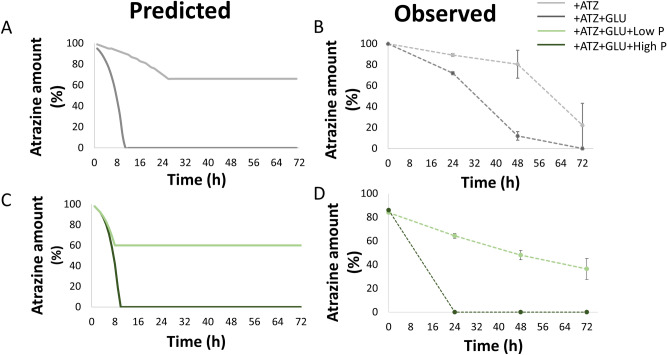
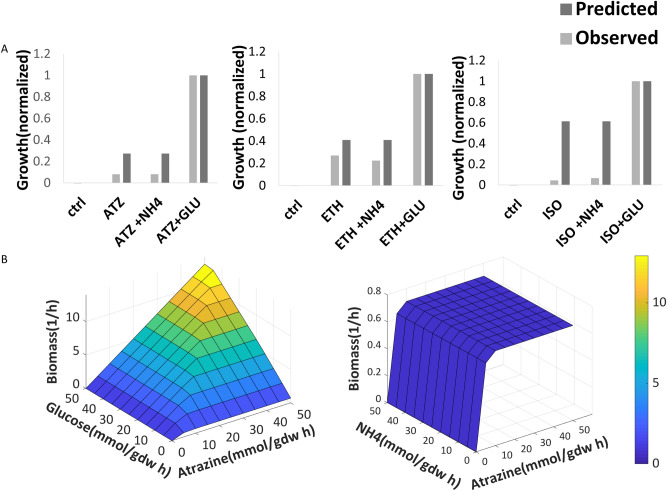
Atrazine is an herbicide and a pollutant of great environmental concern that is naturally biodegraded by microbial communities. Paenarthrobacter aurescens TC1 is one of the most studied degraders of this herbicide. Here, we developed a genome scale metabolic model for P. aurescens TC1, iRZ1179, to study the atrazine degradation process at organism level. Constraint based flux balance analysis and time dependent simulations were used to explore the organism's phenotypic landscape. Simulations aimed at designing media optimized for supporting growth and enhancing degradation, by passing the need in strain design via genetic modifications. Growth and degradation simulations were carried with more than 100 compounds consumed by P. aurescens TC1. In vitro validation confirmed the predicted classification of different compounds as efficient, moderate or poor stimulators of growth. Simulations successfully captured previous reports on the use of glucose and phosphate as bio-stimulators of atrazine degradation, supported by in vitro validation. Model predictions can go beyond supplementing the medium with a single compound and can predict the growth outcomes for higher complexity combinations. Hence, the analysis demonstrates that the exhaustive power of the genome scale metabolic reconstruction allows capturing complexities that are beyond common biochemical expertise and knowledge and further support the importance of computational platforms for the educated design of complex media. The model presented here can potentially serve as a predictive tool towards achieving optimal biodegradation efficiencies and for the development of ecologically friendly solutions for pollutant degradation.
莠去津是一种除草剂,也是一种对环境有重大影响的污染物,可被微生物群落自然生物降解。节杆菌(Paenarthrobacter)属的 A 亚种 TC1 是研究该除草剂降解的最主要的微生物之一。在这里,我们为 P. aurescens TC1(iRZ1179)构建了一个基因组尺度代谢模型,以在机体水平上研究莠去津的降解过程。基于约束的通量平衡分析和时变模拟被用来探索机体的表型景观。通过遗传修饰来绕过菌株设计的需求,模拟旨在设计优化支持生长和增强降解的培养基。生长和降解模拟使用了超过 100 种 P. aurescens TC1 消耗的化合物。体外验证证实了不同化合物作为生长有效、中度或低效刺激物的预测分类。模拟成功捕捉了先前关于葡萄糖和磷酸盐作为莠去津降解生物刺激物的使用报告,并得到了体外验证的支持。模型预测可以超越单一化合物对培养基的补充,并可以预测更复杂组合的生长结果。因此,该分析表明,基因组尺度代谢重建的详尽能力可以捕捉到超出常见生化专业知识和知识的复杂性,并进一步支持计算平台在有教育意义的复杂介质设计中的重要性。这里提出的模型可以作为实现最佳生物降解效率的预测工具,并为污染物降解的生态友好解决方案的开发提供支持。