Department of Cardiology, University Heart and Vascular Center UKE Hamburg, University Medical Center Hamburg-Eppendorf, Hamburg, Germany.
German Center for Cardiovascular Research (DZHK), Partner Site Hamburg/Kiel/Lübeck, Hamburg, Germany.
Clin Res Cardiol. 2020 Dec;109(12):1540-1548. doi: 10.1007/s00392-020-01723-9. Epub 2020 Aug 4.
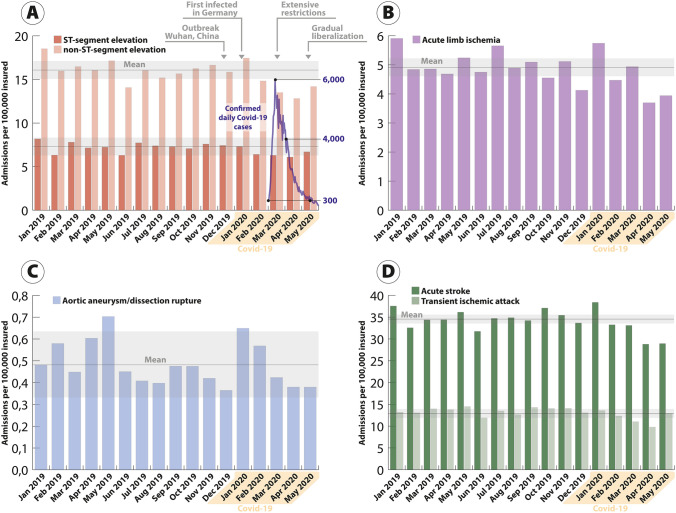
The first reports of declining hospital admissions for major cardiovascular emergencies during the COVID-19 pandemic attracted public attention. However, systematic evidence on this subject is sparse. We aimed to investigate the rate of emergent hospital admissions, subsequent invasive treatments and comorbidities during the COVID-19 pandemic in Germany.
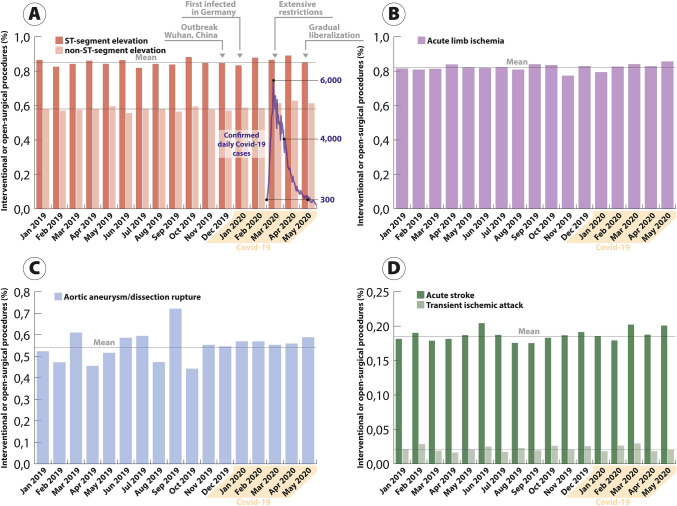
This was a retrospective analysis of health insurance claims data from the second largest insurance fund in Germany, BARMER. Patients hospitalized for acute myocardial infarction, acute limb ischemia, aortic rupture, stroke or transient ischemic attack (TIA) between January 1, 2019, and May 31, 2020, were included. Admission rates per 100,000 insured, invasive treatments and comorbidities were compared from January-May 2019 (pre-COVID) to January-May 2020 (COVID). A total of 115,720 hospitalizations were included in the current analysis (51.3% females, mean age 72.9 years). Monthly admission rates declined from 78.6/100,000 insured (pre-COVID) to 70.6/100,000 (COVID). The lowest admission rate was observed in April 2020 (61.6/100,000). Administration rates for ST-segment elevation myocardial infarction (7.3-6.6), non-ST-segment elevation myocardial infarction (16.8-14.6), acute limb ischemia (5.1-4.6), stroke (35.0-32.5) and TIA (13.7-11.9) decreased from pre-COVID to COVID. Baseline comorbidities and the percentage of these patients treated with interventional or open-surgical procedures remained similar over time across all entities. In-hospital mortality in hospitalizations for stroke increased from pre-COVID to COVID (8.5-9.8%).
Admission rates for cardiovascular and cerebrovascular emergencies declined during the pandemic in Germany, while patients' comorbidities and treatment allocations remained unchanged. Further investigation is warranted to identify underlying reasons and potential implications on patients' outcomes.
COVID-19 大流行期间主要心血管急症住院人数下降的首批报告引起了公众关注。然而,关于这一主题的系统证据很少。我们旨在研究德国 COVID-19 大流行期间紧急住院、后续侵入性治疗和合并症的发生率。
这是对德国第二大保险公司 BARMER 的健康保险索赔数据进行的回顾性分析。纳入 2019 年 1 月 1 日至 2020 年 5 月 31 日期间因急性心肌梗死、急性肢体缺血、主动脉破裂、中风或短暂性脑缺血发作(TIA)住院的患者。比较 2019 年 1 月至 5 月(COVID-19 前)和 2020 年 1 月至 5 月(COVID-19)期间每 10 万参保人入院率、侵入性治疗和合并症。本研究共纳入 115720 例住院患者(女性占 51.3%,平均年龄 72.9 岁)。每月入院率从 COVID-19 前的 78.6/100,000 人下降至 COVID-19 的 70.6/100,000 人。2020 年 4 月的入院率最低(61.6/100,000)。ST 段抬高型心肌梗死(7.3-6.6)、非 ST 段抬高型心肌梗死(16.8-14.6)、急性肢体缺血(5.1-4.6)、中风(35.0-32.5)和 TIA(13.7-11.9)的给药率从 COVID-19 前降至 COVID-19。所有实体中,基线合并症和接受介入或开放手术治疗的患者比例随时间保持相似。COVID-19 前至 COVID-19 期间,中风住院患者的院内死亡率从 8.5%上升至 9.8%。
德国 COVID-19 大流行期间心血管和脑血管急症的入院率下降,而患者的合并症和治疗分配保持不变。需要进一步调查以确定潜在原因及其对患者预后的潜在影响。