Heart Center Leipzig at University of Leipzig and Leipzig Heart Institute, Leipzig, Germany.
Department of Psychiatry, Psychotherapy and Psychosomatics, Helios Park Hospital, Leipzig, Germany.
PLoS One. 2021 Mar 25;16(3):e0249251. doi: 10.1371/journal.pone.0249251. eCollection 2021.
During the early phase of the Covid-19 pandemic, reductions of hospital admissions with a focus on emergencies have been observed for several medical and surgical conditions, while trend data during later stages of the pandemic are scarce. Consequently, this study aims to provide up-to-date hospitalization trends for several conditions including cardiovascular, psychiatry, oncology and surgery cases in both the in- and outpatient setting.
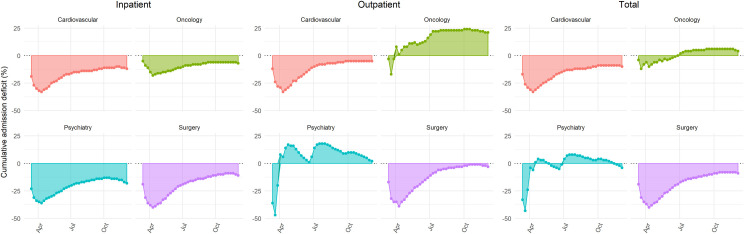
Using claims data of 86 Helios hospitals in Germany, consecutive cases with an in- or outpatient hospital admission between March 13, 2020 (the begin of the "protection" stage of the German pandemic plan) and December 10, 2020 (end of study period) were analyzed and compared to a corresponding period covering the same weeks in 2019. Cause-specific hospitalizations were defined based on the primary discharge diagnosis according to International Statistical Classification of Diseases and Related Health Problems (ICD-10) or German procedure classification codes for cardiovascular, oncology, psychiatry and surgery cases. Cumulative hospitalization deficit was computed as the difference between the expected and observed cumulative admission number for every week in the study period, expressed as a percentage of the cumulative expected number. The expected admission number was defined as the weekly average during the control period. A total of 1,493,915 hospital admissions (723,364 during the study and 770,551 during the control period) were included. At the end of the study period, total cumulative hospitalization deficit was -10% [95% confidence interval -10; -10] for cardiovascular and -9% [-10; -9] for surgical cases, higher than -4% [-4; -3] in psychiatry and 4% [4; 4] in oncology cases. The utilization of inpatient care and subsequent hospitalization deficit was similar in trend with some variation in magnitude between cardiovascular (-12% [-13; -12]), psychiatry (-18% [-19; -17]), oncology (-7% [-8; -7]) and surgery cases (-11% [-11; -11]). Similarly, cardiovascular and surgical outpatient cases had a deficit of -5% [-6; -5] and -3% [-4; -3], respectively. This was in contrast to psychiatry (2% [1; 2]) and oncology cases (21% [20; 21]) that had a surplus in the outpatient sector. While in-hospital mortality, was higher during the Covid-19 pandemic in cardiovascular (3.9 vs. 3.5%, OR 1.10 [95% CI 1.06-1.15], P<0.01) and in oncology cases (4.5 vs. 4.3%, OR 1.06 [95% CI 1.01-1.11], P<0.01), it was similar in surgical (0.9 vs. 0.8%, OR 1.06 [95% CI 1.00-1.13], P = 0.07) and in psychiatry cases (0.4 vs. 0.5%, OR 1.01 [95% CI 0.78-1.31], P<0.95).
There have been varying changes in care pathways and in-hospital mortality in different disciplines during the Covid-19 pandemic in Germany. Despite all the inherent and well-known limitations of claims data use, this data may be used for health care surveillance as the pandemic continues worldwide. While this study provides an up-to-date analysis of utilization of hospital care in the largest German hospital network, short- and long-term consequences are unknown and deserve further studies.
在新冠疫情的早期阶段,人们观察到多种医疗和外科条件下的住院人数减少,主要集中在急诊方面,而在疫情后期阶段的趋势数据则相对较少。因此,本研究旨在提供德国多家医院包括心血管、精神病、肿瘤和外科病例在内的住院趋势的最新数据。
本研究使用了德国 86 家 Helios 医院的索赔数据,分析了 2020 年 3 月 13 日(德国大流行计划“保护”阶段开始)至 2020 年 12 月 10 日(研究期末)期间的门诊和住院患者,并与 2019 年同期相对应的时间段进行了比较。根据国际疾病分类和相关健康问题(ICD-10)或德国手术分类代码,将特定病因的住院治疗定义为心血管、肿瘤、精神病和外科病例的主要出院诊断。累计住院缺陷的计算方法是研究期间每周实际入院人数与预期入院人数之间的差异,以预期入院人数的百分比表示。预期入院人数的定义为控制期内每周的平均值。共有 1493915 例住院治疗(研究期间 723364 例,对照期间 770551 例)被纳入。在研究期末,心血管疾病的累计住院缺陷为-10%(95%置信区间为-10%至-10%),外科病例为-9%(-10%至-9%),高于精神病病例的-4%(-4%至-3%)和肿瘤病例的 4%(4%至 4%)。住院治疗的利用和随后的住院缺陷趋势相似,在心血管疾病(-12%[-13%至-12%])、精神病(-18%[-19%至-17%])、肿瘤(-7%[-8%至-7%])和外科病例(-11%[-11%至-11%])方面存在一定程度的差异。同样,心血管疾病和外科门诊患者分别有-5%(-6%至-5%)和-3%(-4%至-3%)的缺陷。相比之下,精神病(2%[1%至 2%])和肿瘤(21%[20%至 21%])门诊患者则存在过剩情况。尽管心血管疾病(3.9 比 3.5%,OR 1.10[95%CI 1.06-1.15],P<0.01)和肿瘤病例(4.5 比 4.3%,OR 1.06[95%CI 1.01-1.11],P<0.01)在新冠疫情期间的住院死亡率更高,但在外科(0.9 比 0.8%,OR 1.06[95%CI 1.00-1.13],P=0.07)和精神病病例(0.4 比 0.5%,OR 1.01[95%CI 0.78-1.31],P<0.95)中,住院死亡率相似。
在德国,新冠疫情期间不同学科的治疗途径和院内死亡率发生了不同的变化。尽管索赔数据的使用存在所有固有的和众所周知的限制,但在全球大流行继续的情况下,这些数据可用于医疗保健监测。虽然本研究提供了德国最大的医院网络中住院治疗利用情况的最新分析,但短期和长期后果尚不清楚,值得进一步研究。