Department of Radiology & Nuclear Medicine, Erasmus MC, P.O. Box 2240, 3000 CA, Rotterdam, The Netherlands.
Computed Tomography Division, Siemens Healthineers, Forchheim, Germany.
Eur Radiol. 2021 Jan;31(1):131-138. doi: 10.1007/s00330-020-07097-w. Epub 2020 Aug 4.
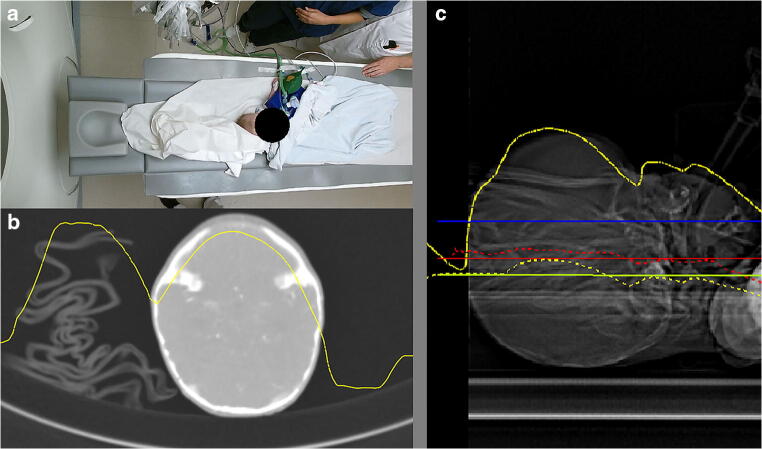
To assess the accuracy of a 3D camera for body contour detection in pediatric patient positioning in CT compared with routine manual positioning by radiographers.
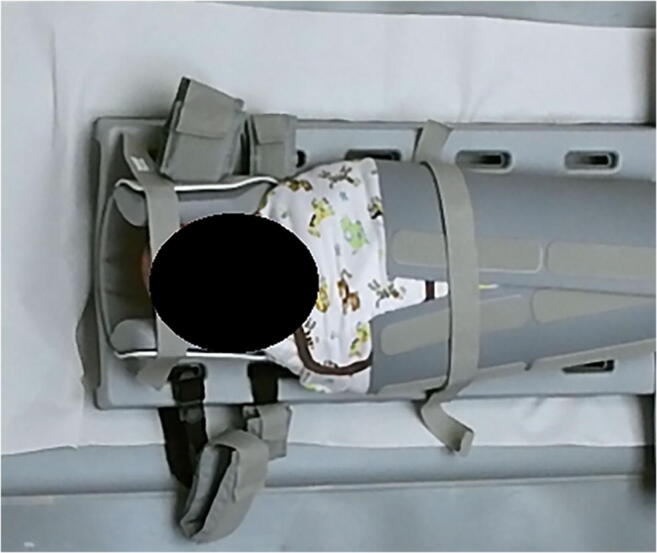
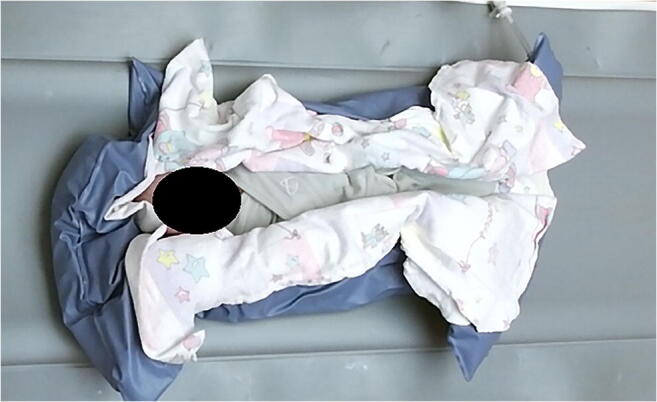
One hundred and ninety-one patients, with and without fixation aid, which underwent CT of the head, thorax, and/or abdomen on a scanner with manual table height selection and with table height suggestion by a 3D camera were retrospectively included. The ideal table height was defined as the position at which the scanner isocenter coincides with the patient's isocenter. Table heights suggested by the camera and selected by the radiographer were compared with the ideal height.
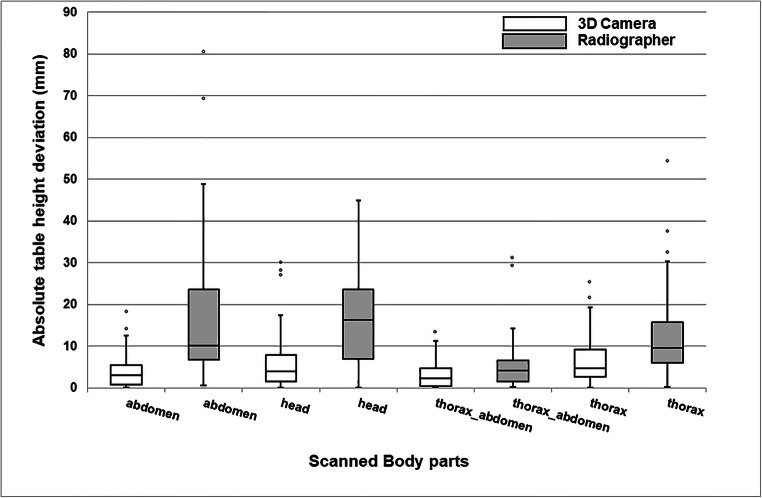
For pediatric patients without fixation aid like a baby cradle or vacuum cushion and positioned by radiographers, the median (interquartile range) absolute table height deviation in mm was 10.2 (16.8) for abdomen, 16.4 (16.6) for head, 4.1 (5.1) for thorax-abdomen, and 9.7 (9.7) for thorax CT scans. The deviation was less for the 3D camera: 3.1 (4.7) for abdomen, 3.9 (6.3) for head, 2.2 (4.3) for thorax-abdomen, and 4.8 (6.7) for thorax CT scans (p < 0.05 for all body parts combined).
A 3D camera for body contour detection allows for automated and more accurate pediatric patient positioning than manual positioning done by radiographers, resulting in overall significantly smaller deviations from the ideal table height. The 3D camera may be also useful in the positioning of patients with fixation aid; however, evaluation of possible improvements in positioning accuracy was limited by the small sample size.
• A 3D camera for body contour detection allows for automated and accurate pediatric patient positioning in CT. • A 3D camera outperformed radiographers in positioning pediatric patients without a fixation aid in CT. • Positioning of pediatric patients with fixation aid was feasible using the 3D camera, but no definite conclusions were drawn regarding the positioning accuracy due to the small sample size.
评估 3D 相机在 CT 中用于儿科患者定位的准确性,与放射技师常规手动定位相比。
回顾性纳入 191 例患者,包括有和没有固定辅助装置的患者,这些患者在手动选择床高和 3D 相机提示床高的扫描仪上进行头部、胸部和/或腹部 CT 检查。理想床高定义为扫描架等中心点与患者等中心点重合的位置。相机提示的床高和放射技师选择的床高与理想高度进行比较。
对于没有像婴儿摇篮或真空垫等固定辅助装置的儿科患者,由放射技师定位,腹部 CT 扫描的毫米绝对床高偏差中位数(四分位距)为 10.2(16.8),头部为 16.4(16.6),胸部-腹部为 4.1(5.1),胸部 CT 扫描为 9.7(9.7)。3D 相机的偏差较小:腹部为 3.1(4.7),头部为 3.9(6.3),胸部-腹部为 2.2(4.3),胸部 CT 扫描为 4.8(6.7)(所有身体部位的差异均小于 0.05)。
3D 相机用于身体轮廓检测可实现自动化和更准确的儿科患者定位,与放射技师手动定位相比,总体上从理想床高的偏差显著更小。3D 相机也可能对带有固定辅助装置的患者定位有用;然而,由于样本量小,评估定位准确性的可能提高受到限制。
3D 相机用于身体轮廓检测可实现 CT 中儿科患者的自动化和精确定位。
3D 相机在定位没有固定辅助装置的儿科患者方面优于放射技师。
使用 3D 相机对带有固定辅助装置的儿科患者进行定位是可行的,但由于样本量小,无法对定位准确性得出明确结论。