Department of Microbiology and Immunology, University of Melbourne at the Peter Doherty Institute for Infection and Immunity, Melbourne, Victoria, Australia.
Department of Infectious Diseases, Monash Health, Clayton, Victoria, Australia.
J Med Microbiol. 2020 Sep;69(9):1169-1178. doi: 10.1099/jmm.0.001238. Epub 2020 Jul 31.
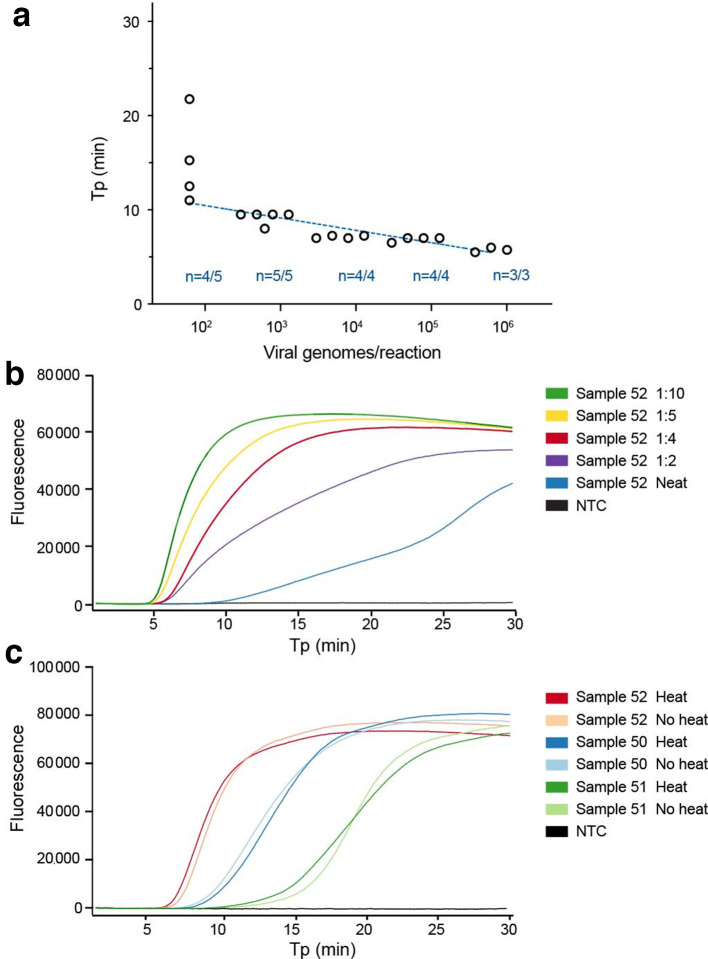
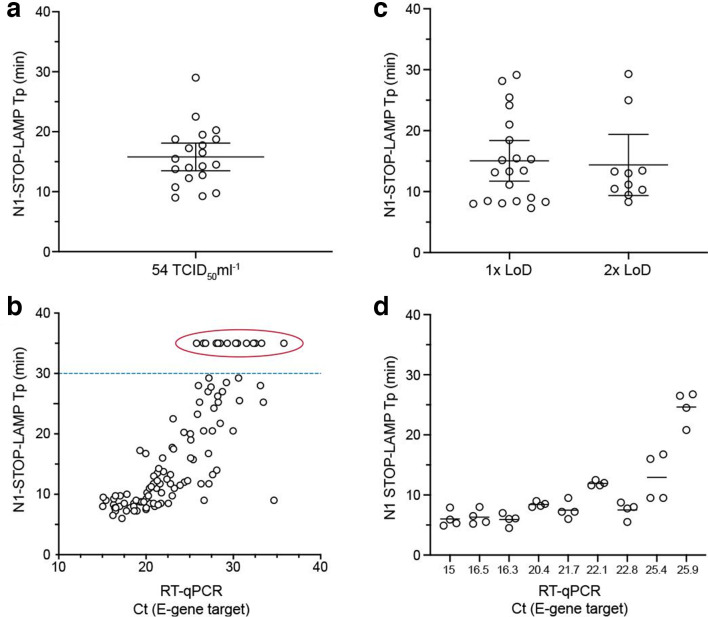
The SARS-CoV-2 pandemic of 2020 has resulted in unparalleled requirements for RNA extraction kits and enzymes required for virus detection, leading to global shortages. This has necessitated the exploration of alternative diagnostic options to alleviate supply chain issues. To establish and validate a reverse transcription loop-mediated isothermal amplification (RT- LAMP) assay for the detection of SARS-CoV-2 from nasopharyngeal swabs. We used a commercial RT-LAMP mastermix from OptiGene in combination with a primer set designed to detect the CDC N1 region of the SARS-CoV-2 nucleocapsid (N) gene. A single-tube, single-step fluorescence assay was implemented whereby 1 µl of universal transport medium (UTM) directly from a nasopharyngeal swab could be used as template, bypassing the requirement for RNA purification. Amplification and detection could be conducted in any thermocycler capable of holding 65 °C for 30 min and measure fluorescence in the FAM channel at 1 min intervals. Assay evaluation by assessment of 157 clinical specimens previously screened by E-gene RT-qPCR revealed assay sensitivity and specificity of 87 and 100%, respectively. Results were fast, with an average time-to-positive (Tp) for 93 clinical samples of 14 min (sd±7 min). Using dilutions of SARS-CoV-2 virus spiked into UTM, we also evaluated assay performance against FDA guidelines for implementation of emergency-use diagnostics and established a limit-of-detection of 54 Tissue Culture Infectious Dose 50 per ml (TCID ml), with satisfactory assay sensitivity and specificity. A comparison of 20 clinical specimens between four laboratories showed excellent interlaboratory concordance; performing equally well on three different, commonly used thermocyclers, pointing to the robustness of the assay. With a simplified workflow, The N1 gene Single Tube Optigene LAMP assay (N1-STOP-LAMP) is a powerful, scalable option for specific and rapid detection of SARS-CoV-2 and an additional resource in the diagnostic armamentarium against COVID-19.
2020 年的 SARS-CoV-2 大流行对用于病毒检测的 RNA 提取试剂盒和酶提出了前所未有的要求,导致全球供应短缺。这就需要探索替代诊断方案来缓解供应链问题。本研究旨在建立并验证一种基于逆转录环介导等温扩增(RT-LAMP)的检测方法,用于从鼻咽拭子中检测 SARS-CoV-2。我们使用了 OptiGene 的商业 RT-LAMP 试剂盒,结合了一组设计用于检测 SARS-CoV-2 核衣壳(N)基因 CDC N1 区的引物。该方法采用单管一步荧光法,可直接使用来自鼻咽拭子的 1 µl 通用运输介质(UTM)作为模板,无需进行 RNA 纯化。在能够保持 65°C 30 分钟的任何热循环仪中均可进行扩增和检测,并在 1 分钟间隔测量 FAM 通道的荧光。通过对先前经 E 基因 RT-qPCR 筛选的 157 份临床标本进行评估,该检测方法的敏感性和特异性分别为 87%和 100%。结果快速,93 份临床样本的平均阳性时间(Tp)为 14 分钟(标准差±7 分钟)。使用 SARS-CoV-2 病毒稀释液掺入 UTM 进行检测,我们还根据 FDA 紧急使用诊断试剂实施指南评估了检测性能,并确定了检测限为 54 组织培养感染剂量 50 每毫升(TCID ml),具有令人满意的检测敏感性和特异性。在四个实验室之间对 20 份临床标本进行的比较显示出极好的实验室间一致性;在三种不同的常用热循环仪上的表现同样出色,这表明该检测方法具有稳健性。N1 基因单管 Optigene LAMP 检测法(N1-STOP-LAMP)具有简化的工作流程,是一种强大的、可扩展的用于快速特异性检测 SARS-CoV-2 的方法,是 COVID-19 诊断工具包的又一资源。