Department of Neuropathology, Regensburg University Hospital, Franz-Josef-Strauss-Allee 11, 93053, Regensburg, Germany.
Wilhelm Sander Neuro-Oncology Unit, Regensburg University Hospital, Regensburg, Germany.
Acta Neuropathol Commun. 2020 Aug 5;8(1):124. doi: 10.1186/s40478-020-01000-w.
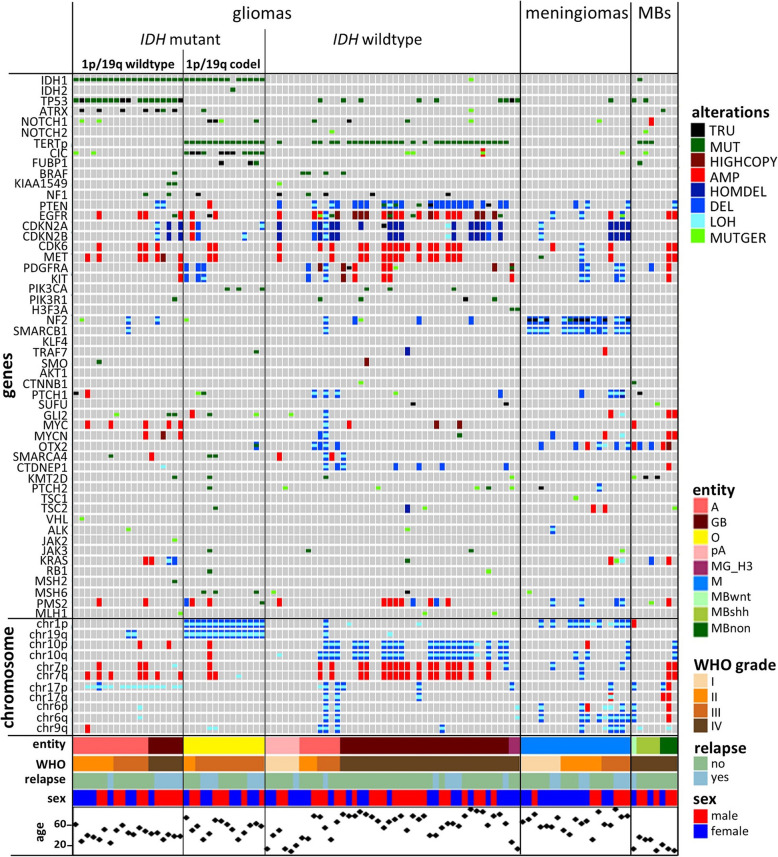
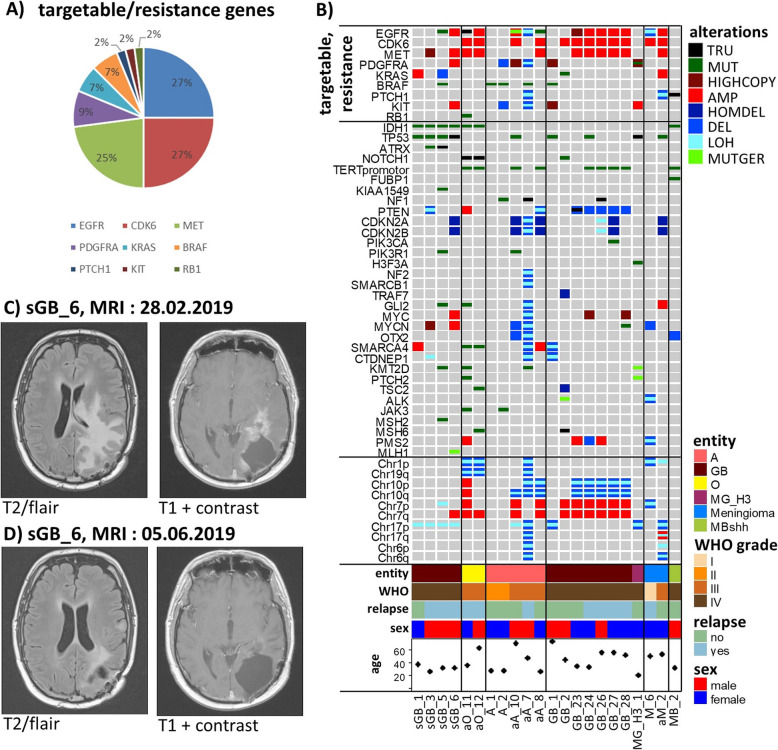
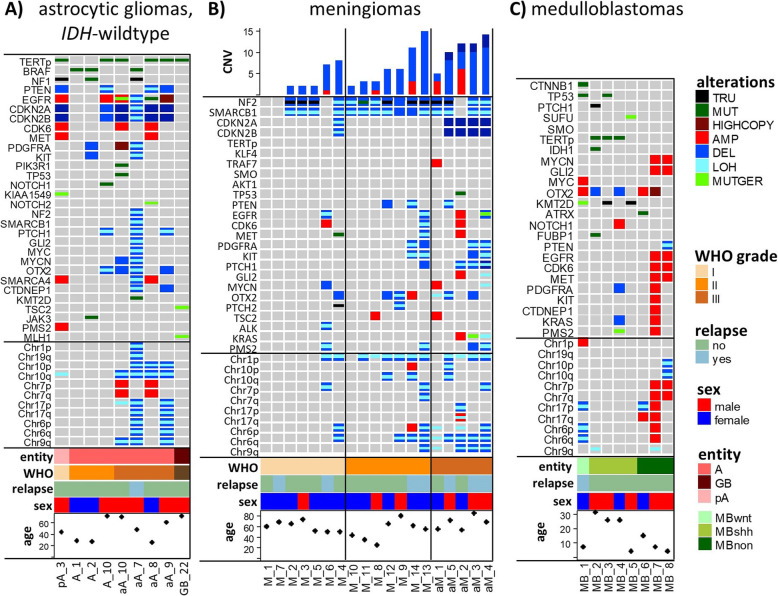
Recent updates in the classification of central nervous system (CNS) tumors have increased the need for molecular testing. Assessment of multiple alterations in parallel, complex combinations of gene sequence and chromosomal changes, as well as therapy prediction by identification of actionable mutations are the major challenges. We here report on a customized next generation sequencing (NGS)-based DNA panel assay that combines diagnostic and predictive testing and -as a comprehensive approach- allows for simultaneous single nucleotide variant (SNP) / small insertion/deletion (InDel), copy number variation (CNV) and loss of heterozygosity (LOH) detection. We analyzed formalin-fixed and paraffin-embedded (FFPE) DNA from a total of 104 patients with CNS tumors. After amplicon capture-based library preparation, sequencing was performed on the relatively cost-efficient Illiumina MiniSeq platform and evaluated with freely available bioinformatical tools. 57 genes for exonic SNP/InDel calling (19 of those in intronic regions for CNV analysis), 3 chromosomal arms and 4 entire chromosomes for CNV and LOH analysis were covered. Results were extensively validated. Our approach yielded high accuracy, sensitivity and specificity. It led to refined diagnoses in a relevant number of analyzed cases, reliably enabled complex subclassifications (e.g. for medulloblastomas) and identified actionable targets for clinical use. Thus, our single-platform approach is an efficient and powerful tool to comprehensively support molecular testing in neurooncology. Future functionality is guaranteed as novel upcoming biomarkers can be easily incorporated in a modular panel design.
最近中枢神经系统(CNS)肿瘤分类的更新增加了对分子检测的需求。评估多个改变,包括基因序列和染色体变化的复杂组合,以及通过识别可操作突变进行治疗预测,是主要的挑战。我们在这里报告了一种定制的基于下一代测序(NGS)的 DNA 面板检测方法,该方法结合了诊断和预测测试,并且作为一种全面的方法,允许同时进行单核苷酸变异(SNP)/小插入/缺失(InDel)、拷贝数变异(CNV)和杂合性丢失(LOH)检测。我们分析了总共 104 例中枢神经系统肿瘤的福尔马林固定石蜡包埋(FFPE)DNA。在基于扩增子捕获的文库制备后,在相对成本效益高的 Illiumina MiniSeq 平台上进行测序,并使用免费的生物信息学工具进行评估。我们覆盖了用于外显子 SNP/InDel 调用的 57 个基因(其中 19 个用于 CNV 分析的内含子区域)、3 个染色体臂和 4 个整个染色体的 CNV 和 LOH 分析。结果进行了广泛验证。我们的方法具有高精度、灵敏度和特异性。它在大量分析病例中得出了更精确的诊断,可靠地实现了复杂的亚分类(例如,用于髓母细胞瘤),并确定了用于临床应用的可操作靶点。因此,我们的单一平台方法是全面支持神经肿瘤学分子检测的有效且强大的工具。未来的功能是有保证的,因为新的即将出现的生物标志物可以很容易地纳入模块化的面板设计中。