Weller Johannes, Potthoff Anna-Laura, Zeyen Thomas, Schaub Christina, Duffy Cathrina, Schneider Matthias, Herrlinger Ulrich
Department of Neurooncology, Center for Neurology, University Hospital Bonn, Germany.
Department of Neurosurgery, University Hospital Bonn, Germany.
Mol Oncol. 2024 Dec;18(12):2927-2950. doi: 10.1002/1878-0261.13678. Epub 2024 Jun 20.
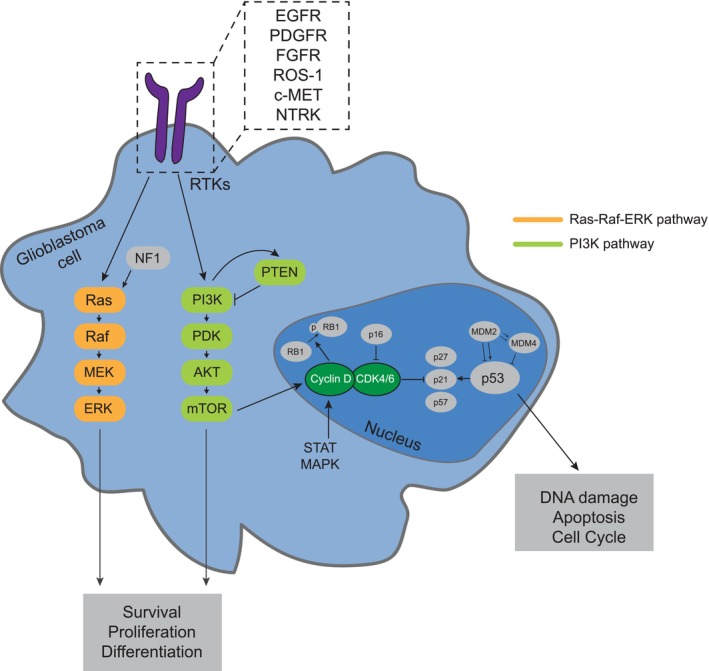
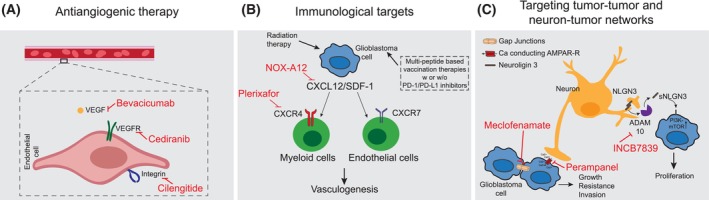
The concept of precision oncology, the application of targeted drugs based on comprehensive molecular profiling, has revolutionized treatment strategies in oncology. This review summarizes the current status of precision oncology in glioblastoma (GBM), the most common and aggressive primary brain tumor in adults with a median survival below 2 years. Targeted treatments without prior target verification have consistently failed. Patients with BRAF V600E-mutated GBM benefit from BRAF/MEK-inhibition, whereas targeting EGFR alterations was unsuccessful due to poor tumor penetration, tumor cell heterogeneity, and pathway redundancies. Systematic screening for actionable molecular alterations resulted in low rates (< 10%) of targeted treatments. Efficacy was observed in one-third and currently appears to be limited to BRAF-, VEGFR-, and mTOR-directed treatments. Advancing precision oncology for GBM requires consideration of pathways instead of single alterations, new trial concepts enabling rapid and adaptive drug evaluation, a focus on drugs with sufficient bioavailability in the CNS, and the extension of target discovery and validation to the tumor microenvironment, tumor cell networks, and their interaction with immune cells and neurons.
精准肿瘤学的概念,即基于全面分子谱分析应用靶向药物,彻底改变了肿瘤学的治疗策略。本综述总结了胶质母细胞瘤(GBM)中精准肿瘤学的现状,GBM是成人中最常见且侵袭性最强的原发性脑肿瘤,中位生存期低于2年。未经事先靶点验证的靶向治疗一直失败。携带BRAF V600E突变的GBM患者可从BRAF/MEK抑制中获益,而针对表皮生长因子受体(EGFR)改变的靶向治疗因肿瘤穿透性差、肿瘤细胞异质性和信号通路冗余而未成功。对可操作分子改变进行系统筛查导致靶向治疗率较低(<10%)。三分之一的治疗观察到了疗效,目前似乎仅限于针对BRAF、血管内皮生长因子受体(VEGFR)和雷帕霉素靶蛋白(mTOR)的治疗。推进GBM的精准肿瘤学需要考虑信号通路而非单一改变,需要新的试验概念以实现快速和适应性药物评估,关注在中枢神经系统中具有足够生物利用度的药物,并将靶点发现和验证扩展到肿瘤微环境、肿瘤细胞网络及其与免疫细胞和神经元的相互作用。