
基于 10MHz 薄膜 PZT 的柔性 PMUT 阵列:有限元设计与特性分析。
10 MHz Thin-Film PZT-Based Flexible PMUT Array: Finite Element Design and Characterization.
机构信息
Department of Engineering Science and Mechanics, The Pennsylvania State University, University Park, PA 16802, USA.
School of Electrical Engineering and Computer Science, The Pennsylvania State University, University Park, PA 16802, USA.
出版信息
Sensors (Basel). 2020 Aug 4;20(15):4335. doi: 10.3390/s20154335.
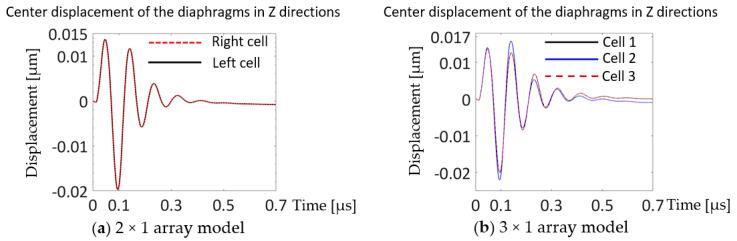
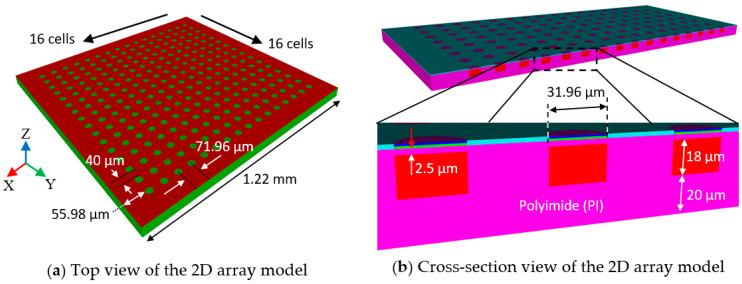
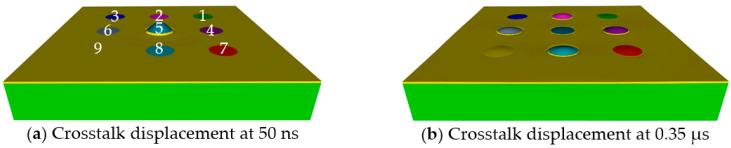
Piezoelectric micromachined ultrasound transducers (PMUT) incorporating lead zirconate titanate PbZrTiO (PZT) thin films were investigated for miniaturized high-frequency ultrasound systems. A recently developed process to remove a PMUT from an underlying silicon (Si) substrate has enabled curved arrays to be readily formed. This research aimed to improve the design of flexible PMUT arrays using PZFlex, a finite element method software package. A 10 MHz PMUT 2D array working in 3-1 mode was designed. A circular unit-cell was structured from the top, with concentric layers of platinum (Pt)/PZT/Pt/titanium (Ti) on a polyimide (PI) substrate. Pulse-echo and spectral response analyses predicted a center frequency of 10 MHz and bandwidth of 87% under water load and air backing. A 2D array, consisting of the 256 (16 × 16) unit-cells, was created and characterized in terms of pulse-echo and spectral responses, surface displacement profiles, crosstalk, and beam profiles. The 2D array showed: decreased bandwidth due to protracted oscillation decay and guided wave effects; mechanical focal length at 2.9 mm; 3.7 mm depth of field for -6 dB; and -55.6 dB crosstalk. Finite element-based virtual prototyping identified figures of merit-center frequency, bandwidth, depth of field, and crosstalk-that could be optimized to design robust, flexible PMUT arrays.
基于锆钛酸铅(PZT)薄膜的压电微机械超声换能器(PMUT)被用于研究小型高频超声系统。最近开发的一种从底层硅(Si)衬底上去除 PMUT 的工艺,使得可以轻松地形成弯曲的阵列。本研究旨在使用有限元方法软件包 PZFlex 改进柔性 PMUT 阵列的设计。设计了一个工作在 3-1 模式下的 10MHz PMUT 2D 阵列。在聚酰亚胺(PI)基底上,从顶部构造出一个圆形单元,其具有同心层的铂(Pt)/PZT/Pt/钛(Ti)。在水负载和空气背衬下,脉冲回波和频谱响应分析预测中心频率为 10MHz,带宽为 87%。创建并根据脉冲回波和频谱响应、表面位移轮廓、串扰和波束轮廓对包含 256(16×16)个单元的 2D 阵列进行了表征。2D 阵列显示:带宽由于延长的振荡衰减和导波效应而减小;机械焦距为 2.9mm;-6dB 的景深为 3.7mm;串扰为-55.6dB。基于有限元的虚拟原型设计确定了可以优化的关键指标——中心频率、带宽、景深和串扰——以设计稳健、灵活的 PMUT 阵列。






 Zotero 插件