Department of Animal Science, Michigan State University, East Lansing, Michigan, United States of America.
Milk Production, Production Systems, Natural Resources Institute Finland (Luke), Jokioinen, Finland.
PLoS One. 2020 Aug 6;15(8):e0235357. doi: 10.1371/journal.pone.0235357. eCollection 2020.
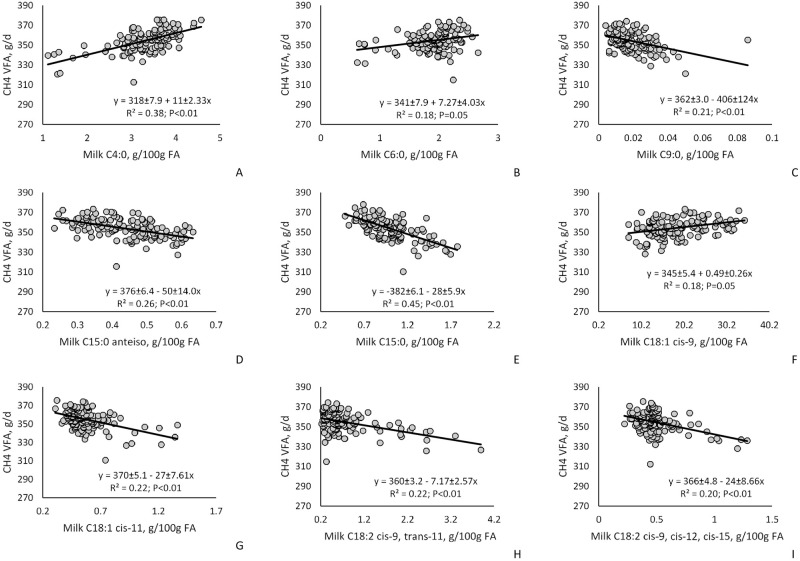
We evaluated the between-cow (b-cow) variation and repeatability in omasal and milk fatty acids (FA) related to methane (CH4) emission. The dataset was originated from 9 studies with rumen-cannulated dairy cows conducted using either a switch-back or a Latin square design. Production of CH4 per mole of VFA (Y_CH4VFA) was calculated based on VFA stoichiometry. Experiment, diet within experiment, period within experiment, and cow within experiment were considered as random factors. Empirical models were developed between the variables of interest by univariate and bivariate mixed model regression analysis. The variation associated with diet was higher than the b-cow variation with low repeatability (< 0.25) for milk odd- and branch-chain FA (OBCFA). Similarly, for de novo synthesized milk FA, diet variation was ~ 3-fold greater than the b-cow variation; repeatability for these FA was moderate to high (0.34-0.58). Also, for both cis-9 C18:1 and cis-9 cis-12 cis-15 C18:3 diet variation was more than double the b-cow variation, but repeatability was moderate. Among the de novo milk FA, C4:0 was positively related with stoichiometric Y_CH4VFA, while for OBCFA, anteiso C15:0 and C15:0 were negatively related with it. Notably, when analyzing the relationship between omasal FA and milk FA we observed positive intercept estimates for all the OBCFA, which may indicate endogenous post-ruminal synthesis of these FA, most likely in the mammary gland. For milk iso C13:0, iso C15:0, anteiso C15:0, and C15:0 were positively influenced by omasal proportion of their respective FA and by energy balance. In contrast, the concentration of milk C17:0, iso C18:0, C18:0, cis-11 C18:1, and cis-9 cis-12 cis-15 C18:3 were positively influenced by omasal proportion of their respective FA but negatively related to calculated energy balance. Our findings demonstrate that for most milk FA examined, a larger variation is attributed to diet than b-cow differences with low to moderate repeatability. While some milk FA were positively or negatively related with Y_CH4VFA, there was a pronounced effect of calculated energy balance on these estimates. Additionally, even though OBCFA have been indicated as markers of rumen function, our results suggest that endogenous synthesis of these FA may occur, which therefore, may limit the utilization of milk FA as a proxy for CH4 predictions for cows fed the same diet.
我们评估了瘤胃后(b-cow)变化和奶脂肪酸(FA)与甲烷(CH4)排放的重复性。该数据集来源于 9 项使用换向或拉丁方设计的瘤胃插管奶牛研究。基于 VFA 化学计量,计算每摩尔挥发性脂肪酸(VFA)产生的 CH4(Y_CH4VFA)。实验、实验内的日粮、实验内的时期和实验内的奶牛被认为是随机因素。通过单变量和双变量混合模型回归分析,在感兴趣的变量之间建立经验模型。与饮食相关的变异高于奶牛间变异,初乳奇数和支链 FA(OBCFA)的重复性较低(<0.25)。同样,对于从头合成的奶 FA,饮食变化是奶牛间变异的~3 倍;这些 FA 的重复性为中等到高(0.34-0.58)。此外,对于 cis-9 C18:1 和 cis-9 cis-12 cis-15 C18:3,饮食变化是奶牛间变异的两倍多,但重复性中等。在从头合成的奶 FA 中,C4:0 与化学计量 Y_CH4VFA 呈正相关,而对于 OBCFA,anteiso C15:0 和 C15:0 则呈负相关。值得注意的是,当分析瘤胃 FA 和奶 FA 之间的关系时,我们观察到所有 OBCFA 的截距估计值均为正,这可能表明这些 FA 的内源性瘤胃后合成,最有可能在乳腺中。对于奶 iso C13:0、iso C15:0、anteiso C15:0 和 C15:0,瘤胃中各自 FA 的比例和能量平衡正向影响其浓度。相比之下,奶 C17:0、iso C18:0、C18:0、cis-11 C18:1 和 cis-9 cis-12 cis-15 C18:3 的浓度与瘤胃中各自 FA 的比例呈正相关,但与计算出的能量平衡呈负相关。我们的研究结果表明,对于大多数研究的奶 FA,与奶牛间差异相比,饮食差异导致的变化更大,重复性较低到中等。虽然一些奶 FA 与 Y_CH4VFA 呈正相关或负相关,但计算出的能量平衡对这些估计值有明显影响。此外,尽管 OBCFA 已被认为是瘤胃功能的标志物,但我们的结果表明,这些 FA 可能发生内源性合成,因此可能限制了奶 FA 作为奶牛摄入相同日粮时 CH4 预测的替代物的利用。