Xia Di, Zhang Xiao-Ran, Ma Yan-Li, Zhao Zhi-Jun, Zhao Ren, Wang Yan-Yang
Graduate School, Ningxia Medical University, Yinchuan, 750004 Ningxia China.
Cancer Center, Union Hospital, Tongji Medical College, Huazhong University of Science and Technology, Wuhan, 430023 Hubei China.
Cell Biosci. 2020 Jul 30;10:90. doi: 10.1186/s13578-020-00456-6. eCollection 2020.
NF-E2-related factor 2 (Nrf2) is involved in the radiation resistance of esophageal squamous cell carcinoma (ESCC), but the underlying molecular mechanism is unclear. The purpose of our study was to explore the role of Nrf2 in the radiation resistance of ESCC and the potential molecular mechanism.
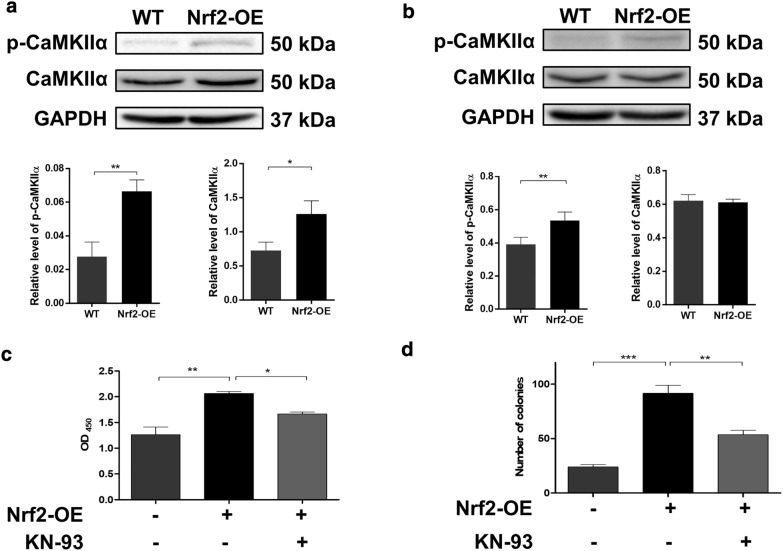
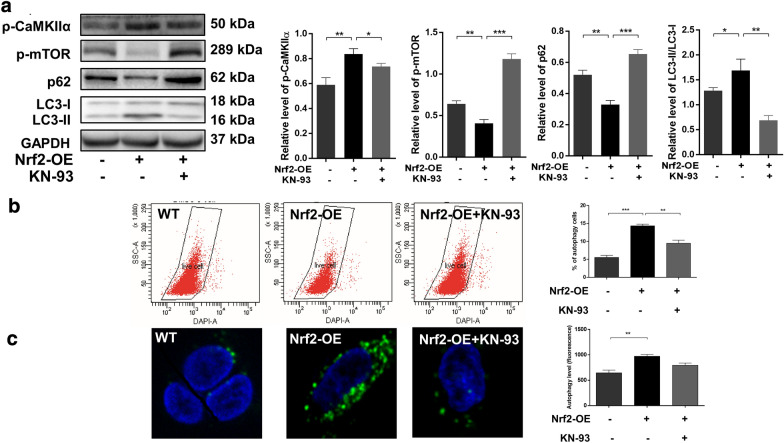
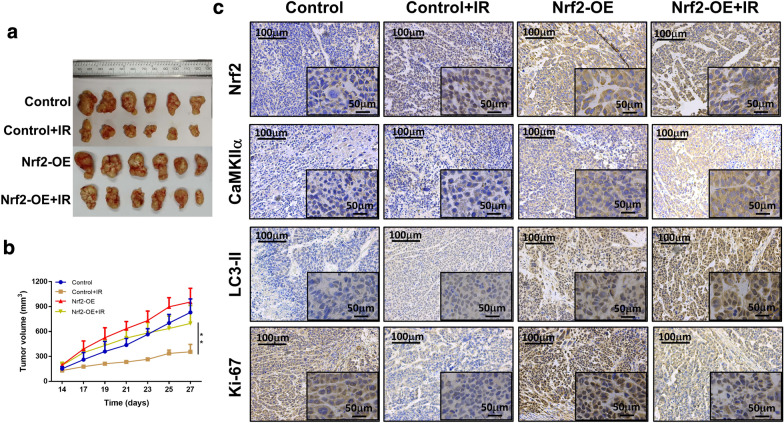
Nrf2 expression was introduced into Ec109 and KYSE-30 ESCC cells with lentivirus. CCK-8 and colony formation assays were used to evaluate the effect of Nrf2 on radioresistance in culture. The autophagy level was assessed by western blotting, flow cytometry, and confocal fluorescence microscopy. The effect of Nrf2 on the transcription of Ca2 +/calmodulin-dependent protein kinase II α (CaMKIIα) was studied by chromatin immunoprecipitation. We found that the overexpression of Nrf2 increased the radiation resistance of ESCC cells. Mechanistically, Nrf2 triggered the radiation resistance of ESCC cells by targeting CaMKIIα and subsequently activating autophagy. In addition, we found that Nrf2 directly regulated the transcription of CaMKIIα by binding to its promoter region. The effect of Nrf2 on radiation resistance was also explored in both a xenograft mouse model and ESCC patient samples. Consistent with the results of the in vitro study, high Nrf2 expression level resulted in in vivo radioresistance in an Ec109-derived xenograft mouse model. Furthermore, we also demonstrated that upregulations of both Nrf2 and CaMKIIα was closely related to lower survival rates of ESCC patients.
Our study reveals that Nrf2 promotes the radiation resistance of ESCC by targeting CaMKIIα and subsequently activating autophagy, which is characterized by the suppression of phosphorylated mTOR and p62, activation of Beclin 1, and transformation of LC3-I to LC3-II.
NF-E2相关因子2(Nrf2)参与食管鳞状细胞癌(ESCC)的辐射抗性,但潜在的分子机制尚不清楚。我们研究的目的是探讨Nrf2在ESCC辐射抗性中的作用及潜在的分子机制。
用慢病毒将Nrf2表达导入Ec109和KYSE-30 ESCC细胞。采用CCK-8和集落形成试验评估Nrf2对培养物中辐射抗性的影响。通过蛋白质印迹、流式细胞术和共聚焦荧光显微镜评估自噬水平。通过染色质免疫沉淀研究Nrf2对Ca2+/钙调蛋白依赖性蛋白激酶IIα(CaMKIIα)转录的影响。我们发现Nrf2的过表达增加了ESCC细胞的辐射抗性。机制上,Nrf2通过靶向CaMKIIα并随后激活自噬来触发ESCC细胞的辐射抗性。此外,我们发现Nrf2通过与其启动子区域结合直接调节CaMKIIα的转录。还在异种移植小鼠模型和ESCC患者样本中探讨了Nrf2对辐射抗性的影响。与体外研究结果一致,在Ec109衍生的异种移植小鼠模型中,高Nrf2表达水平导致体内辐射抗性。此外,我们还证明Nrf2和CaMKIIα的上调均与ESCC患者较低的生存率密切相关。
我们的研究表明,Nrf2通过靶向CaMKIIα并随后激活自噬来促进ESCC的辐射抗性,其特征是磷酸化mTOR和p62的抑制、Beclin 1的激活以及LC3-I向LC3-II的转化。