Department of Immunogenetics, Institute of Tropical Medicine (NEKKEN), Nagasaki University, Japan; Graduate School of Biomedical Sciences, Nagasaki University, Japan.
Department of Molecular Infection Dynamics, Shionogi Global Infectious Diseases Division, Institute of Tropical Medicine (NEKKEN), Nagasaki University, Japan; School of Tropical Medicine and Global Health, Nagasaki University, Japan; Department of Biomedical Chemistry, Graduate School of Medicine, The University of Tokyo, Japan.
Biochim Biophys Acta Bioenerg. 2020 Nov 1;1861(11):148283. doi: 10.1016/j.bbabio.2020.148283. Epub 2020 Aug 4.
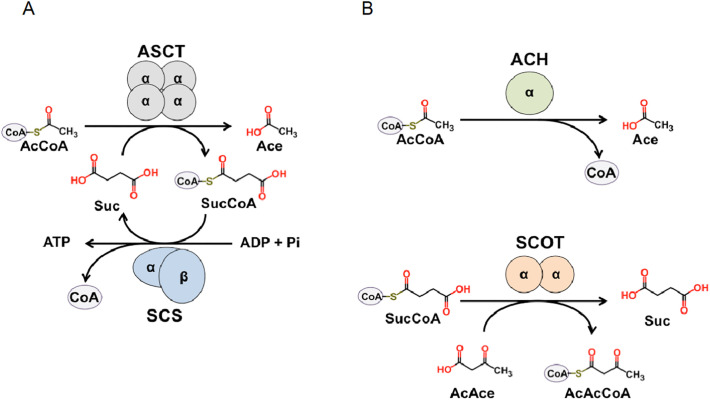
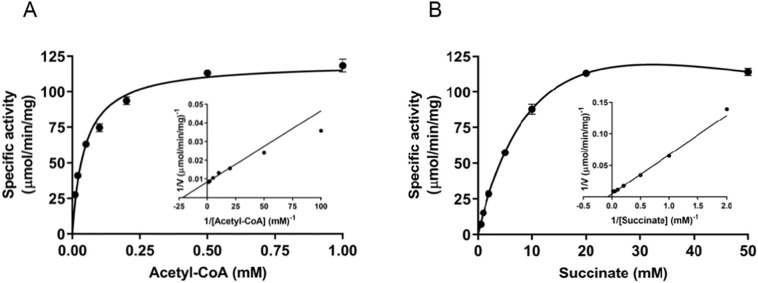
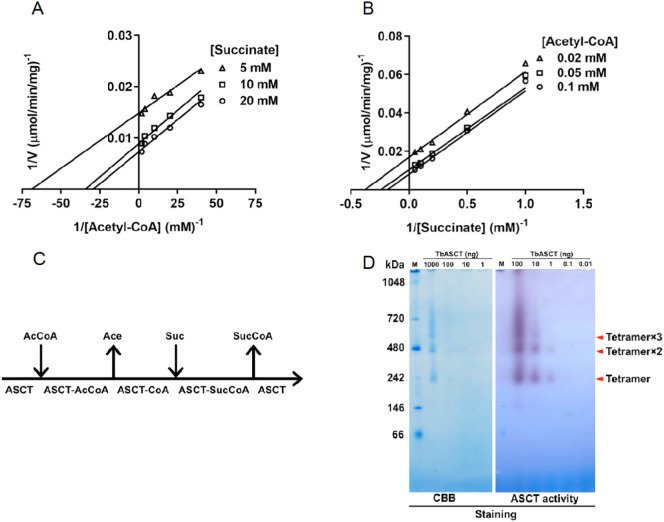
Acetate:succinate CoA transferase (ASCT) is a mitochondrial enzyme that catalyzes the production of acetate and succinyl-CoA, which is coupled to ATP production with succinyl-CoA synthetase (SCS) in a process called the ASCT/SCS cycle. This cycle has been studied in Trypanosoma brucei (T. brucei), a pathogen of African sleeping sickness, and is involved in (i) ATP and (ii) acetate production and proceeds independent of oxygen and an electrochemical gradient. Interestingly, knockout of ASCT in procyclic form (PCF) of T. brucei cause oligomycin A-hypersensitivity phenotype indicating that ASCT/SCS cycle complements the deficiency of ATP synthase activity. In bloodstream form (BSF) of T. brucei, ATP synthase works in reverse to maintain the electrochemical gradient by hydrolyzing ATP. However, no information has been available on the source of ATP, although ASCT/SCS cycle could be a potential candidate. Regarding mitochondrial acetate production, which is essential for fatty acid biosynthesis and growth of T. brucei, ASCT or acetyl-CoA hydrolase (ACH) are known to be its source. Despite the importance of this cycle, direct evidence of its function is lacking, and there are no comprehensive biochemical or structural biology studies reported so far. Here, we show that in vitro-reconstituted ASCT/SCS cycle is highly specific towards acetyl-CoA and has a higher k than that of yeast and bacterial ATP synthases. Our results provide the first biochemical basis for (i) rescue of ATP synthase-deficient phenotype by ASCT/SCS cycle in PCF and (ii) a potential source of ATP for the reverse reaction of ATP synthase in BSF.
乙酰辅酶 A:琥珀酰辅酶 A 转移酶(ASCT)是一种线粒体酶,可催化生成乙酰辅酶 A 和琥珀酰辅酶 A,这与通过琥珀酰辅酶 A 合成酶(SCS)与 ATP 生成偶联,形成 ASCT/SCS 循环。该循环在非洲昏睡病病原体锥虫(T. brucei)中进行了研究,涉及(i)ATP 和(ii)乙酰辅酶 A 的产生,并且独立于氧气和电化学梯度进行。有趣的是,在锥虫的前鞭毛体(PCF)中敲除 ASCT 会导致寡霉素 A 超敏表型,表明 ASCT/SCS 循环可弥补 ATP 合酶活性的不足。在锥虫的血液体(BSF)中,ATP 合酶通过水解 ATP 来反向工作以维持电化学梯度。然而,尚无关于 ATP 来源的信息,尽管 ASCT/SCS 循环可能是一个潜在的候选者。关于线粒体乙酰辅酶 A 的产生,这对脂肪酸生物合成和锥虫的生长至关重要,已知 ASCT 或乙酰辅酶 A 水解酶(ACH)是其来源。尽管该循环很重要,但缺乏其功能的直接证据,并且迄今为止尚无全面的生化或结构生物学研究报告。在这里,我们表明体外重建的 ASCT/SCS 循环对乙酰辅酶 A 具有高度特异性,并且比酵母和细菌 ATP 合酶的 k 值更高。我们的结果为(i)ASCT/SCS 循环在 PCF 中挽救 ATP 合酶缺陷表型和(ii)BSF 中 ATP 合酶的反向反应的潜在 ATP 来源提供了第一个生化基础。