Global Health and Development Group, Imperial College London, London, UK.
Department of Surgery, WHO Collaboration Centre for Research in Surgical Care Delivery in LMIC, Bhabha Atomic Research Centre Hospital, Mumbai, India
BMJ Open Qual. 2020 Aug;9(3). doi: 10.1136/bmjoq-2019-000893.
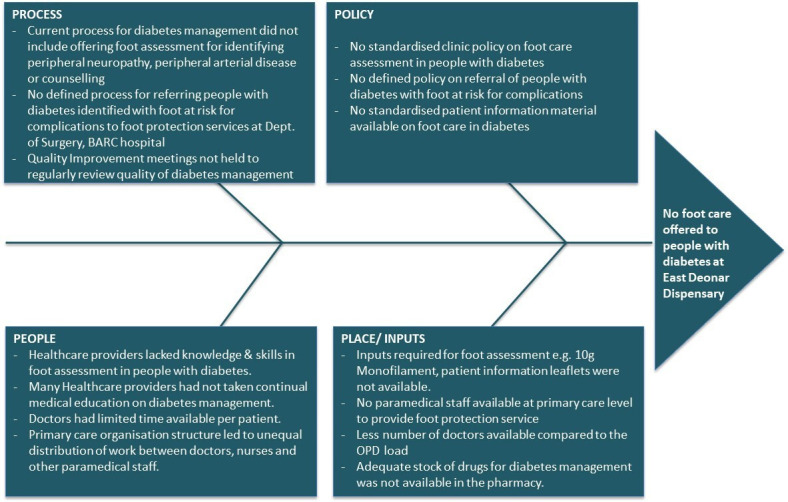
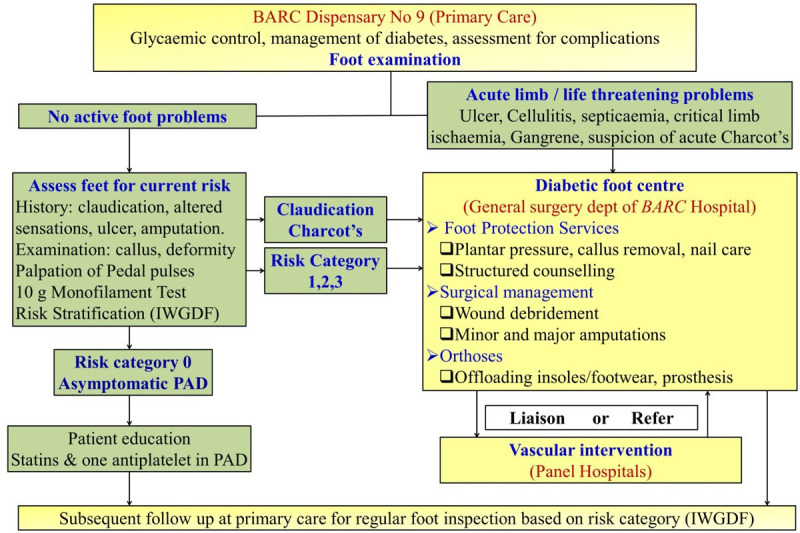
The majority of foot amputations are preventable in people with diabetes. Guidelines recommend that people with diabetes should receive a foot examination for risk assessment, at least annually. In an audit at a primary health centre (PHC) in Mumbai, India, no patient with diabetes was offered preventive foot assessment in preceding 12 months. Problem analysis identified a lack of clinic policy, training and equipment for foot assessment. There was no standardised referral pathway for patients identified with foot at risk of diabetes complications. Furthermore, limited data review, high patient volumes and little time available with healthcare providers were important constraints. A quality improvement project was carried out at the PHC from January to September 2017. The project aimed at increasing compliance to standardised foot assessment in patients with diabetes presenting to the PHC from a baseline of 0% to 100% over 6 months. This would help identify patients having a foot at risk of complications due to diabetes. The Quality Standard on foot assessment was adopted from the Ministry of Health and Family Welfare Diabetic Foot Guideline. The electronic medical record (EMR) was standardised, health providers were trained, PHC processes and referral pathways were redesigned. Plan-Do-Study-Act was used to address barriers with weekly data review. 88.2% (848) of patients with diabetes visiting the PHC during the study period received a foot examination. Out of these, 11% (95) were identified to have a foot at risk and referred to a specialist foot centre. 57% of referred patients followed with specialised foot protection services. Training of healthcare providers, standardisation of processes and regular data feedback can improve diabetic foot care. Integrating quality indicators in the EMR helps monitor compliance. The inability to use doctor's time efficiently was the biggest challenge and sustaining the change will require organisational changes with suitable task shifting.
大多数糖尿病患者的足部截肢是可以预防的。指南建议,糖尿病患者应至少每年进行一次足部检查以评估风险。在印度孟买的一个初级保健中心(PHC)进行的审计中,过去 12 个月内没有为任何糖尿病患者提供预防性足部评估。问题分析发现,缺乏足部评估的诊所政策、培训和设备。对于有糖尿病并发症风险的足部患者,没有标准化的转诊途径。此外,数据审查有限、患者数量多以及医疗保健提供者可支配的时间少也是重要的限制因素。2017 年 1 月至 9 月,在 PHC 开展了一项质量改进项目。该项目的目的是在 6 个月内,将接受 PHC 治疗的糖尿病患者接受标准化足部评估的符合率从 0%提高到 100%。这将有助于发现有足部并发症风险的患者。足部评估的质量标准是从卫生部和家庭福利部的糖尿病足指南中采用的。标准化了电子病历(EMR),对卫生保健提供者进行了培训,重新设计了 PHC 流程和转诊途径。使用计划-执行-研究-行动来解决每周数据审查中的障碍。在研究期间,有 88.2%(848 名)糖尿病患者到 PHC 就诊,接受了足部检查。其中,11%(95 名)被认为足部有风险,并被转介到专门的足部中心。57%的转诊患者接受了专门的足部保护服务。培训医疗保健提供者、标准化流程和定期数据反馈可以改善糖尿病足护理。在电子病历中整合质量指标有助于监测依从性。有效利用医生时间的能力不足是最大的挑战,要维持这种改变需要进行组织变革,并进行适当的任务转移。