Ness-Jensen Eivind, Santoni Giola, Gottlieb-Vedi Eivind, Lindam Anna, Pedersen Nancy, Lagergren Jesper
Upper Gastrointestinal Research, Department of Molecular Medicine and Surgery, Karolinska Institute, Stockholm, Sweden
HUNT Research Centre, Department of Public Health and Nursing, NTNU, Norwegian University of Science and Technology, Levanger, Norway.
BMJ Open. 2020 Aug 6;10(8):e037456. doi: 10.1136/bmjopen-2020-037456.
The public health disorder gastro-oesophageal reflux disease (GORD) is linked with several comorbidities, including oesophageal adenocarcinoma (OAC), but whether life expectancy is reduced by GORD is uncertain. This study assessed all-cause and cancer-specific mortality in GORD after controlling for confounding by heredity and other factors.
Population-based cohort study from 1998 to 2015.
Swedish nationwide study.
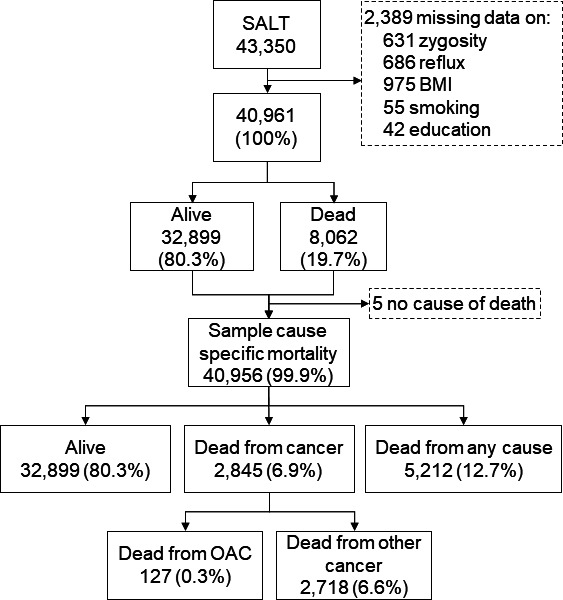
Twins (n=40 961) born in 1958 or earlier in Sweden.
GORD symptoms reported in structured computer-assisted telephone interviews.
The primary outcome was all-cause mortality and the secondary outcome was cancer-specific mortality among twins with GORD and twins without GORD. HRs and 95% CIs were analysed using parametric survival models, both in individual twin analyses and co-twin pair analyses, with adjustment for body mass index, smoking, education and comorbidity.
Among 40 961 individual twins, 5812 (14.2%) had GORD at baseline and 8062 (19.7%) died during follow-up of up to 16 years. The risks of all-cause mortality (HR=1.00, 95% CI: 0.94-1.07) and cancer-specific mortality (HR=0.99, 95% CI: 0.89-1.10) were not increased in individual twins with GORD compared with individual twins without GORD. Similarly, there were no differences in mortality outcomes in within-pair analyses. The OAC-specific mortality rate was 0.45 (95% CI: 0.32-0.66) per 1000 person-years in individual twins with GORD and 0.22 (95% CI: 0.18-0.27) per 1000 person-years without GORD, rendering an adjusted HR of 2.01 (95% CI: 1.35-2.98).
GORD did not increase all-cause or cancer-specific mortality when taking heredity and other confounders into account. The increased relative risk of mortality in OAC was low in absolute numbers.
公共卫生疾病胃食管反流病(GORD)与多种合并症相关,包括食管腺癌(OAC),但GORD是否会缩短预期寿命尚不确定。本研究在控制遗传和其他因素的混杂影响后,评估了GORD患者的全因死亡率和癌症特异性死亡率。
1998年至2015年基于人群的队列研究。
瑞典全国性研究。
1958年或更早出生在瑞典的双胞胎(n = 40961)。
在结构化计算机辅助电话访谈中报告的GORD症状。
主要结局是全因死亡率,次要结局是患有GORD和未患有GORD的双胞胎中的癌症特异性死亡率。使用参数生存模型分析风险比(HRs)和95%置信区间(CIs),包括个体双胞胎分析和双胞胎配对分析,并对体重指数、吸烟、教育程度和合并症进行调整。
在40961名个体双胞胎中,5812名(14.2%)在基线时患有GORD,8062名(19.7%)在长达16年的随访期间死亡。与未患有GORD的个体双胞胎相比,患有GORD的个体双胞胎的全因死亡率风险(HR = 1.00,95% CI:0.94 - 1.07)和癌症特异性死亡率风险(HR = 0.99,95% CI:0.89 - 1.10)并未增加。同样,在配对分析中死亡率结局也没有差异。患有GORD的个体双胞胎中OAC特异性死亡率为每1000人年0.45(95% CI:0.32 - 0.66),未患有GORD的为每1000人年0.22(95% CI:0.18 - 0.27),调整后的HR为2.01(95% CI:1.35 - 2.98)。
在考虑遗传和其他混杂因素后,GORD并未增加全因死亡率或癌症特异性死亡率。OAC中增加的相对死亡风险绝对值较低。