• 文献检索
  • 文档翻译
  • 深度研究
  • 学术资讯
  • Suppr Zotero 插件Zotero 插件
  • 邀请有礼
  • 套餐&价格
  • 历史记录
应用&插件
Suppr Zotero 插件Zotero 插件浏览器插件Mac 客户端Windows 客户端微信小程序
定价
高级版会员购买积分包购买API积分包
服务
文献检索文档翻译深度研究API 文档MCP 服务
关于我们
关于 Suppr公司介绍联系我们用户协议隐私条款
关注我们

Suppr 超能文献

核心技术专利:CN118964589B侵权必究
粤ICP备2023148730 号-1Suppr @ 2026

文献检索

告别复杂PubMed语法,用中文像聊天一样搜索,搜遍4000万医学文献。AI智能推荐,让科研检索更轻松。

立即免费搜索

文件翻译

保留排版,准确专业,支持PDF/Word/PPT等文件格式,支持 12+语言互译。

免费翻译文档

深度研究

AI帮你快速写综述,25分钟生成高质量综述,智能提取关键信息,辅助科研写作。

立即免费体验

质子泵抑制剂维持治疗与瑞典全因及特定原因死亡率增加相关。

Maintenance Proton Pump Inhibitor Use Associated with Increased All-Cause and Cause-Specific Mortality in Sweden.

机构信息

Centre for Translational Microbiome Research, Department of Microbiology, Tumour and Cell Biology, Karolinska Institutet, Biomedicum A8, Solnavägen 9, 171 65, Stockholm, Sweden.

Department of Family Medicine and Population Health, University of Antwerp, Universiteitsplein 1, 2610, Antwerp, Belgium.

出版信息

Dig Dis Sci. 2023 Jun;68(6):2252-2263. doi: 10.1007/s10620-023-07820-9. Epub 2023 Jan 11.

DOI:10.1007/s10620-023-07820-9
PMID:36629968
原文链接:https://pmc.ncbi.nlm.nih.gov/articles/PMC10188584/
Abstract

BACKGROUND

Proton pump inhibitor (PPI) use has increased over the last decades and has been associated with multiple adverse events and potentially even overall survival.

AIMS

We aimed to investigate the association between proton pump inhibitor maintenance use and all-cause and cause-specific mortality, addressing confounding by indication and duration of use.

METHODS

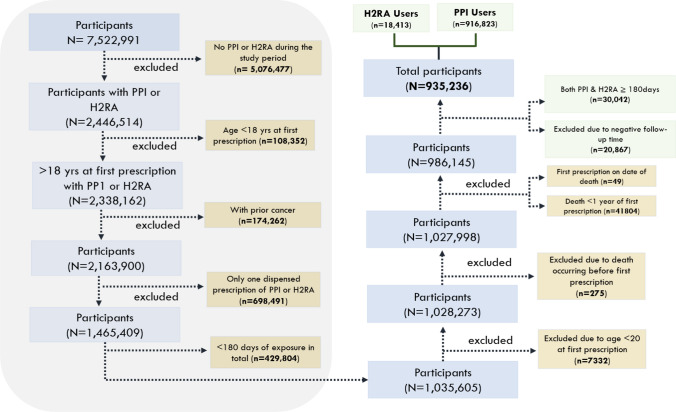
This Swedish population-based cohort study included all adult (N = 935,236) PPI and histamine-2 receptor antagonist maintenance users (≥ 180 days use) during 2005-2014. Standardised mortality ratios (SMRs) and 95% confidence intervals were calculated for all-cause and cause-specific mortality comparing the risk among PPI/H2RA users to that of the Swedish background population, stratified by age, sex, calendar period, indication and duration of use. Multivariable Poisson regression models were used to compare PPI use to H2RA use, expressed as incidence rate ratios and 95% confidence intervals.

RESULTS

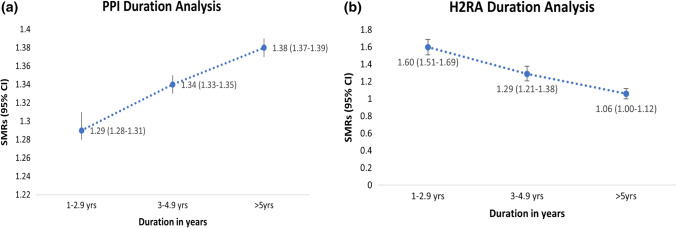
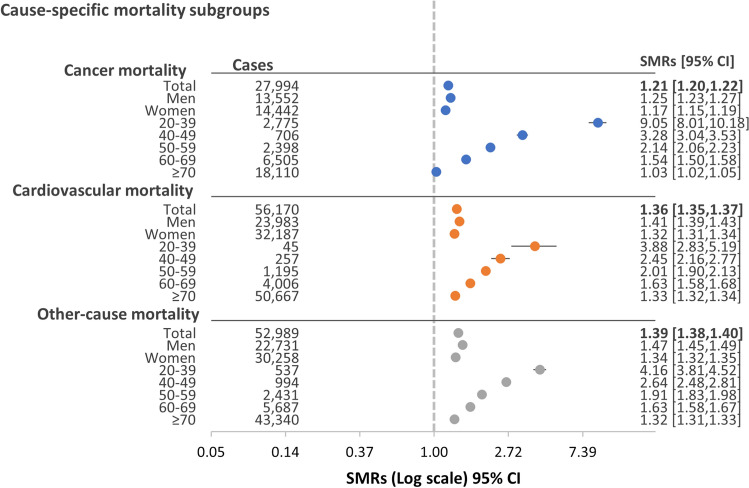
PPI and histamine-2 receptor antagonist use were associated with an increased risk of all-cause mortality (SMR = 1.35; 1.34-1.36; SMR = 1.31; 1.27-1.36, respectively). The highest SMRs were found in the youngest age groups. In direct comparison, PPI use showed a higher mortality risk than histamine-2 receptor antagonist use (incidence rate ratios = 1.42; 1.38-1.46). PPIs were related to increased cancer (SMR = 1.21; 1.20-1.22), and cardiovascular mortality (SMR = 1.36; 1.35-1.37). Increased SMRs were observed for most indications. Longer duration of use was associated with a higher mortality among PPI users but not among histamine-2 receptor antagonist users.

CONCLUSION

Maintenance PPI use was associated with an increased risk of all-cause and cause-specific mortality, and the risk increased with prolonged duration.

摘要

背景

质子泵抑制剂(PPI)的使用在过去几十年中有所增加,并与多种不良事件甚至整体生存率相关。

目的

我们旨在研究质子泵抑制剂维持治疗与全因和病因特异性死亡率之间的关联,同时解决适应证和使用时间的混杂因素。

方法

本项基于人群的瑞典队列研究纳入了 2005 年至 2014 年期间所有(N=935236)接受质子泵抑制剂和组胺 2 受体拮抗剂(≥180 天)维持治疗的成年患者。通过比较 PPI/H2RA 使用者与瑞典背景人群的全因和病因特异性死亡率的标准化死亡率比(SMR)和 95%置信区间,按年龄、性别、日历时间、适应证和使用时间进行分层。采用多变量泊松回归模型比较 PPI 与 H2RA 的使用,结果表示为发病率比值和 95%置信区间。

结果

PPI 和组胺 2 受体拮抗剂的使用与全因死亡率增加相关(SMR=1.35;1.34-1.36;SMR=1.31;1.27-1.36)。最高的 SMR 见于最年轻的年龄组。直接比较显示,PPI 治疗的死亡率风险高于组胺 2 受体拮抗剂(发病率比值=1.42;1.38-1.46)。PPIs 与癌症(SMR=1.21;1.20-1.22)和心血管死亡率(SMR=1.36;1.35-1.37)增加相关。大多数适应证与 SMR 增加相关。PPI 使用者的使用时间延长与死亡率增加相关,但组胺 2 受体拮抗剂使用者无此关联。

结论

质子泵抑制剂维持治疗与全因和病因特异性死亡率增加相关,且风险随使用时间延长而增加。
https://cdn.ncbi.nlm.nih.gov/pmc/blobs/a470/10188584/55fb8edc6ab3/10620_2023_7820_Fig3_HTML.jpg
https://cdn.ncbi.nlm.nih.gov/pmc/blobs/a470/10188584/f59110d686c6/10620_2023_7820_Fig1_HTML.jpg
https://cdn.ncbi.nlm.nih.gov/pmc/blobs/a470/10188584/7559a2f177d3/10620_2023_7820_Fig2_HTML.jpg
https://cdn.ncbi.nlm.nih.gov/pmc/blobs/a470/10188584/55fb8edc6ab3/10620_2023_7820_Fig3_HTML.jpg
https://cdn.ncbi.nlm.nih.gov/pmc/blobs/a470/10188584/f59110d686c6/10620_2023_7820_Fig1_HTML.jpg
https://cdn.ncbi.nlm.nih.gov/pmc/blobs/a470/10188584/7559a2f177d3/10620_2023_7820_Fig2_HTML.jpg
https://cdn.ncbi.nlm.nih.gov/pmc/blobs/a470/10188584/55fb8edc6ab3/10620_2023_7820_Fig3_HTML.jpg

相似文献

1
Maintenance Proton Pump Inhibitor Use Associated with Increased All-Cause and Cause-Specific Mortality in Sweden.质子泵抑制剂维持治疗与瑞典全因及特定原因死亡率增加相关。
Dig Dis Sci. 2023 Jun;68(6):2252-2263. doi: 10.1007/s10620-023-07820-9. Epub 2023 Jan 11.
2
Maintenance therapy with proton pump inhibitors and risk of gastric cancer: a nationwide population-based cohort study in Sweden.质子泵抑制剂维持治疗与胃癌风险:瑞典一项基于全国人口的队列研究
BMJ Open. 2017 Oct 30;7(10):e017739. doi: 10.1136/bmjopen-2017-017739.
3
Maintenance proton pump inhibitor use and risk of colorectal cancer: a Swedish retrospective cohort study.维持质子泵抑制剂使用与结直肠癌风险:一项瑞典回顾性队列研究。
BMJ Open. 2024 Jul 2;14(7):e079591. doi: 10.1136/bmjopen-2023-079591.
4
Use of Proton Pump Inhibitors vs Histamine 2 Receptor Antagonists for the Risk of Gastric Cancer: Population-Based Cohort Study.质子泵抑制剂与组胺 2 受体拮抗剂用于胃癌风险:基于人群的队列研究。
Am J Gastroenterol. 2021 Jun 1;116(6):1211-1219. doi: 10.14309/ajg.0000000000001167.
5
Proton pump inhibitors and risk of all-cause and cause-specific mortality: A cohort study.质子泵抑制剂与全因及特定原因死亡率的关系:一项队列研究。
Br J Clin Pharmacol. 2021 Aug;87(8):3150-3161. doi: 10.1111/bcp.14728. Epub 2021 Feb 4.
6
Histamine-2 Receptor Antagonists and Proton Pump Inhibitors Are Associated With Reduced Risk of SARS-CoV-2 Infection Without Comorbidities Including Diabetes, Hypertension, and Dyslipidemia: A Propensity Score-Matched Nationwide Cohort Study.组胺 2 受体拮抗剂和质子泵抑制剂与 SARS-CoV-2 感染风险降低相关,无论是否存在糖尿病、高血压和血脂异常等合并症:一项倾向评分匹配的全国队列研究。
J Korean Med Sci. 2023 Apr 3;38(13):e99. doi: 10.3346/jkms.2023.38.e99.
7
Long-term proton pump inhibitor usage and the association with pancreatic cancer in Sweden.长期质子泵抑制剂使用与瑞典胰腺癌的关联。
J Gastroenterol. 2020 Apr;55(4):453-461. doi: 10.1007/s00535-019-01652-z. Epub 2019 Dec 6.
8
Proton Pump Inhibitor Use, H-Receptor Antagonist Use, and Risk of Incident Clinical Vertebral Fracture in Women.质子泵抑制剂的使用、H2 受体拮抗剂的使用与女性临床椎体骨折发生率的关系。
Calcif Tissue Int. 2018 Oct;103(4):380-387. doi: 10.1007/s00223-018-0432-2. Epub 2018 May 12.
9
Proton pump inhibitor use and risk of pneumonia: a self-controlled case series study.质子泵抑制剂的使用与肺炎风险:一项自身对照病例系列研究。
J Gastroenterol. 2023 Aug;58(8):734-740. doi: 10.1007/s00535-023-02007-5. Epub 2023 Jun 14.
10
Effect of proton pump inhibitors versus histamine-2 receptor antagonists on acute kidney injury in septic patients at high risk for developing stress ulcers.质子泵抑制剂与组胺 2 受体拮抗剂对高风险发生应激性溃疡的脓毒症患者急性肾损伤的影响。
Pharmacotherapy. 2024 Jul;44(7):539-548. doi: 10.1002/phar.2947. Epub 2024 Jun 20.

引用本文的文献

1
Prenatal and Early Childhood Exposure to Proton Pump Inhibitors and Antibiotics and the Risk of Childhood Cancer: A Nationwide Population-Based Cohort Study.产前及幼儿期暴露于质子泵抑制剂和抗生素与儿童癌症风险:一项基于全国人口的队列研究。
Drug Saf. 2025 Apr;48(4):375-388. doi: 10.1007/s40264-024-01500-x. Epub 2024 Dec 12.
2
Trends in Proton Pump Inhibitor Use in Sweden by Sex and Age: A Drug Utilisation Study.瑞典按性别和年龄划分的质子泵抑制剂使用趋势:一项药物利用研究。
Drug Saf. 2025 Apr;48(4):389-400. doi: 10.1007/s40264-024-01502-9. Epub 2024 Dec 8.
3
Significance of serological atrophic gastritis on proton pump inhibitor prescriptions and referrals to gastroscopy in the general population.

本文引用的文献

1
Association between proton-pump inhibitors and the risk of gastric cancer: a systematic review with meta-analysis.质子泵抑制剂与胃癌风险之间的关联:一项系统评价与荟萃分析
Therap Adv Gastroenterol. 2021 Nov 10;14:17562848211051463. doi: 10.1177/17562848211051463. eCollection 2021.
2
Proton pump inhibitors and survival in patients with colorectal cancer: a Swedish population-based cohort study.质子泵抑制剂与结直肠癌患者的生存:一项瑞典基于人群的队列研究。
Br J Cancer. 2021 Sep;125(6):893-900. doi: 10.1038/s41416-021-01480-0. Epub 2021 Jul 12.
3
Umbrella review of 42 systematic reviews with meta-analyses: the safety of proton pump inhibitors.
血清学萎缩性胃炎在普通人群质子泵抑制剂处方及胃镜转诊中的意义。
JGH Open. 2024 Sep 2;8(9):e70022. doi: 10.1002/jgh3.70022. eCollection 2024 Sep.
4
The association between drugs and repeated treatment with budesonide in patients with microscopic colitis: a retrospective observational study.显微镜下结肠炎患者中药物与布地奈德重复治疗之间的关联:一项回顾性观察研究。
Therap Adv Gastroenterol. 2024 Mar 19;17:17562848241240640. doi: 10.1177/17562848241240640. eCollection 2024.
5
Timely Cessation of Proton Pump Inhibitors in Critically Ill Patients Impacts Morbidity and Mortality: A Propensity Score-Matched Cohort Study.危重症患者质子泵抑制剂及时停药对发病率和死亡率的影响:一项倾向评分匹配队列研究。
Crit Care Med. 2024 Feb 1;52(2):190-199. doi: 10.1097/CCM.0000000000006104. Epub 2024 Jan 19.
42 项系统评价和荟萃分析的伞状评价:质子泵抑制剂的安全性。
Aliment Pharmacol Ther. 2021 Jul;54(2):129-143. doi: 10.1111/apt.16407. Epub 2021 Jun 11.
4
Association Between Proton Pump Inhibitor Use and Biliary Tract Cancer Risk: A Swedish Population-Based Cohort Study.质子泵抑制剂的使用与胆道癌风险的关联:一项瑞典基于人群的队列研究。
Hepatology. 2021 Oct;74(4):2021-2031. doi: 10.1002/hep.31914. Epub 2021 Jul 13.
5
Proton pump inhibitors and risk of all-cause and cause-specific mortality: A cohort study.质子泵抑制剂与全因及特定原因死亡率的关系:一项队列研究。
Br J Clin Pharmacol. 2021 Aug;87(8):3150-3161. doi: 10.1111/bcp.14728. Epub 2021 Feb 4.
6
Do proton pump inhibitors increase mortality? A systematic review and in-depth analysis of the evidence.质子泵抑制剂是否会增加死亡率?系统评价及证据深度分析。
Pharmacol Res Perspect. 2020 Oct;8(5):e00651. doi: 10.1002/prp2.651.
7
Mortality in gastro-oesophageal reflux disease in a population-based nationwide cohort study of Swedish twins.基于瑞典双胞胎的全国性队列研究中胃食管反流病的死亡率
BMJ Open. 2020 Aug 6;10(8):e037456. doi: 10.1136/bmjopen-2020-037456.
8
Long-term use of proton-pump inhibitors: whole-of-population patterns in Australia 2013-2016.质子泵抑制剂的长期使用:2013 - 2016年澳大利亚的全人群模式
Therap Adv Gastroenterol. 2020 Mar 19;13:1756284820913743. doi: 10.1177/1756284820913743. eCollection 2020.
9
Use of proton pump inhibitors in adults in France: a nationwide drug utilization study.法国成年人质子泵抑制剂的使用:一项全国性药物利用研究。
Eur J Clin Pharmacol. 2020 Mar;76(3):449-457. doi: 10.1007/s00228-019-02810-1. Epub 2019 Dec 14.
10
Long-term proton pump inhibitor usage and the association with pancreatic cancer in Sweden.长期质子泵抑制剂使用与瑞典胰腺癌的关联。
J Gastroenterol. 2020 Apr;55(4):453-461. doi: 10.1007/s00535-019-01652-z. Epub 2019 Dec 6.