Department of Food, Nutrition, Dietetics and Health, Kansas State University, Manhattan, KS 66506, USA.
Elmore Consulting, Columbia, MO 65202, USA.
Int J Environ Res Public Health. 2020 Aug 5;17(16):5641. doi: 10.3390/ijerph17165641.
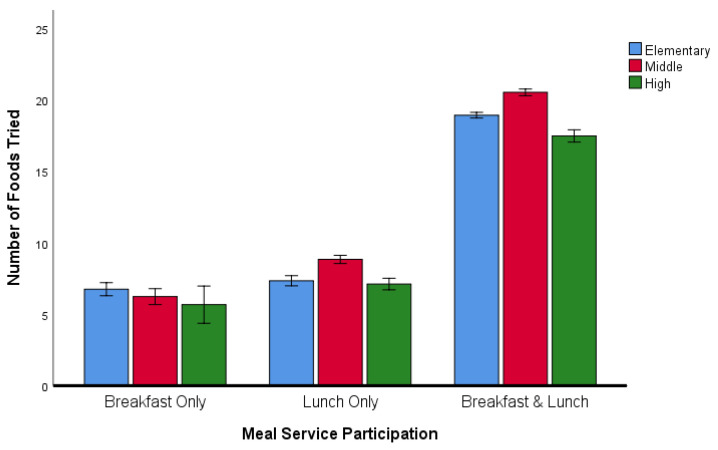
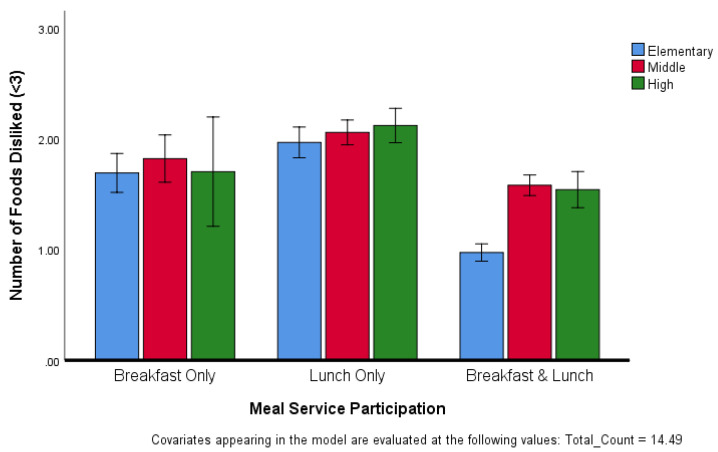
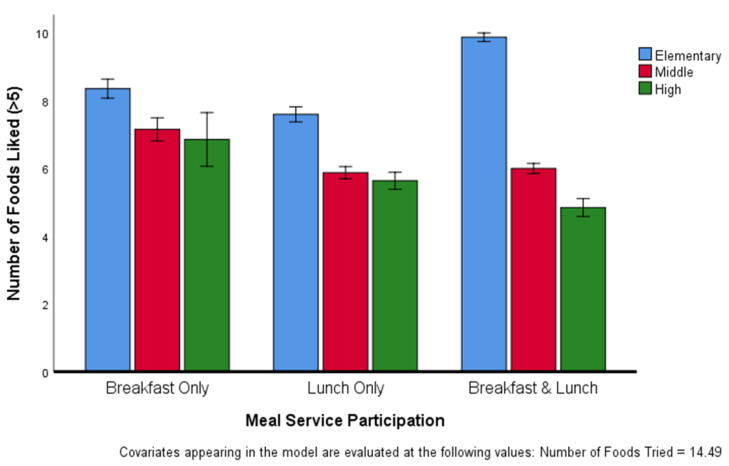
School-based child nutrition programs provide students with meals and snacks that align with guidelines for a healthy eating pattern. However, participation is not universal, and research on the determinants of food selection is needed to improve school nutrition practices and policies. The purpose of this study was to examine the relationships between grade level (i.e., grade school, middle school, or high school) as well as meal participation category (i.e., only breakfast, only lunch, or both) and food trying and liking in a large urban school district. Outcomes were measured using an online survey completed by students from 2nd through 12th grade ( = 21,540). Breakfast and lunch item liking scores were higher among the grade school and middle school students than among the high school students. Breakfast and lunch liking scores were also higher among those who participated in both breakfast and lunch as opposed to those who only participated in one meal. Food item liking scores were positively correlated with the percentage of students who had tried the particular foods ( = 0.52, < 0.001), and the number of foods tried was dependent on both grade level and meal participation category (F(4, 21,531) = 10.994, < 0.001). In this survey of students, both grade level and meal participation category were found to be related to the liking of foods, while foods that were tried more often tended to be liked more. Future studies should consider grade level and meal participation when exploring student preferences. School nutrition programs should also consider these factors when assessing satisfaction.
学校为学生提供符合健康饮食模式指南的餐点和零食。然而,参与度并不普遍,需要研究食物选择的决定因素,以改善学校营养实践和政策。本研究的目的是探讨年级(即小学、初中或高中)以及用餐参与类别(即仅早餐、仅午餐或两者兼而有之)与食物尝试和喜爱之间的关系,研究对象是一个大型城市学区的学生。结果通过对 2 至 12 年级学生(=21540 人)进行在线调查来衡量。小学生和初中生对早餐和午餐的喜爱程度高于高中生。与仅参加一顿餐的学生相比,同时参加早餐和午餐的学生对早餐和午餐的喜爱程度更高。食物喜爱程度与尝试过特定食物的学生百分比呈正相关(=0.52,<0.001),尝试过的食物数量取决于年级和用餐参与类别(F(4,21531)=10.994,<0.001)。在这项针对学生的调查中,年级和用餐参与类别都与食物的喜爱程度有关,而尝试过的食物越多,往往越受喜爱。未来的研究应在探索学生偏好时考虑年级和用餐参与度。学校营养计划在评估满意度时也应考虑这些因素。