Department of Physical Therapy, Shizuoka, Faculty of Health Science, Tokoha University, Shizuoka 420-0911, Japan.
Anti-aging Center, Ginza Hospital, Tokyo 104-0061, Japan.
Int J Environ Res Public Health. 2020 Aug 5;17(16):5643. doi: 10.3390/ijerph17165643.
Aerobic exercise is known to reduce arterial stiffness; however, high-intensity resistance exercise is associated with increased arterial stiffness. Stretching exercises are another exercise modality, and their effect on arterial stiffness remains unclear. The purpose of this study was to determine whether stretching exercises reduce arterial stiffness in middle-aged and older adults, performing the first meta-analysis of currently available studies.
We searched the literature for randomized controlled trials (RCTs) and non-RCTs published up to January 2020 describing middle-aged and older adults who participated in a stretching intervention vs. controls without exercise training. The primary and secondary outcomes were changes in arterial stiffness and vascular endothelial function and hemodynamic status. Pooled mean differences (MDs) and standard MDs (SMDs) with 95% confidence intervals (CIs) between the intervention and control groups were calculated using a random effects model.
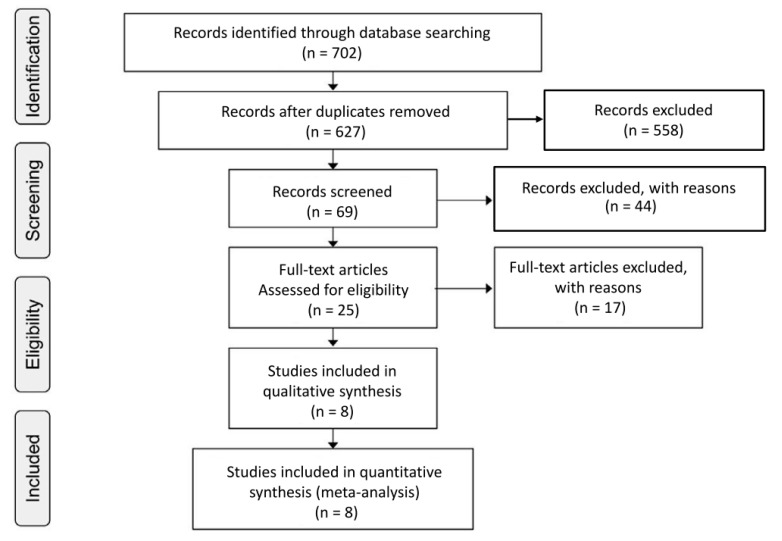
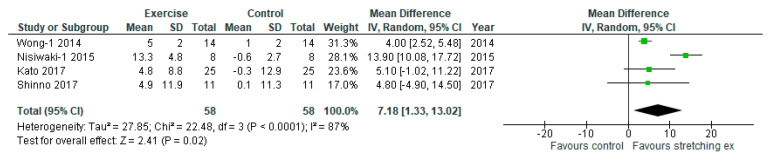
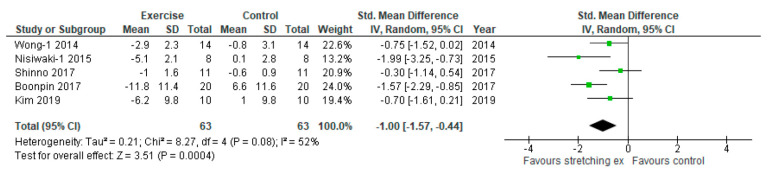
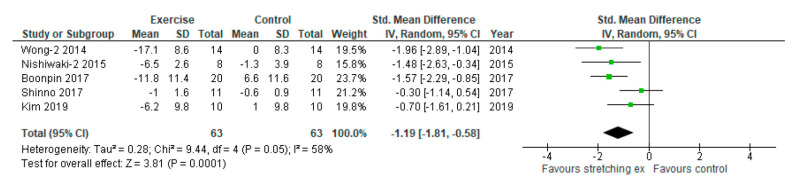
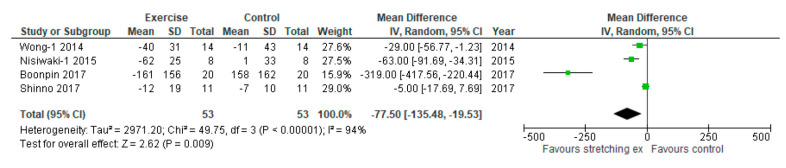
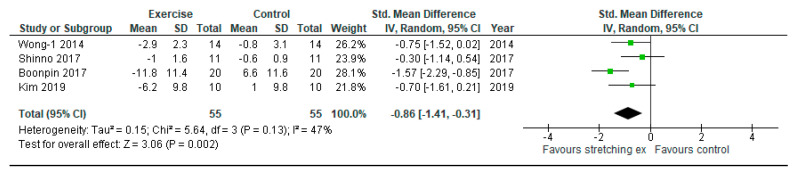
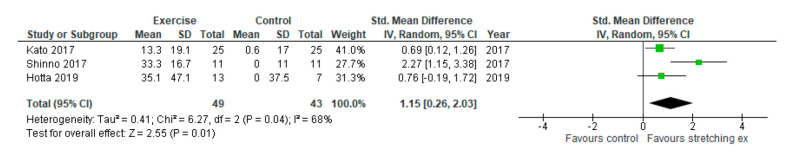
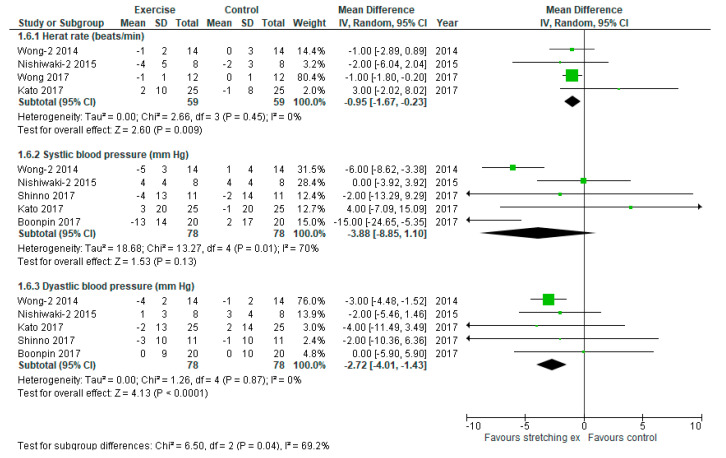
We identified 69 trials and, after an assessment of relevance, eight trials, including a combined total of 213 subjects, were analyzed. Muscle stretching exercises were shown to significantly reduce arterial stiffness and improve vascular endothelial function (SMD: -1.00, 95% CI: -1.57 to -0.44, = 0.0004; SMD: 1.15, 95% CI: 0.26 to 2.03, = 0.01, respectively). Resting heart rate (HR) and diastolic blood pressure (DBP) decreased significantly after stretching exercise intervention (MD: -0.95 beats/min, 95% CI: -1.67 to -0.23 beats/min, = 0.009; MD: -2.72 mm Hg, 95% CI: -4.01 to -1.43 mm Hg, < 0.0001, respectively) Conclusions: Our analyses suggest that stretching exercises reduce arterial stiffness, HR, and DBP, and improve vascular endothelial function in middle-aged and older adults.
有氧运动已被证实可降低动脉僵硬度;然而,高强度抗阻运动与动脉僵硬度增加有关。伸展运动是另一种运动方式,其对动脉僵硬度的影响尚不清楚。本研究旨在确定伸展运动是否可降低中年及以上人群的动脉僵硬度,这是对现有研究进行的首次荟萃分析。
我们检索了截至 2020 年 1 月发表的描述中年及以上人群参加伸展干预与无运动训练对照组的随机对照试验(RCT)和非 RCT 文献。主要和次要结局为动脉僵硬度和血管内皮功能以及血液动力学状态的变化。采用随机效应模型计算干预组与对照组之间的主要结局和次要结局的差异的合并均数(MD)和标准化 MD(SMD)及其 95%置信区间(CI)。
我们共确定了 69 项试验,在评估相关性后,对 8 项试验(共 213 例患者)进行了分析。肌肉伸展运动可显著降低动脉僵硬度并改善血管内皮功能(SMD:-1.00,95%CI:-1.57 至-0.44, = 0.0004;SMD:1.15,95%CI:0.26 至 2.03, = 0.01)。伸展运动干预后,静息心率(HR)和舒张压(DBP)显著降低(MD:-0.95 次/分,95%CI:-1.67 至-0.23 次/分, = 0.009;MD:-2.72mmHg,95%CI:-4.01 至-1.43mmHg, < 0.0001)。
我们的分析表明,伸展运动可降低中年及以上人群的动脉僵硬度、HR 和 DBP,并改善血管内皮功能。