Dunn Karen J, McCray Gareth
Assessment Research Group, British Council, London, United Kingdom.
School of Primary, Community and Social Care, Keele University, Keele, United Kingdom.
Front Psychol. 2020 Jul 17;11:1357. doi: 10.3389/fpsyg.2020.01357. eCollection 2020.
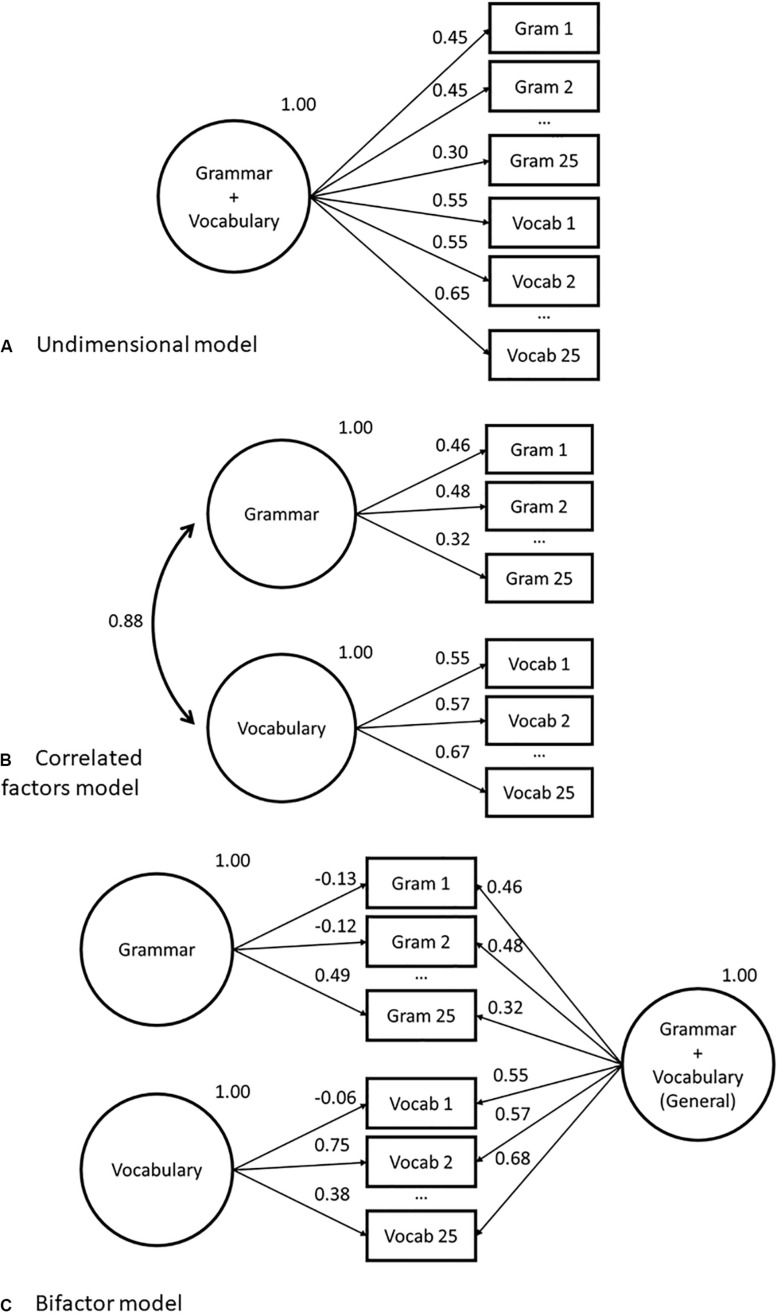
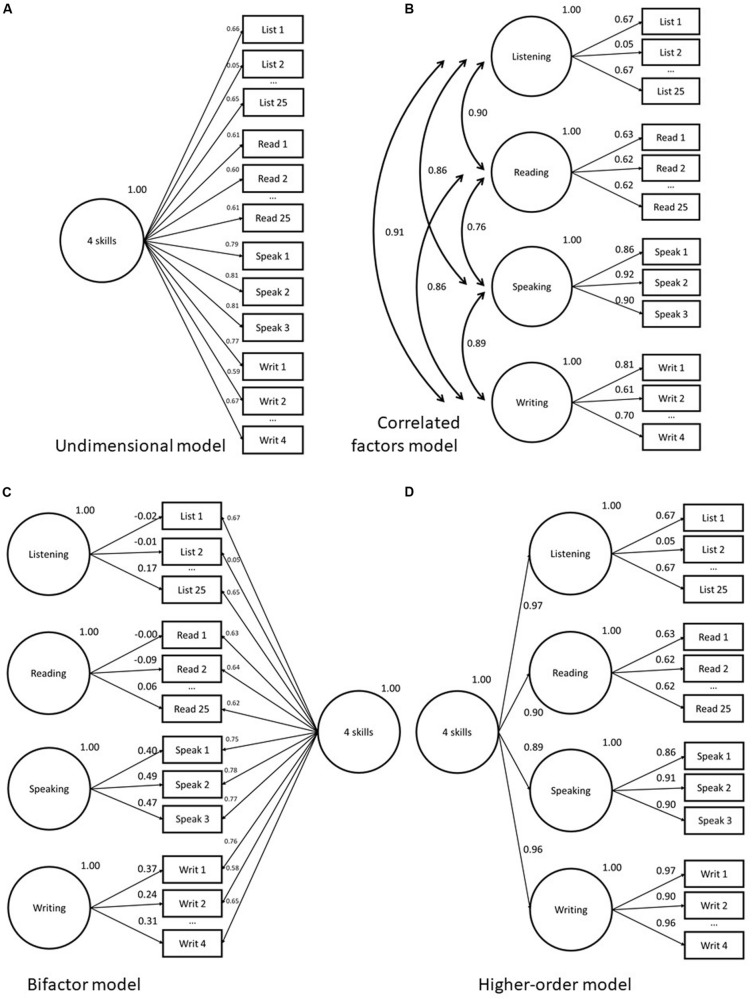
For practical and theoretical purposes, tests of second language (L2) ability commonly aim to measure one overarching trait, general language ability, while simultaneously measuring multiple sub-traits (e.g., reading, grammar, etc.). This tension between measuring uni- and multi-dimensional constructs concurrently can generate vociferous debate about the precise nature of the construct(s) being measured. In L2 testing, this tension is often addressed through the use of a higher-order factor model wherein multidimensional traits representing subskills load on a general ability latent trait. However, an alternative modeling framework that is currently uncommon in language testing, but gaining traction in other disciplines, is the bifactor model. The bifactor model hypothesizes a general factor, onto which all items load, and a series of orthogonal (uncorrelated) skill-specific grouping factors. The model is particularly valuable for evaluating the empirical plausibility of subscales and the practical impact of dimensionality assumptions on test scores. This paper compares a range of CFA model structures with the bifactor model in terms of theoretical implications and practical considerations, framed for the language testing audience. The models are illustrated using primary data from the British Council's Aptis English test. The paper is intended to spearhead the uptake of the bifactor model within the cadre of measurement models used in L2 language testing.
出于实践和理论目的,第二语言(L2)能力测试通常旨在衡量一个总体特征,即通用语言能力,同时测量多个子特征(如阅读、语法等)。在同时测量单维和多维结构之间的这种矛盾可能引发关于所测量结构的确切性质的激烈争论。在第二语言测试中,这种矛盾通常通过使用高阶因子模型来解决,在该模型中,代表子技能的多维特征加载到一个通用能力潜在特征上。然而,一种目前在语言测试中不常见但在其他学科中越来越受关注的替代建模框架是双因子模型。双因子模型假设一个所有项目都加载其上的一般因子,以及一系列正交(不相关)的特定技能分组因子。该模型对于评估子量表的实证合理性以及维度假设对测试分数的实际影响特别有价值。本文从理论意义和实际考虑方面,为语言测试受众构建框架,将一系列验证性因子分析(CFA)模型结构与双因子模型进行比较。使用英国文化协会的Aptis英语测试的原始数据对模型进行说明。本文旨在率先在第二语言测试中使用的测量模型框架内推广双因子模型的应用。