Wang Yu-Qing, Zhao Xiang-Yu
Peking University People's Hospital, Peking University Institute of Hematology, National Clinical Research Center for Hematologic Disease, Key Laboratory of Hematopoietic Stem Cell Transplantation, Beijing, China.
PKU-THU Center for Life Sciences, Academy for Advanced Interdisciplinary Studies, Peking University, Beijing, China.
Front Microbiol. 2020 Jul 14;11:1511. doi: 10.3389/fmicb.2020.01511. eCollection 2020.
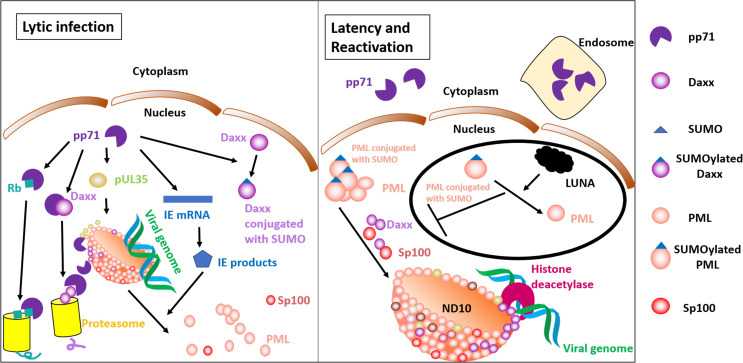
Human cytomegalovirus (HCMV), a ubiquitous beta-herpesvirus, is able to establish lifelong latency after initial infection. Periodical reactivation occurs after immunosuppression, remaining a major cause of death in immunocompromised patients. HCMV has to reach a structural and functional balance with the host at its earliest entry. Virion-carried mediators are considered to play pivotal roles in viral adaptation into a new cellular environment upon entry. Additionally, one clear difference between primary infection and reactivation is the idea that virion-packaged factors are already formed such that those molecules can be used swiftly by the virus. In contrast, virion-carried mediators have to be transcribed and translated; thus, they are not readily available during reactivation. Hence, understanding virion-carried molecules helps to elucidate HCMV reactivation. In this article, the impact of virion-packaged molecules on viral structure, biological behavior, and viral life cycle will be reviewed.
人巨细胞病毒(HCMV)是一种广泛存在的β疱疹病毒,初次感染后能够建立终身潜伏感染。免疫抑制后会出现周期性再激活,仍是免疫功能低下患者的主要死亡原因。HCMV在最早进入宿主时就必须与宿主达成结构和功能上的平衡。病毒体携带的介质被认为在病毒进入后适应新的细胞环境中起关键作用。此外,原发性感染和再激活之间的一个明显区别是,病毒体包装的因子已经形成,使得这些分子可以被病毒迅速利用。相比之下,病毒体携带的介质必须进行转录和翻译;因此,它们在再激活期间不易获得。因此,了解病毒体携带的分子有助于阐明HCMV再激活。在本文中,将综述病毒体包装分子对病毒结构、生物学行为和病毒生命周期的影响。