Zare Reza, Tanideh Nader, Nikahval Behrooz, Mirtalebi Maryam Sadat, Ahmadi Nasrollah, Zarea Shahrokh, Hosseinabadi Omid Koohi, Bhimani Rohan, Ashkani-Esfahani Soheil
Department of Veterinary Surgery, Shiraz University, Shiraz, Iran.
Stem Cells Technology Research Center, Shiraz University of Medical Sciences, Shiraz, Iran.
Int J Rheumatol. 2020 Jul 13;2020:9610261. doi: 10.1155/2020/9610261. eCollection 2020.
Osteoarthritis (OA) is a chronic disease and a significant cause of joint pain, tenderness, and limitation of motion. At present, no specific treatment is available, and mesenchymal stem cells (MSCs) have shown promising potentials in this regard. Herein, we aimed to evaluate the repairing potentials of stem cells derived from the synovium and fat pad in the treatment of OA.
Twenty-eight male rats (220 ± 20 g, aged 10-12 weeks), were randomly divided into four groups ( = 7): C1: nontreated group, C2: Hyalgan-treated group, E1: adipose tissue-derived stem cell-treated group, and E2: synovial membrane-based stem cell-treated group. Collagenase type II was injected into the left knee; after eight weeks, OA was developed. Then, stem cells were injected, and rats were followed for three months. Afterward, specimens and radiological images were investigated. value ≤ 0.05 was set as statistically significant.
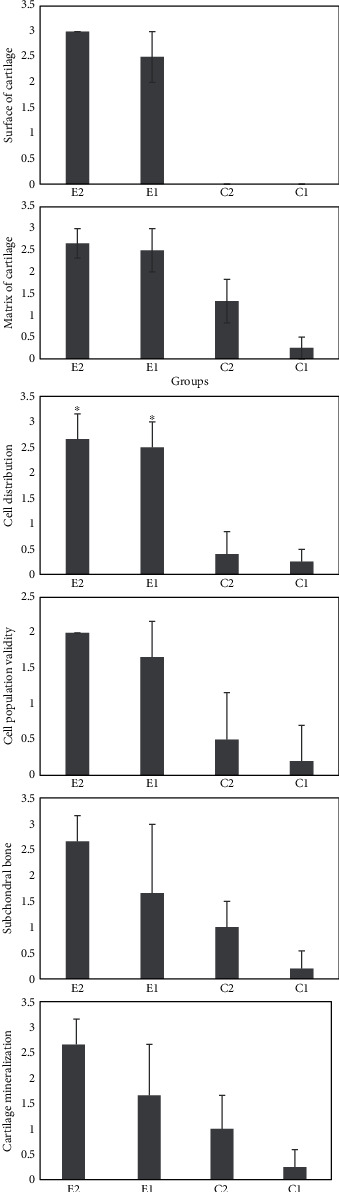
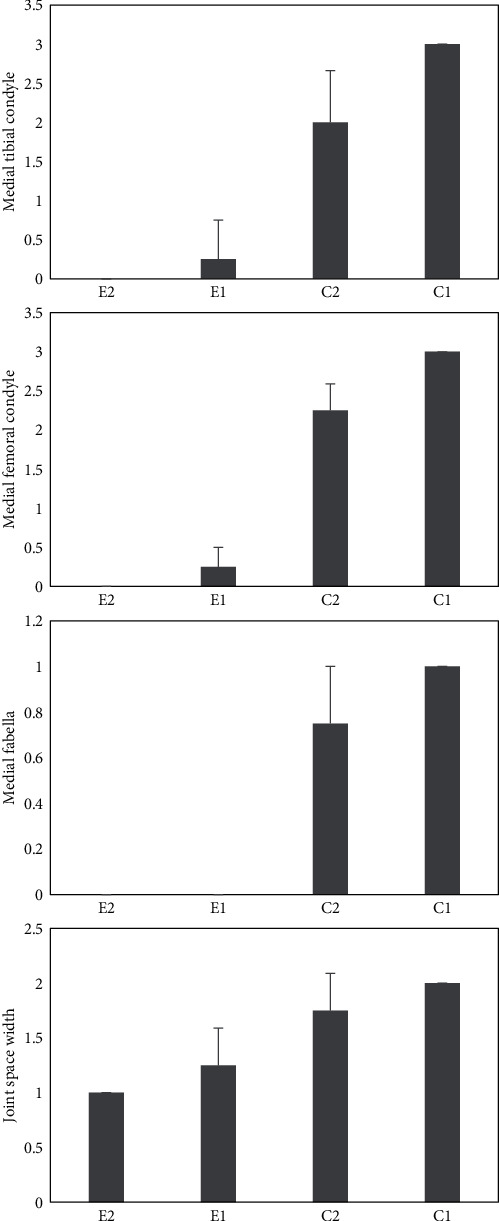
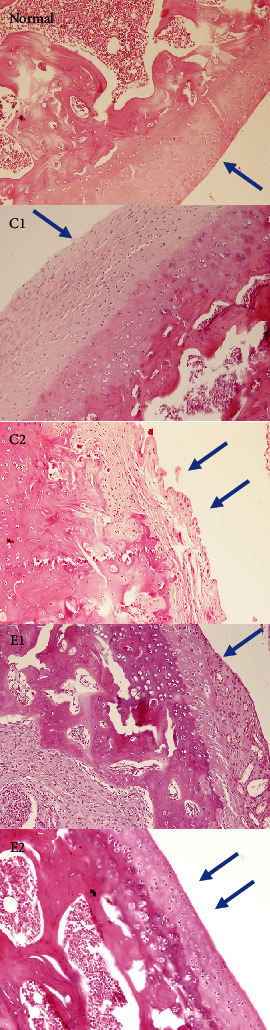
Compared to the C1 group, the E1 and E2 groups showed significantly better results in all six pathological criteria as well as joint space width and osteophytes of medial tibial, medial femoral, and medial fabellar condyles ( ≤ 0.001). Similarly, compared to the C2 group, the E1 and E2 groups had better scores regarding surface, matrix, cell distribution, and cell population viability ( < 0.05). E2 showed considerably higher scores compared to C2 regarding subchondral bone and cartilage mineralization ( < 0.05). The joint space width was similar between the C2 and E groups.
Treatment of OA with MSCs, particularly synovial membrane-derived stem cells, not only prevented but also healed OA of the knee to some extent in comparison to the Hyalgan and nontreatment groups.
骨关节炎(OA)是一种慢性疾病,是关节疼痛、压痛和活动受限的重要原因。目前尚无特效治疗方法,间充质干细胞(MSCs)在这方面已显示出有前景的潜力。在此,我们旨在评估滑膜和脂肪垫来源的干细胞在OA治疗中的修复潜力。
28只雄性大鼠(体重220±20克,年龄10 - 12周),随机分为四组(每组n = 7):C1:未治疗组,C2:透明质酸钠治疗组,E1:脂肪组织来源干细胞治疗组,E2:滑膜来源干细胞治疗组。将II型胶原酶注射到左膝;八周后,诱导OA形成。然后注射干细胞,并对大鼠随访三个月。之后,对标本和放射影像进行研究。设定P值≤0.05为具有统计学意义。
与C1组相比,E1组和E2组在所有六项病理标准以及内侧胫骨、内侧股骨和内侧腓骨头髁的关节间隙宽度和骨赘方面均显示出明显更好的结果(P≤0.001)。同样,与C2组相比,E1组和E2组在表面、基质、细胞分布和细胞群体活力方面得分更高(P<0.05)。与C2组相比,E2组在软骨下骨和软骨矿化方面得分显著更高(P<0.05)。C2组和E组之间的关节间隙宽度相似。
与透明质酸钠组和未治疗组相比,用MSCs治疗OA,特别是滑膜来源的干细胞,不仅可以预防,而且在一定程度上可以治愈膝关节OA。