Mirnezami Seyed Vahid, Young Therin, Assefa Teshale, Prichard Shelby, Nagasubramanian Koushik, Sandhu Kulbir, Sarkar Soumik, Sundararajan Sriram, O'Neal Matt E, Ganapathysubramanian Baskar, Singh Arti
Department of Mechanical Engineering Iowa State University Ames Iowa USA.
Colaberry Inc. 200 Portland Street Boston Massachusetts 02114 USA.
Appl Plant Sci. 2020 Jul 28;8(7):e11375. doi: 10.1002/aps3.11375. eCollection 2020 Jul.
Trichomes are hair-like appendages extending from the plant epidermis. They serve many important biotic roles, including interference with herbivore movement. Characterizing the number, density, and distribution of trichomes can provide valuable insights on plant response to insect infestation and define the extent of plant defense capability. Automated trichome counting would speed up this research but poses several challenges, primarily because of the variability in coloration and the high occlusion of the trichomes.
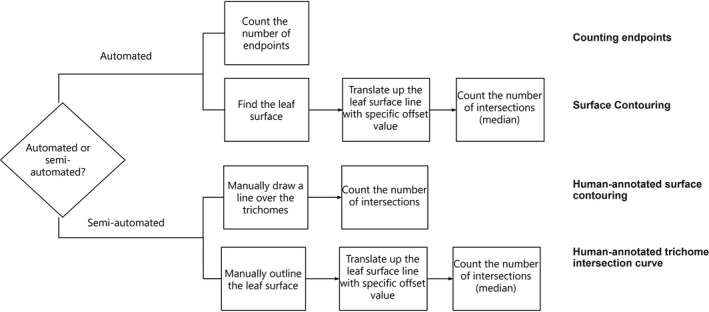
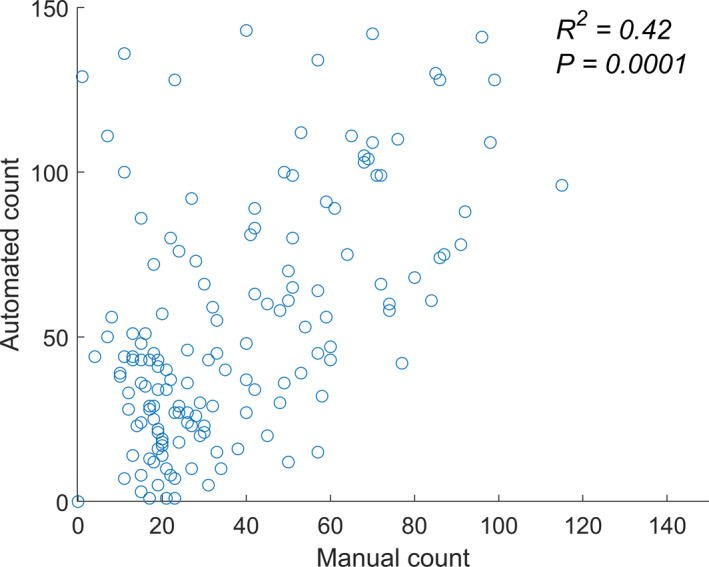
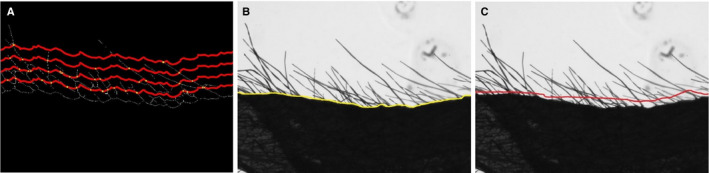
We developed a simplified method for image processing for automated and semi-automated trichome counting. We illustrate this process using 30 leaves from 10 genotypes of soybean () differing in trichome abundance. We explored various heuristic image-processing methods including thresholding and graph-based algorithms to facilitate trichome counting. Of the two automated and two semi-automated methods for trichome counting tested and with the help of regression analysis, the semi-automated manually annotated trichome intersection curve method performed best, with an accuracy of close to 90% compared with the manually counted data.
We address trichome counting challenges including occlusion by combining image processing with human intervention to propose a semi-automated method for trichome quantification. This provides new opportunities for the rapid and automated identification and quantification of trichomes, which has applications in a wide variety of disciplines.
表皮毛是从植物表皮延伸出来的毛发状附属物。它们发挥着许多重要的生物作用,包括干扰食草动物的活动。表征表皮毛的数量、密度和分布可以为植物对昆虫侵害的反应提供有价值的见解,并确定植物防御能力的程度。表皮毛的自动计数将加快这项研究,但存在几个挑战,主要是因为表皮毛颜色的变异性和高度遮挡。
我们开发了一种用于自动和半自动表皮毛计数图像处理的简化方法。我们使用来自10种表皮毛丰度不同的大豆基因型的30片叶子来说明这个过程。我们探索了各种启发式图像处理方法,包括阈值处理和基于图的算法,以促进表皮毛计数。在测试的两种自动和两种半自动表皮毛计数方法中,并借助回归分析,半自动手动注释表皮毛相交曲线方法表现最佳,与手动计数数据相比,准确率接近90%。
我们通过将图像处理与人工干预相结合来应对包括遮挡在内的表皮毛计数挑战,提出了一种用于表皮毛量化的半自动方法。这为表皮毛的快速自动识别和量化提供了新机会,在广泛的学科中都有应用。