Katagiri Daisuke, Ishikane Masahiro, Asai Yusuke, Kinoshita Noriko, Ota Masayuki, Moriyama Yuki, Ide Satoshi, Nakamura Keiji, Nakamoto Takato, Nomoto Hidetoshi, Akiyama Yutaro, Miyazato Yusuke, Suzuki Tetsuya, Okuhama Ayako, Kanda Kohei, Wakimoto Yuji, Morioka Shinichiro, Saito Sho, Yamamoto Kei, Ujiie Mugen, Hayakawa Kayoko, Kustuna Satoshi, Yanagawa Yasuaki, Terada Junko, Takasaki Jin, Izumi Shinyu, Hojo Masayuki, Hinoshita Fumihiko, Sugiyama Masaya, Noiri Eisei, Mizokami Masashi, Ohmagari Norio, Sugiyama Haruhito
Department of Nephrology, National Center for Global Health and Medicine, Tokyo, Japan.
Disease Control and Prevention Center, National Center for Global Health and Medicine, Tokyo, Japan.
Crit Care Explor. 2020 Jul 31;2(8):e0170. doi: 10.1097/CCE.0000000000000170. eCollection 2020 Aug.
Early detection of coronavirus disease 2019 in patients likely to develop severe manifestations enables appropriate interventions, including rapid ICU admission. This study was conducted to determine whether noninvasive urine biomarkers can predict the clinical severity of coronavirus disease 2019.
Not applicable.
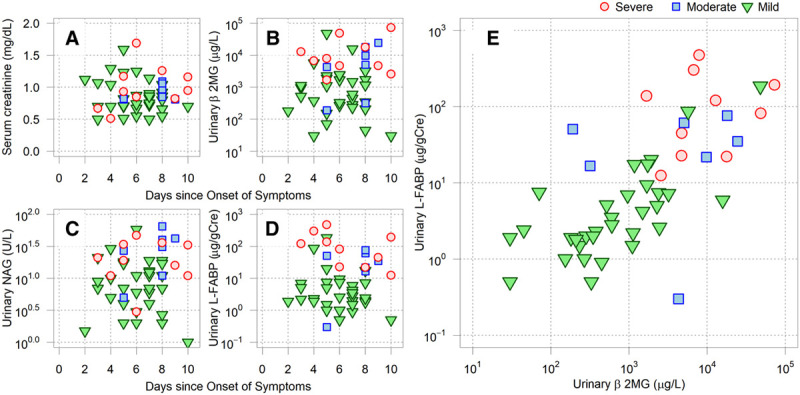
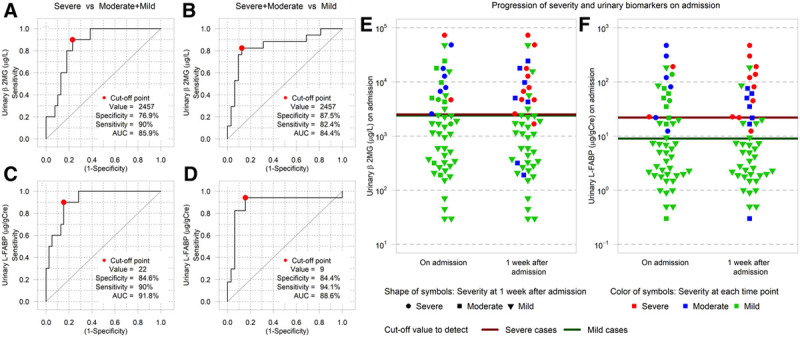
This is single-center study, national center hospital designated for infectious disease. Fifty-eight patients who tested positive for severe acute respiratory syndrome coronavirus 2 in respiratory specimens through real-time reverse transcription-polymerase chain reaction were retrospectively studied. Urinary β2-microglobulin, liver-type fatty acid-binding protein were serially measured. Serum interferon-γ and monocyte chemotactic protein-1 were also evaluated. The 58 patients were assigned into three groups. Patients requiring intensive care were assigned to the severe group ( = 12). Patients treated with oxygen were assigned to the moderate group ( = 13). Other patients were assigned to the mild group ( = 33). Urine tests revealed that low β2-microglobulin and liver-type fatty acid-binding protein levels were associated with mild disease, whereas high levels were associated with severe disease. In severe cases, liver-type fatty acid-binding protein tended to be persistently high. The resulting cutoff values were β2-microglobulin; severe versus moderate + mild: 2,457 μg/dL (specificity 76.9% and sensitivity 90.0%, area under the receiver operating characteristic curve 85.9%), liver-type fatty acid-binding protein; severe versus moderate + mild: 22.0 μg/gCre (specificity 84.6% and sensitivity 90%, area under the receiver operating characteristic curve 91.8%). Urinary β2-microglobulin and serum interferon-γ/monocyte chemotactic protein-1 showed a similar trend.
Evaluating urinary biomarkers such as β2-microglobulin and liver-type fatty acid-binding protein may allow determination of coronavirus disease 2019 patients with active cytokines and recognition of patients likely to become critically ill and requiring careful observation and early intervention.
对可能出现严重症状的2019冠状病毒病患者进行早期检测,有助于采取适当干预措施,包括迅速入住重症监护病房(ICU)。本研究旨在确定非侵入性尿液生物标志物是否能够预测2019冠状病毒病的临床严重程度。
不适用。
本研究为单中心研究,研究对象来自指定的国家级传染病中心医院。对58例经实时逆转录聚合酶链反应检测呼吸道标本中严重急性呼吸综合征冠状病毒2呈阳性的患者进行回顾性研究。连续检测尿β2微球蛋白、肝型脂肪酸结合蛋白。同时评估血清干扰素-γ和单核细胞趋化蛋白-1。58例患者分为三组。需要重症监护的患者被归入重症组(n = 12)。接受吸氧治疗的患者被归入中度组(n = 13)。其他患者被归入轻症组(n = 33)。尿液检测显示,低水平的β2微球蛋白和肝型脂肪酸结合蛋白与轻症相关,而高水平则与重症相关。在重症病例中,肝型脂肪酸结合蛋白往往持续处于高水平。得到的截断值为:β2微球蛋白,重症与中度+轻症相比:2457μg/dL(特异性76.9%,敏感性90.0%,受试者工作特征曲线下面积85.9%);肝型脂肪酸结合蛋白,重症与中度+轻症相比:22.0μg/gCr(特异性84.6%,敏感性90%,受试者工作特征曲线下面积91.8%)。尿β2微球蛋白与血清干扰素-γ/单核细胞趋化蛋白-1呈相似趋势。
评估尿β2微球蛋白和肝型脂肪酸结合蛋白等尿液生物标志物,可能有助于判断2019冠状病毒病患者是否存在活跃的细胞因子,并识别可能发展为危重症、需要密切观察和早期干预的患者。