Schmied V, Reilly N, Black E, Kingston D, Talcevska K, Mule V, Austin M-P
School of Nursing & Midwifery, Western Sydney University, Locked Bag 1797 Penrith, Sydney, NSW, 2751, Australia.
Research Centre for Generational Health and Ageing & School of Nursing and Midwifery, University of Newcastle, Newcastle, NSW, Australia.
BMC Pregnancy Childbirth. 2020 Aug 7;20(1):451. doi: 10.1186/s12884-020-03133-1.
One in five women experience psychological distress in the perinatal period. To support women appropriately, Australian guidelines recommend routine depression screening and psychosocial risk assessment by midwives in pregnancy. However, there is some evidence that current screening processes results in higher rates of false positives. The Perinatal Integrated Psychosocial Assessment (PIPA) Project compared two models of psychosocial assessment and referral - Usual Care and the PIPA model - with a view to improving referral decisions. This paper describes midwives' perspectives on psychosocial assessment, depression screening and referral at the antenatal booking appointment and compares midwives' experiences with, and perspectives on, the two models of care under investigation.
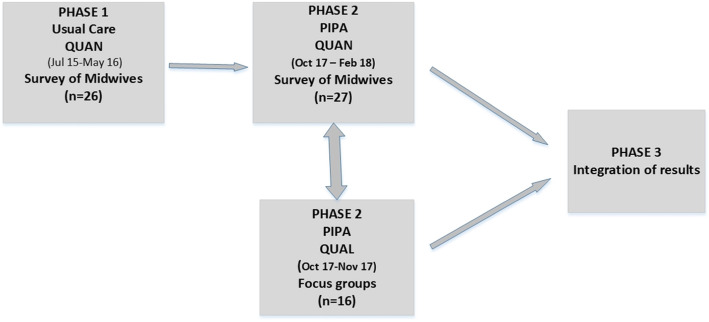
A two-phase, convergent mixed methods design was used. Midwives providing antenatal care completed a self-report survey in phase one prior to implementation of the new model of psychosocial assessment (n = 26) and again in phase two, following implementation (n = 27). Sixteen midwives also participated in two focus groups in phase two. Quantitative and qualitative data were compared and integrated in the presentation of results and interpretation of findings.
Midwives supported psychosocial assessment believing it was a catalyst for 'Opening the door" to conversations with women. Midwives were comfortable asking the questions and tailored their approach to build rapport and trust. Overall. midwives expressed favourable views towards the PIPA model. A greater proportion of midwives relied mostly or entirely on the suggested wording for the psychosocial questions in the PIPA model compared to Usual Care (44.4% vs 12.0%, χ=5.17, p=.023, φ =-.36). All midwives reported finding the referral or action message displayed at the end of the PIPA psychosocial assessment to be 'somewhat' or 'very' helpful, compared to 42.3% in Usual Care (χ = 18.36, p < .001, φ = -.64). Midwives were also more likely to act on or implement the message often or all of the time) in the PIPA model (PIPA = 69.2% vs Usual Care = 32.0%, (χ = 5.66, p < .017, φ = -.37).
The study identified benefits of the new model and can inform improvements in psychosocial screening, referral and related care processes within maternity settings. The study demonstrates that psychosocial assessment can, over time, become normalised and embedded in practice.
五分之一的女性在围产期会经历心理困扰。为了恰当地支持女性,澳大利亚指南建议助产士在孕期进行常规的抑郁症筛查和社会心理风险评估。然而,有证据表明当前的筛查流程导致假阳性率较高。围产期综合社会心理评估(PIPA)项目比较了两种社会心理评估和转诊模式——常规护理和PIPA模式,以期改善转诊决策。本文描述了助产士在产前预约时对社会心理评估、抑郁症筛查和转诊的看法,并比较了助产士对所研究的两种护理模式的体验和看法。
采用两阶段、收敛性混合方法设计。提供产前护理的助产士在第一阶段,即新的社会心理评估模式实施前,完成了一份自我报告调查(n = 26),并在第二阶段,即实施后再次完成调查(n = 27)。16名助产士在第二阶段还参加了两个焦点小组。在结果呈现和研究结果解释中,对定量和定性数据进行了比较和整合。
助产士支持社会心理评估,认为这是与女性展开对话的“敲门砖”。助产士对提问感到自在,并会调整方法以建立融洽关系和信任。总体而言,助产士对PIPA模式表达了赞许态度。与常规护理相比,更大比例的助产士在很大程度上或完全依赖PIPA模式中社会心理问题的建议措辞(44.4%对12.0%,χ = 5.17,p = 0.023,φ = -0.36)。所有助产士报告称,发现PIPA社会心理评估末尾显示的转诊或行动信息“有些”或“非常”有帮助,而常规护理中这一比例为42.3%(χ = 18.36,p < 0.001,φ = -0.64)。在PIPA模式中,助产士也更有可能经常或总是根据该信息采取行动或实施(PIPA = 69.2%,常规护理 = 32.0%,(χ = 5.66,p < 0.017,φ = -0.37)。
该研究确定了新模式的益处,并可为改善产科环境中的社会心理筛查、转诊及相关护理流程提供参考。该研究表明,随着时间推移,社会心理评估可以规范化并融入实践。