School of Geography and water@leeds, University of Leeds, Woodhouse Lane, Leeds, LS2 9JT, West Yorkshire, UK.
National Institute of Water and Atmospheric Research, Auckland, New Zealand.
Sci Rep. 2020 Aug 7;10(1):13392. doi: 10.1038/s41598-020-70276-8.
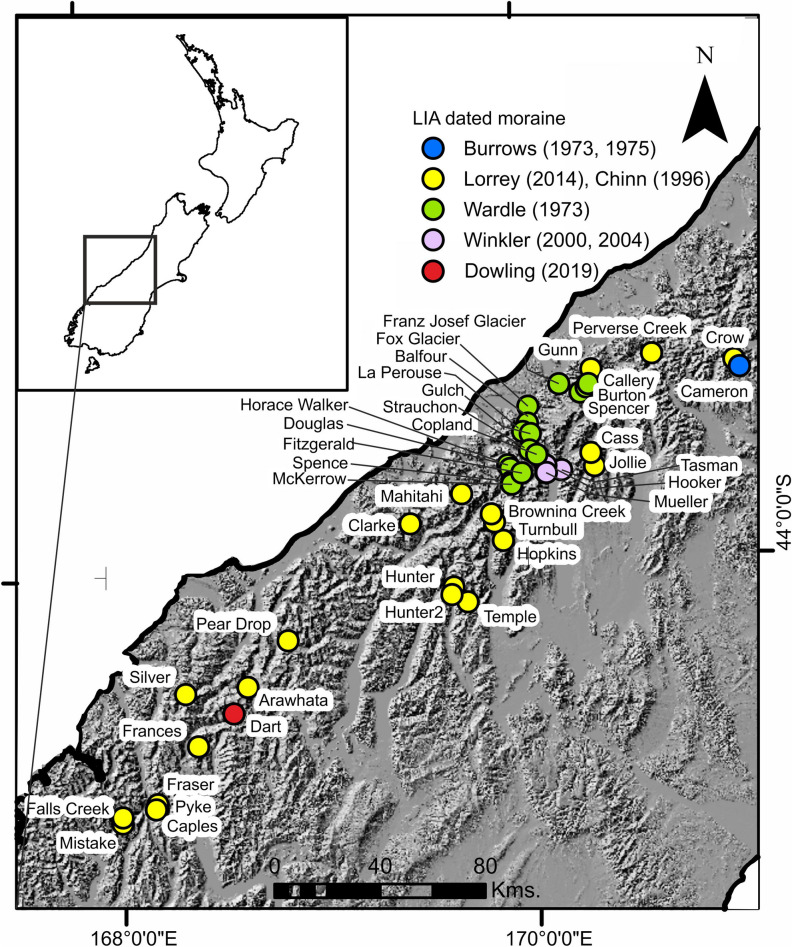
Rapid changes observed today in mountain glaciers need to be put into a longer-term context to understand global sea-level contributions, regional climate-glacier systems and local landscape evolution. In this study we determined volume changes for 400 mountain glaciers across the Southern Alps, New Zealand for three time periods; pre-industrial "Little Ice Age (LIA)" to 1978, 1978 to 2009 and 2009 to 2019. At least 60 km ± 12 km or between 41 and 62% of the LIA total ice volume has been lost. The rate of mass loss has nearly doubled from - 0.4 m w.e year during 1,600 to 1978 to - 0.7 m w.e year at present. In comparison Patagonia has lost just 11% of it's LIA volume. Glacier ice in the Southern Alps has become restricted to higher elevations and to large debris-covered ablation tongues terminating in lakes. The accelerating rate of ice loss reflects regional-specific climate conditions and suggests that peak glacial meltwater production is imminent if not already passed, which has profound implications for water resources and riverine habitats.
今天观察到的山地冰川的快速变化需要放在更长的时间范围内来理解全球海平面贡献、区域气候-冰川系统和当地景观演化。在这项研究中,我们确定了新西兰南阿尔卑斯山脉 400 座山地冰川在三个时期的体积变化:工业化前的“小冰期 (LIA)”到 1978 年、1978 年到 2009 年和 2009 年到 2019 年。至少有 60 ± 12 公里或 41%至 62%的 LIA 总冰量已经流失。目前的质量损失率几乎是从 1600 年到 1978 年的-0.4 米水位当量/年增加到-0.7 米水位当量/年。相比之下,巴塔哥尼亚只损失了其 LIA 体积的 11%。南阿尔卑斯山脉的冰川冰已经限制在更高的海拔和大型覆盖着碎片的消融舌头上,这些消融舌终止于湖泊中。冰流失率的加速反映了区域特定的气候条件,并表明,如果不是已经过去的话,冰川融水的峰值生产即将到来,这对水资源和河流栖息地有着深远的影响。