Laboratoire d'Hydrologie et de Géochimie de Strasbourg, UMR 7517, Université de Strasbourg-CNRS/ENGEES-EOST, Strasbourg, France.
Institut de Minéralogie, de Physique des Matériaux et de Cosmochimie, Museum National d'Histoire Naturelle, Sorbonne-Université, UMR 7590 CNRS, Paris, France.
Sci Rep. 2020 Aug 7;10(1):13385. doi: 10.1038/s41598-020-70265-x.
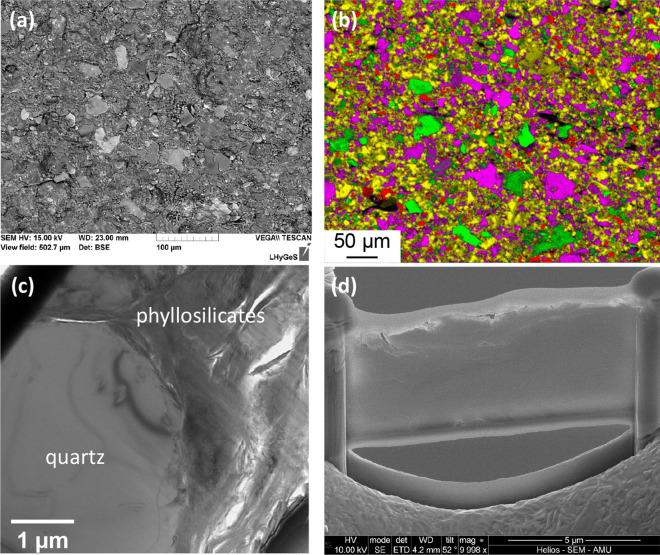
Bioerosion is a process with a high socio-economic impact that contributes to coastal retreat, and likely to increase with climate change. Whereas limestone bioerosion is well explained by a combination of mechanical and chemical pathways, the bioerosion mechanisms of silicates, which are harder and chemically more resistant, remain elusive. Here we investigated the interface between siltstone and freshwater rock-boring bivalves Lignopholas fluminalis (Bivalvia: Pholadidae). Remains of a microbial biofilm were observed only in the poorly consolidated part of the rock within the macroborings created by bivalves. Secondary Mn-bearing minerals identified in the biofilm suggest that microbes promoted silicate rock weathering by dissolving Mn-rich chlorites. Moreover, hard mineral debris found in a biofilm attached to the shells likely contributed to the abrasion of the rock substrate. Thus, beyond the classical view of chemical and/or mechanical action(s) of macroborers, silicate bioerosion may also be facilitated by an unexpected synergistic association between macro- and microorganisms.
生物侵蚀是一个具有高社会经济影响的过程,它导致了海岸退缩,并可能随着气候变化而加剧。虽然石灰岩的生物侵蚀可以很好地用机械和化学途径的组合来解释,但硅酸盐的生物侵蚀机制,由于其硬度更高、化学稳定性更强,仍然难以捉摸。在这里,我们研究了粉砂岩和淡水掘穴双壳类动物Lignopholas fluminalis(双壳纲:豆蛤科)之间的界面。只在双壳类动物所产生的大钻孔内的固结程度较差的岩石部分观察到微生物生物膜的残留物。在生物膜中鉴定出的次生含锰矿物表明,微生物通过溶解富含锰的绿泥石促进了硅酸盐岩石的风化。此外,在附着在贝壳上的生物膜中发现的硬矿物碎片可能有助于磨损岩石基质。因此,除了宏观生物钻孔的经典化学和/或机械作用观点之外,宏观生物和微生物之间意想不到的协同作用也可能促进硅酸盐的生物侵蚀。