New Jersey Safe Schools Program (NJSS), Rutgers School of Public Health (SPH), 683 Hoes Lane West, 3rd Floor SPH - Suite 399, Piscataway, New Jersey, 08854, USA.
Department of Environmental and Occupational Health, Rutgers SPH, 683 Hoes Lane West, 3rd Floor SPH Building, Piscataway, New Jersey, 08854, USA.
BMC Public Health. 2020 Aug 8;20(1):1215. doi: 10.1186/s12889-020-09319-8.
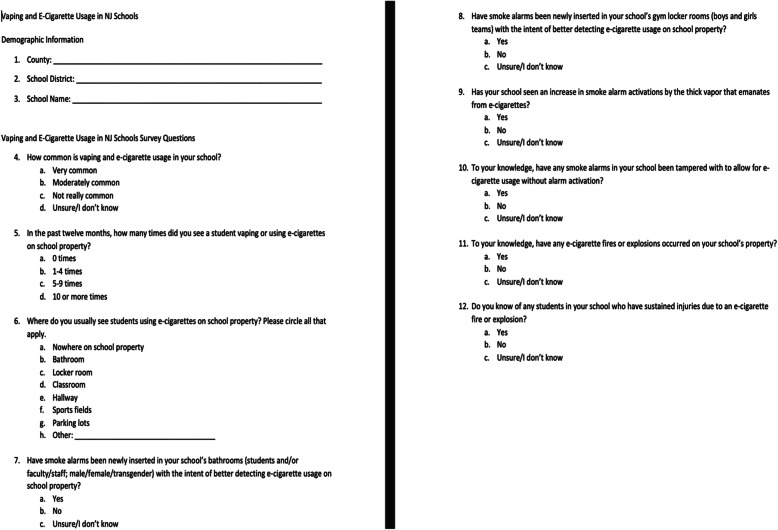
To identify if e-cigarette usage is an on-campus problem for secondary schools and evaluate initial school survey responses. More specifically, this survey can aid in identifying where students are seen using e-cigarettes, if smoke alarms have been newly inserted on school property, if smoke alarms have been tampered with to allow for vaping without detection; and, if any e-cigarette fires or explosions have occurred on school property.
This survey, disseminated to New Jersey secondary school teachers across seven sessions January-July 2019, resulted in 104 complete responses of 109 respondents. The survey was conducted after fire prevention, exit/egress, and life safety portions of "OSHA 10 Plus for General Industry" courses. Survey questions included number of times teachers observed students vaping and location where vaping in last 12 months, fire alarm installation and tampering, and fires or explosions and injuries from vaping/e-cigarette devices.
Many (63%) respondents reported very or moderately common rates of vaping within their schools; however, three of four questions regarding school fire and smoke alarm use specifically to detect vaping had a majority of unsure/I don't know responses.
Results suggested concerns regarding student vaping and e-cigarette use inside and outside secondary schools. Improved school detection and response are warranted.
Not applicable.
确定电子烟的使用是否是中学的校园问题,并评估初步的学校调查回应。更具体地说,这项调查可以帮助识别学生在何处被发现使用电子烟,如果学校财产上是否新插入了烟雾报警器,如果烟雾报警器被篡改以允许在不被发现的情况下蒸气;以及,如果在学校财产上发生任何电子烟火灾或爆炸。
这项调查于 2019 年 1 月至 7 月期间在新泽西州的七次会议上向中学教师分发,共收到 109 名受访者中的 104 名完整回复。该调查是在“OSHA 10 Plus for General Industry”课程的防火、出口/紧急出口和生命安全部分之后进行的。调查问题包括教师观察到学生蒸气的次数和过去 12 个月蒸气的地点、火灾报警器的安装和篡改,以及蒸气/电子烟设备引发的火灾或爆炸和伤害。
许多(63%)受访者报告说,在他们的学校里蒸气的情况非常或中度普遍;然而,关于学校火灾和烟雾报警器使用专门用于检测蒸气的四个问题中的三个,大多数人的回答是不确定/不知道。
结果表明,人们对学生在中学内外吸食电子烟和使用电子烟存在担忧。需要改进学校的检测和应对措施。
不适用。