Department of Orthopedic Surgery, Singapore General Hospital, Singapore, Singapore.
Changi General Hospital, Singapore, Singapore.
BMC Musculoskelet Disord. 2020 Aug 8;21(1):524. doi: 10.1186/s12891-020-03554-1.
Elderly patients with hip fractures often have multiple medical comorbidities, and vitamin D deficiency is common in this population. Accumulating evidence links low vitamin D levels to various comorbidities. However, very little is known about the collective impact of comorbidities on vitamin D levels. The Charlson Comorbidity Index (CCI) is a validated comorbidity burden index. We hypothesized that a high CCI score is associated with vitamin D deficiency in elderly patients with hip fracture.
A retrospective cohort study was conducted among all hospitalized elderly patients aged > 60 years admitted for low-energy hip fracture in a single tertiary hospital from 2013 to 2015. Data regarding patient demographics, fracture type, serum 25-hydroxyvitamin D3 levels and age-adjusted CCI score were collected and analysed.
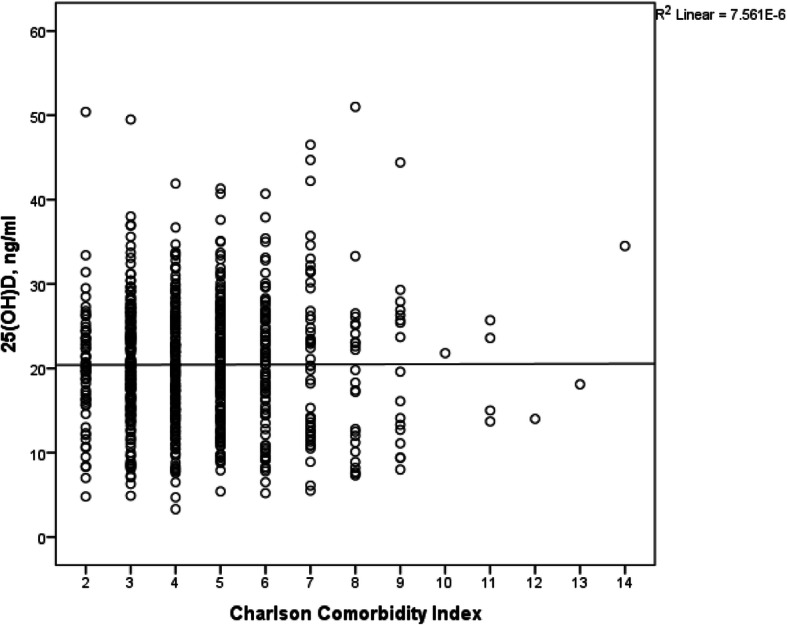
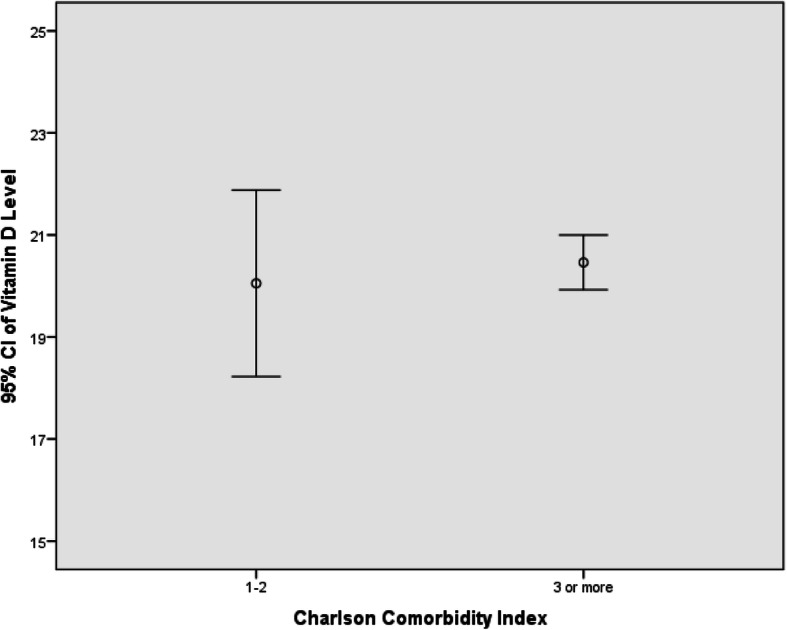
Of the 796 patients included in the study, 70.6% (n = 562) of the patients were women and the mean age was 77.7 ± 8.0 years. The mean vitamin D level was 20.4 ± 7.4 ng/mL, and 91.7% ofhospitalized elderly patients with hip fracture had inadequate vitamin D level. There was no correlation between the individual serum vitamin D level with respect to age-adjusted CCI (Pearson correlation coefficient = 0.01; p = 0.87). After stratifying the CCI scores into low and high comorbidity burden groups (i.e., with scores 1-2 and ≥ 3), there was no relationship between the 2 subgroups for age-adjusted CCI and vitamin D levels (p = 0.497). Furthermore, there was also no association among age, gender, fracture type, and smoking status with the mean 25(OH)D level (p > 0.05).
Low vitamin D levels were highly prevalent in our hip fracture cohort. There was no relationship between the CCI score and vitamin D levels in the geriatric hip population. The comorbidity burden in geriatric patients with hip fractures did not seem to be a significant factor for vitamin D levels.
髋部骨折的老年患者常伴有多种合并症,且该人群中维生素 D 缺乏较为常见。越来越多的证据表明,维生素 D 水平低下与多种合并症有关。然而,关于合并症对维生素 D 水平的综合影响,我们知之甚少。Charlson 合并症指数(CCI)是一种经过验证的合并症负担指数。我们假设 CCI 评分较高与老年髋部骨折患者的维生素 D 缺乏有关。
我们对 2013 年至 2015 年期间在一家三级医院因低能量髋部骨折住院的所有年龄>60 岁的老年患者进行了一项回顾性队列研究。收集了患者的人口统计学资料、骨折类型、血清 25-羟维生素 D3 水平和年龄调整后的 CCI 评分,并进行了分析。
在纳入的 796 例患者中,70.6%(n=562)为女性,平均年龄为 77.7±8.0 岁。平均维生素 D 水平为 20.4±7.4ng/mL,91.7%的髋部骨折老年住院患者存在维生素 D 水平不足。个体血清维生素 D 水平与年龄调整后的 CCI 之间无相关性(Pearson 相关系数=0.01;p=0.87)。将 CCI 评分分为低合并症负担组(评分 1-2)和高合并症负担组(评分≥3)后,2 个亚组的年龄调整后的 CCI 和维生素 D 水平之间无关系(p=0.497)。此外,年龄、性别、骨折类型和吸烟状态与平均 25(OH)D 水平之间也没有关系(p>0.05)。
在我们的髋部骨折队列中,维生素 D 水平普遍较低。老年髋部人群的 CCI 评分与维生素 D 水平之间无关系。髋部骨折老年患者的合并症负担似乎不是维生素 D 水平的重要因素。