Cancer Prevention and Control, Roswell Park Comprehensive Cancer Center, Buffalo, NY, United States.
Department of Health Services Administration, D'Youville College, Buffalo, NY, United States.
J Med Internet Res. 2020 Aug 10;22(8):e16239. doi: 10.2196/16239.
In the United States, there are lower rates of breastfeeding among African American mothers, particularly those who are younger women. Recent epidemiological studies have shown a strong association of more aggressive types of breast cancer (estrogen receptor negative) among African American women, with a higher risk in African American women who did not breastfeed their children.
This study aims to describe the process evaluation of recruitment and educational strategies to engage pregnant African American participants for a pilot study designed to determine whether social media messaging about breast cancer risk reduction through breastfeeding may positively influence breastfeeding rates.
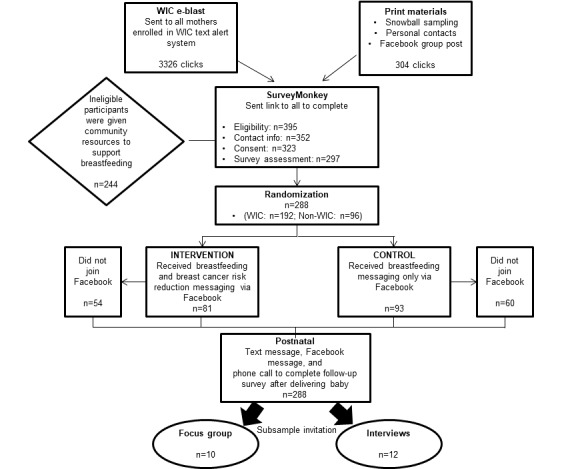
This pilot study is conducted in collaboration with a local Women, Infants, and Children (WIC) organization and hospital and prenatal clinics of a local health care network. To engage African American women to enroll in the study, several methods and monitoring processes were explored, including WIC electronic text-based messages sent out to all phones of current WIC recipients (referred to as e-blasts); keyword responses to texts from flyers and posters in local community-based organizations, hospitals, and prenatal clinics; keyword responses using electronic links posted in established Facebook groups; and snowball recruitment of other pregnant women by current participants through Facebook. Once enrolled, participants were randomized to 2 study conditions: (1) an intervention group receiving messages about breast cancer risk reduction and breastfeeding or (2) a control group receiving breastfeeding-only messages. Data were obtained through electronic monitoring, SurveyMonkey, qualitative responses on Facebook, focus groups, and interviews.
More than 3000 text messages were sent and received through WIC e-blasts and keyword responses from flyers. A total of 472 women were recruited through WIC e-blast, and 161 responded to flyers and contacts through the local health care network, community-based organizations, Facebook, and friend referrals. A total of 633 women were assessed for eligibility to participate in the study. A total of 288 pregnant African American women were enrolled, consented, and completed presurvey assessments (102.8% of the goal), and 22 participants attended focus groups or interviews reporting on their experiences with Facebook and the educational messages.
This process evaluation suggests that using electronic, smartphone apps with social media holds promise for both recruitment and conduct of health education intervention studies for pregnant African American women. Providing messaging and resources through social media to reinforce and educate women about breastfeeding and potentially provide lactation support is intriguing. Convenience (for researchers and participants) is an attribute of social media for this demographic of women and worthy of further research as an educational tool.
ClinicalTrials.gov NCT03680235; https://clinicaltrials.gov/ct2/show/NCT03680235.
在美国,非裔美国母亲的母乳喂养率较低,尤其是年轻女性。最近的流行病学研究表明,非裔美国女性中更具侵袭性的乳腺癌(雌激素受体阴性)的比例较高,而未母乳喂养孩子的非裔美国女性的风险更高。
本研究旨在描述招募和教育策略的过程评估,以吸引参与一项旨在确定通过母乳喂养降低乳腺癌风险的社交媒体信息是否可能对母乳喂养率产生积极影响的试点研究的怀孕非裔美国参与者。
本试点研究是与当地妇女、婴儿和儿童(WIC)组织以及当地医疗保健网络的医院和产前诊所合作进行的。为了让非裔美国妇女参与研究,探索了几种方法和监测过程,包括向所有当前 WIC 接受者的手机发送 WIC 电子短信(称为电子爆炸);通过当地社区组织、医院和产前诊所的传单和海报上的关键词回复;通过已建立的 Facebook 群组发布电子链接进行关键词回复;以及通过当前参与者通过 Facebook 招募其他孕妇的滚雪球招募。一旦入组,参与者被随机分配到 2 个研究条件:(1)干预组接受有关乳腺癌风险降低和母乳喂养的信息,或(2)对照组仅接受母乳喂养信息。通过电子监测、SurveyMonkey、Facebook 上的定性回复、焦点小组和访谈获得数据。
通过 WIC 电子爆炸和传单上的关键词回复发送和接收了超过 3000 条短信。通过 WIC 电子爆炸共招募了 472 名女性,通过当地医疗保健网络、社区组织、Facebook 和朋友推荐,通过传单和联系方式共招募了 161 名女性。共有 633 名女性接受了参与研究的资格评估。共有 288 名怀孕的非裔美国妇女入组、同意并完成了预调查评估(目标的 102.8%),22 名参与者参加了焦点小组或访谈,报告了他们对 Facebook 和教育信息的体验。
该过程评估表明,使用带有社交媒体的电子、智能手机应用程序在招募和开展针对怀孕非裔美国妇女的健康教育干预研究方面具有潜力。通过社交媒体提供信息和资源,以加强和教育妇女有关母乳喂养并可能提供哺乳支持的信息很有吸引力。对于这一女性群体来说,社交媒体的便利性(对研究人员和参与者而言)是一种特质,值得进一步研究作为一种教育工具。
ClinicalTrials.gov NCT03680235;https://clinicaltrials.gov/ct2/show/NCT03680235。