Smith Gillian S, Fleming Michael, Kinnear Deborah, Henderson Angela, Pell J P, Melville Craig, Cooper Sally-Ann
Institute of Health and Wellbeing, University of Glasgow, Glasgow, UK.
Institute of Health and Wellbeing, University of Glasgow, Glasgow, UK
BMJ Open. 2020 Aug 9;10(8):e034077. doi: 10.1136/bmjopen-2019-034077.
To investigate mortality rates and causes in children and young people with intellectual disabilities.
Retrospective cohort; individual record linkage between Scotland's annual pupil census and National Records of Scotland death register.
General community.
Pupils receiving local authority-funded schooling in Scotland, 2008 to 2013, with an Additional Support Need due to intellectual disabilities, compared with other pupils.
Deaths up to 2015: age of death, age-standardised mortality ratios (age-SMRs); causes of death including cause-specific age-SMRs; avoidable deaths as defined by the UK Office of National Statistics.
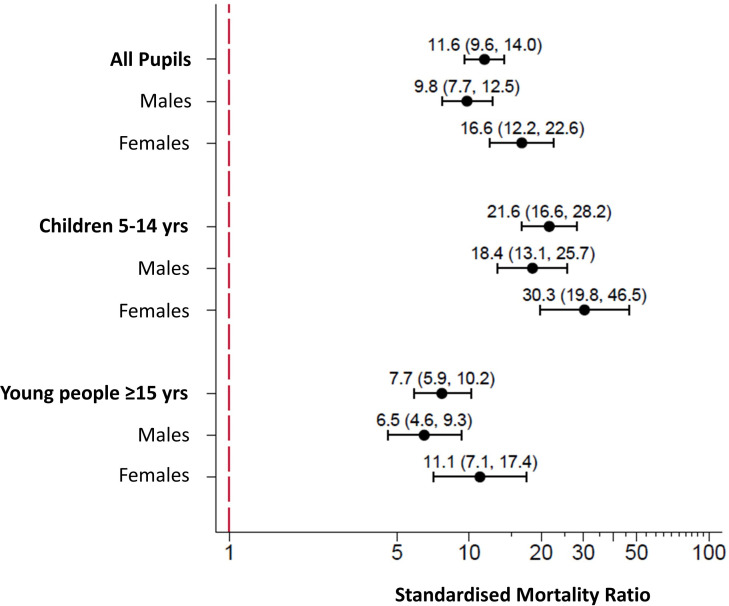
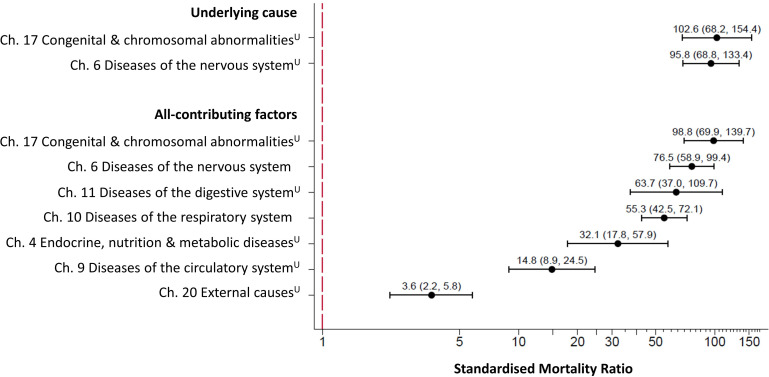
18 278/947 922 (1.9%) pupils had intellectual disabilities. 106 died over 67 342 person-years (crude mortality rate=157/100 000 person-years), compared with 458 controls over 3 672 224 person-years (crude mortality rate=12/100 000 person-years). Age-SMR was 11.6 (95% CI 9.6 to 14.0); 16.6 (95% CI 12.2 to 22.6) for female pupils and 9.8 (95% CI 7.7 to 12.5) for male pupils. Most common main underlying causes were diseases of the nervous system, followed by congenital anomalies; most common all-contributing causes were diseases of the nervous system, followed by respiratory system; most common specific contributing causes were cerebral palsy, pneumonia, respiratory failure and epilepsy. For all contributing causes, SMR was 98.8 (95% CI 69.9 to 139.7) for congenital anomalies, 76.5 (95% CI 58.9 to 99.4) for nervous system, 63.7 (95% CI 37.0 to 109.7) for digestive system, 55.3 (95% CI 42.5 to 72.1) for respiratory system, 32.1 (95% CI 17.8 to 57.9) for endocrine and 14.8 (95% CI 8.9 to 24.5) for circulatory system. External causes accounted for 46% of control deaths, but the SMR for external-related deaths was still higher (3.6 (95% CI 2.2 to 5.8)) for pupils with intellectual disabilities. Deaths amenable to good care were common.
Pupils with intellectual disabilities were much more likely to die than their peers, and had a different pattern of causes, including amenable deaths across a wide range of disease categories. Improvements are needed to reduce amenable deaths, for example, epilepsy-related and dysphagia, and to support families of children with life-limiting conditions.
调查智障儿童和青少年的死亡率及死因。
回顾性队列研究;将苏格兰年度学生普查与苏格兰国家记录死亡登记册进行个体记录链接。
一般社区。
2008年至2013年在苏格兰接受地方当局资助教育、因智障有额外支持需求的学生,并与其他学生进行比较。
截至2015年的死亡情况:死亡年龄、年龄标准化死亡率(age-SMRs);死因,包括特定病因的年龄标准化死亡率;英国国家统计局定义的可避免死亡。
18278/947922(1.9%)的学生有智障。在67342人年期间有106人死亡(粗死亡率=157/100000人年),相比之下,在3672224人年期间有458名对照者死亡(粗死亡率=12/100000人年)。年龄标准化死亡率为11.6(95%可信区间9.6至14.0);女生为16.6(95%可信区间12.2至22.6),男生为9.8(95%可信区间7.7至12.5)。最常见的主要潜在病因是神经系统疾病,其次是先天性异常;最常见的所有促成病因是神经系统疾病,其次是呼吸系统疾病;最常见的特定促成病因是脑瘫、肺炎、呼吸衰竭和癫痫。对于所有促成病因,先天性异常的标准化死亡率为98.8(95%可信区间69.9至139.7),神经系统疾病为76.5(95%可信区间58.9至99.4),消化系统疾病为63.7(95%可信区间37.0至109.7),呼吸系统疾病为55.3(95%可信区间42.5至72.1),内分泌系统疾病为32.1(95%可信区间17.8至57.9),循环系统疾病为14.8(95%可信区间8.9至24.5)。外部原因占对照者死亡的46%,但智障学生与外部相关死亡的标准化死亡率仍然更高(3.6(95%可信区间2.2至5.8))。可通过良好护理避免的死亡很常见。
智障学生比同龄人死亡的可能性大得多,且死因模式不同,包括在广泛疾病类别中可通过良好护理避免的死亡。需要改进以减少可通过良好护理避免的死亡,例如与癫痫和吞咽困难相关的死亡,并为患有危及生命疾病的儿童家庭提供支持。