Department of Neurology.
Department of Psychiatry.
AIDS. 2020 Nov 15;34(14):2081-2088. doi: 10.1097/QAD.0000000000002655.
With combination antiretroviral therapy (cART), infants with perinatally acquired HIV (pHIV) are living into adolescence and adulthood. Worldwide, many have not received cART in the first years of life, and challenges of adolescence complicate transition to adulthood. Neurobehavioral outcomes in pHIV young adults (pHIVAd) are infrequently reported.
To examine neurobehavioral characteristics of pHIVAd ages 21-30 years, and to compare them with age-matched young adults infected in the second or third decade of life (HIVagematch), and older adults with similar duration HIV disease (HIVOA).
A comprehensive neuropsychological test battery and questionnaires to determine cognitive function and mood, and reviews of neuromedical and behavioral records were undertaken in three groups of 13 individuals each. Descriptive analysis and bivariate techniques were used for comparisons.
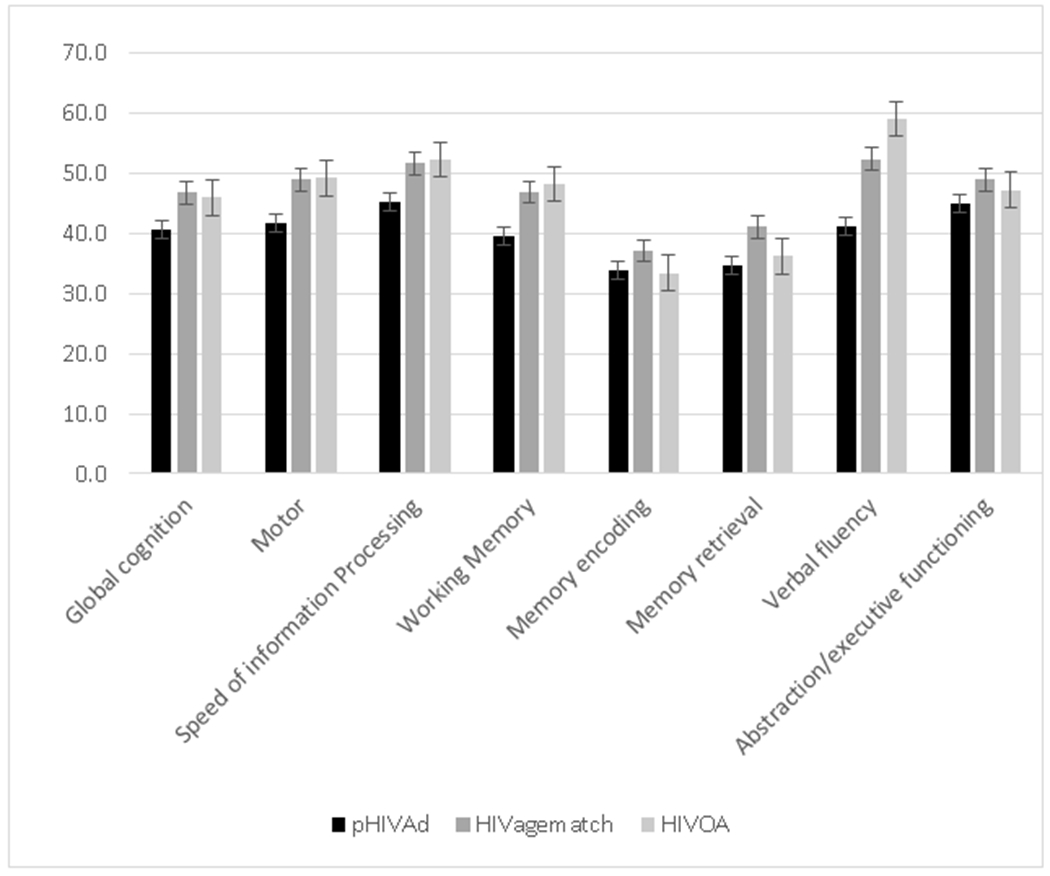
Rates of cognitive impairment were highest in pHIVAd (85%) compared with HIVagematch (38%) and HIVOA (62%). pHIVAd had the worst scores in global cognition, speed of information processing, working memory, and verbal fluency (0.5--1.0 SD below other groups). There was a trend for higher rates of psychiatric dysfunction (predominantly mood disorders) in pHIVAd (85%) compared with HIV-agematch (46%) and HIVOA (54%). Only four pHIVAd reported employment or enrollment in school. Four had autoimmune disorders.
These pHIVAd displayed high rates of cognitive, psychiatric, and autoimmune dysfunction, greater than age-matched or HIV duration-matched comparators. Although this small study is largely descriptive in nature, it suggests that a lack of cART in early life may result in long-term neurobehavioral and immune abnormalities manifesting into adulthood.
随着联合抗逆转录病毒疗法(cART)的应用,在围生期感染 HIV 的婴儿(pHIV)能够存活至青少年和成年期。在世界范围内,许多婴儿在生命的最初几年没有接受 cART,而青少年期的各种挑战使得他们向成年期的过渡变得复杂。pHIV 青少年(pHIVAd)的神经行为结局很少被报道。
研究 21-30 岁 pHIVAd 的神经行为特征,并将其与同期感染(HIVagematch)和相似 HIV 病程的老年患者(HIVOA)进行比较。
对三组各 13 名患者进行了全面的神经心理学测试、认知和情绪问卷评估,以及神经医学和行为记录的回顾。采用描述性分析和双变量技术进行比较。
与 HIVagematch(38%)和 HIVOA(62%)相比,pHIVAd 的认知障碍发生率最高(85%)。pHIVAd 的总体认知、信息处理速度、工作记忆和言语流畅性得分最差(比其他两组低 0.5-1.0 个标准差)。pHIVAd 出现精神功能障碍(主要为情绪障碍)的比例较高(85%),高于 HIV-agematch(46%)和 HIVOA(54%)。仅有 4 名 pHIVAd 报告就业或在校学习。4 名患者患有自身免疫性疾病。
这些 pHIVAd 表现出较高的认知、精神和自身免疫功能障碍发生率,高于年龄匹配或 HIV 病程匹配的对照组。尽管本研究规模较小,主要为描述性研究,但它表明婴儿期缺乏 cART 可能导致长期的神经行为和免疫异常,在成年期表现出来。