Division of Behavioral Medicine and Clinical Psychology, Cincinnati Children's Hospital Medical Center, Cincinnati, OH, United States.
Center for Understanding Pediatric Pain, Cincinnati Children's Hospital Medical Center, Cincinnati, OH, United States.
Pain. 2021 Feb 1;162(2):372-381. doi: 10.1097/j.pain.0000000000002029.
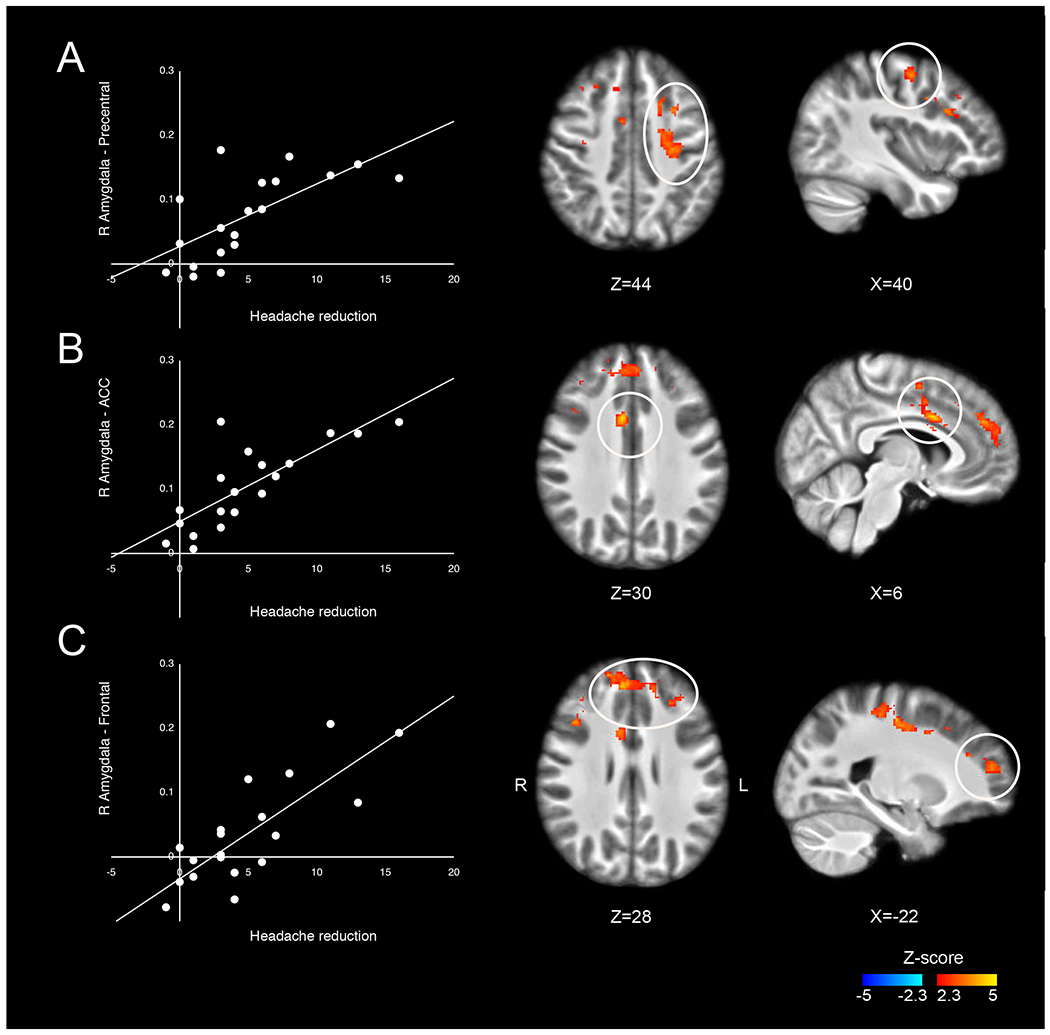
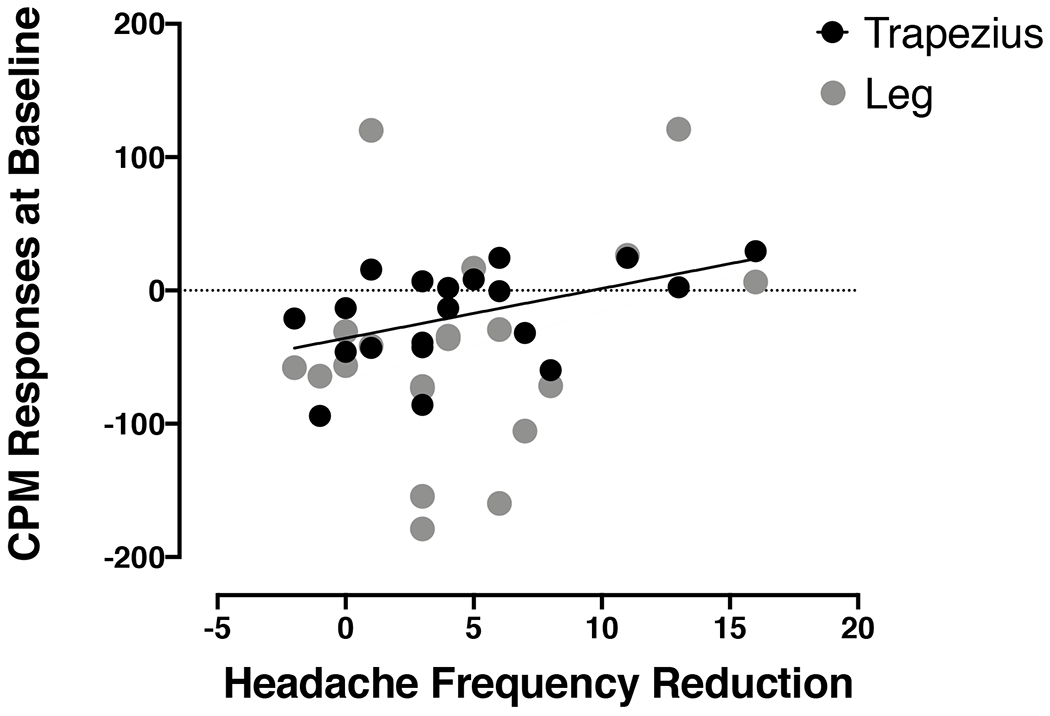
Cognitive behavioral therapy (CBT) is a psychological intervention that involves development of coping strategies to reduce the experience of pain. Although CBT is a promising intervention to reduce headache days in patients with migraine, it may not be effective for all patients. Thus, there is a need to identify markers that could predict which patients will respond to CBT. We aimed to determine whether baseline brain function and amygdalar connectivity, assessed by functional magnetic resonance imaging, or pain modulation capacities, assessed by the conditioned pain modulation (CPM) response, can predict a reduction in headache days after CBT in adolescents with migraine. Patients with migraine (n = 20; age range 10-17 years) completed 8 weekly CBT sessions. The CPM response was examined in the trapezius and the leg. Headache days significantly decreased after CBT (P < 0.001). Greater functional connectivity before CBT between the right amygdala and frontal gyrus, anterior cingulate cortex, and precentral gyrus was related to greater headache reduction after CBT. Greater reduction in headache days after CBT was related with less efficient CPM response before CBT at the trapezius (r = -0.492, P = 0.028) but not at the leg. This study found that headache reduction after CBT was related to right amygdala connectivity with frontal and sensorimotor regions at baseline as well as baseline pain modulation capacities. These findings suggest that individual differences in brain function and pain modulation can be associated with clinical improvements and help with determination of CBT responsiveness.
认知行为疗法(CBT)是一种心理干预措施,涉及制定应对策略以减少疼痛体验。虽然 CBT 是减少偏头痛患者头痛天数的一种很有前途的干预措施,但它可能对所有患者都不起作用。因此,需要确定可以预测哪些患者对 CBT 有反应的标志物。我们旨在确定基线大脑功能和杏仁核连接,通过功能磁共振成像评估,或疼痛调节能力,通过条件疼痛调制(CPM)反应评估,是否可以预测偏头痛青少年接受 CBT 后头痛天数的减少。偏头痛患者(n = 20;年龄范围 10-17 岁)完成了 8 周的 CBT 疗程。在斜方肌和腿部检查 CPM 反应。接受 CBT 后头痛天数明显减少(P < 0.001)。接受 CBT 前右杏仁核与额回、前扣带回和中央前回之间的功能连接越强,接受 CBT 后头痛减轻越大。接受 CBT 后头痛天数减少与接受 CBT 前斜方肌 CPM 反应效率降低(r = -0.492,P = 0.028)有关,但与腿部无关。这项研究发现,接受 CBT 后头痛的减轻与基线时右杏仁核与额部和感觉运动区域的连接以及基线时的疼痛调节能力有关。这些发现表明,大脑功能和疼痛调节的个体差异可能与临床改善有关,并有助于确定 CBT 的反应性。