Departments of Biochemistry and Immunology, University of São Paulo, Ribeirão Preto, Brazil.
Pharmacology, University of São Paulo, Ribeirão Preto, Brazil.
Front Immunol. 2020 Jul 7;11:1265. doi: 10.3389/fimmu.2020.01265. eCollection 2020.
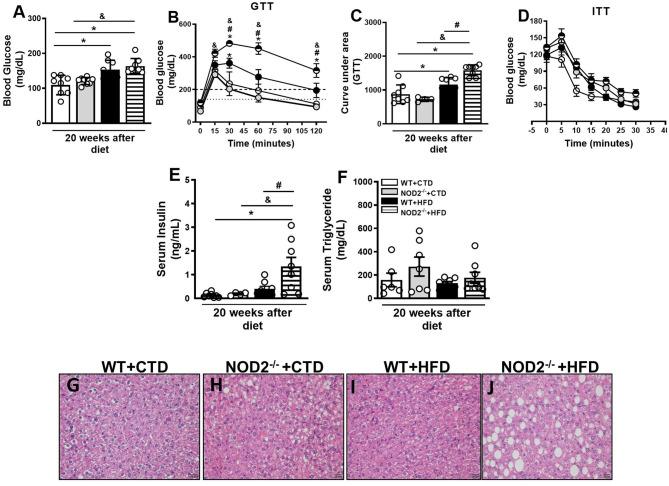
Type 2 diabetes (T2D) is a metabolic disease characterized by increased inflammation, NOD-like receptors (NLRs) activation and gut dysbiosis. Our research group has recently reported that intestinal Th17 response limits gut dysbiosis and LPS translocation to visceral adipose tissue (VAT), protecting against metabolic syndrome. However, whether NOD2 receptor contributes intestinal Th17 immunity, modulates dysbiosis-driven metabolic tissue inflammation, and obesity-induced T2D remain poorly understood. In this context, we observed that mice lacking NOD2 fed a high-fat diet (HFD) display severe obesity, exhibit greater adiposity, and more hepatic steatosis compared to HFD-fed wild-type (WT) mice. In addition, they develop increased hyperglycemia, worsening of glucose intolerance, and insulin resistance. Notably, the deficiency of NOD2 causes a deviation from M2 macrophage and regulatory T cells (Treg) to M1 macrophage and mast cells into VAT compared to WT mice fed HFD. An imbalance was also observed in Th17/Th1 cell populations, with reduced IL-17 and IL-22 gene expression in the mesenteric lymph nodes (MLNs) and ileum, respectively, of NOD2-deficient mice fed HFD. 16S rRNA sequencing indicates lower richness, alpha diversity, and a depletion of , and enrichment with genera in these mice compared to HFD-fed WT mice. These alterations were associated with disrupted tight-junctions expression, augmented serum LPS, and bacterial translocation into VAT. Overall, NOD2 activation is required for a protective Th17 over Th1 immunity in the gut, which seems to decrease gram-negative bacteria outgrowth in gut microbiota, attenuating the endotoxemia, metainflammation, and protecting against obesity-induced T2D.
2 型糖尿病(T2D)是一种代谢疾病,其特征为炎症增加、NOD 样受体(NLRs)激活和肠道菌群失调。我们的研究小组最近报道,肠道 Th17 反应限制了肠道菌群失调和 LPS 易位到内脏脂肪组织(VAT),从而防止代谢综合征。然而,NOD2 受体是否有助于肠道 Th17 免疫、调节由菌群失调驱动的代谢组织炎症以及肥胖诱导的 T2D 仍知之甚少。在这种情况下,我们观察到缺乏 NOD2 的小鼠在高脂肪饮食(HFD)喂养下表现出严重肥胖,与 HFD 喂养的野生型(WT)小鼠相比,表现出更大的肥胖和更多的肝脂肪变性。此外,它们发生了更高的血糖升高、葡萄糖耐量恶化和胰岛素抵抗。值得注意的是,与 HFD 喂养的 WT 小鼠相比,NOD2 的缺乏导致 VAT 中 M2 巨噬细胞和调节性 T 细胞(Treg)向 M1 巨噬细胞和肥大细胞的偏离。在 Th17/Th1 细胞群中也观察到失衡,与 HFD 喂养的 WT 小鼠相比,NOD2 缺陷型小鼠的肠系膜淋巴结(MLNs)和回肠中 IL-17 和 IL-22 基因表达减少。16S rRNA 测序表明,与 HFD 喂养的 WT 小鼠相比,这些小鼠的丰富度、alpha 多样性降低,而 和 属富集。这些改变与紧密连接表达的破坏、血清 LPS 增加和细菌易位到 VAT 有关。总的来说,NOD2 的激活对于肠道中保护性 Th17 免疫超过 Th1 免疫是必需的,这似乎减少了肠道微生物群中革兰氏阴性菌的过度生长,减轻了内毒素血症、代谢炎症,并防止肥胖诱导的 T2D。