Sun Xiaomin, Ma Xiao-Kai, Zhang Lin, Cao Zhen-Bo
Global Health Institute, School of Public Health, Xi'an Jiaotong University Health Science Center, Xi'an, 710061 China.
School of Kinesiology, Shanghai University of Sport, 399 Chang Hai Road, Shanghai, 200438 China.
Nutr Metab (Lond). 2020 Aug 1;17:59. doi: 10.1186/s12986-020-00480-w. eCollection 2020.
Previous studies indicated that serum 25-hydroxyvitamin D [25(OH)D] concentrations are positively associated with physical activity levels independent of sun exposure. However, the effect of resistance training on serum 25(OH) D concentrations remains unclear. Thus, this study aimed to examine the effect of chronic resistance training on serum 25(OH) D concentrations and determine whether 25(OH) D concentration variations are influenced by body composition changes.
Eighteen young men aged 19-39 years were randomly divided into a 12-week resistance training group (RT, = 9) and non-exercise control group (CON, = 9). The trial was undertaken in Shanghai University of Sport in Shanghai, China. Randomization and allocation to trial group were carried out by a central computer system. Serum 25(OH) D and intact parathyroid hormone concentrations were measured using commercially available enzyme-linked immunosorbent assay kits. Body composition was measured by dual-energy X-ray absorptiometry.
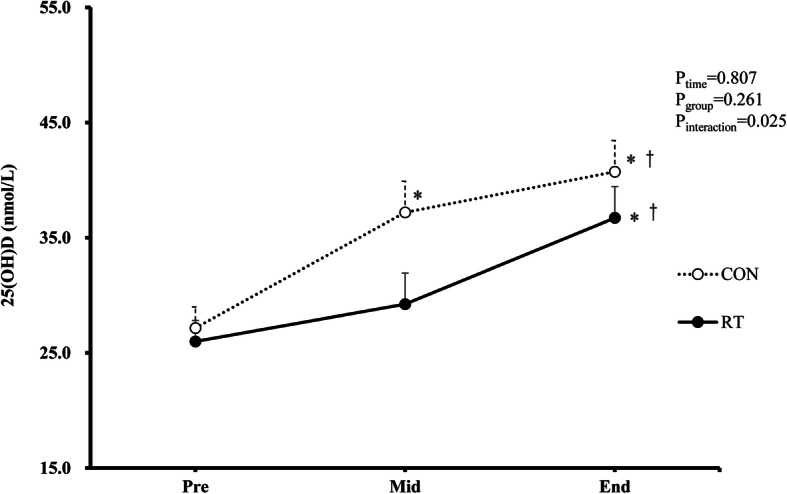
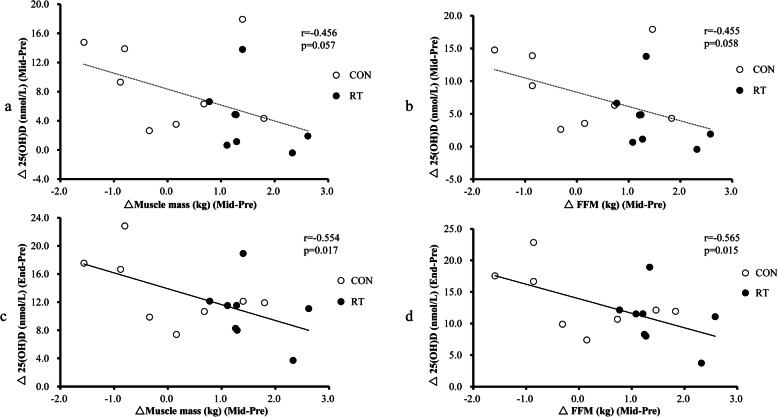
The average serum 25(OH) D concentrations were 26.6 nmol/L at baseline. After the 12-week intervention program, serum 25(OH) D concentrations significantly increased in both groups. Serum 25(OH) D concentrations at midpoint (6-week) increased significantly only in the CON group ( < 0.01). From training midpoint to endpoint, a significantly greater increase in serum 25(OH) D concentrations was noted in the RT group (P-interaction = 0.043); 25(OH) D concentration changes (end-pre) were negatively related to fat-free mass (mid-pre) ( = - 0.565, = 0.015) and muscle mass (mid-pre) ( = - 0.554, = 0.017).
There were no beneficial effects of the 12-week resistance training on serum 25(OH) D concentration in vitamin D deficient young men, and an indication that seasonal increase in serum 25(OH) D concentrations during the early phase of resistance training was transiently inhibited, which may partly be attributed to resistance training-induced muscle mass gain.
Chinese Clinical Trial Registry, ChiCTR2000030876. Registered 16 March 2020 - Retrospectively registered, http://www.chictr.org.cn/showproj.aspx?proj=50504.
先前的研究表明,血清25-羟基维生素D[25(OH)D]浓度与身体活动水平呈正相关,且不受阳光照射影响。然而,抗阻训练对血清25(OH)D浓度的影响仍不明确。因此,本研究旨在探讨长期抗阻训练对血清25(OH)D浓度的影响,并确定25(OH)D浓度变化是否受身体成分变化的影响。
18名年龄在19 - 39岁的年轻男性被随机分为12周抗阻训练组(RT,n = 9)和非运动对照组(CON,n = 9)。试验在中国上海的上海体育学院进行。随机分组和分配到试验组由中央计算机系统完成。使用市售酶联免疫吸附测定试剂盒测量血清25(OH)D和完整甲状旁腺激素浓度。通过双能X线吸收法测量身体成分。
基线时血清25(OH)D平均浓度为26.6 nmol/L。经过12周的干预计划后,两组血清25(OH)D浓度均显著升高。仅CON组在中点(6周)时血清25(OH)D浓度显著升高(P < 0.01)。从训练中点到终点,RT组血清25(OH)D浓度升高幅度显著更大(P交互作用 = 0.043);血清25(OH)D浓度变化(终点 - 基线)与去脂体重变化(中点 - 基线)呈负相关(r = - 0.565,P = 0.015),与肌肉量变化(中点 - 基线)呈负相关(r = - 0.554,P = 0.017)。
12周抗阻训练对维生素D缺乏的年轻男性血清25(OH)D浓度没有有益影响,且有迹象表明抗阻训练早期血清25(OH)D浓度的季节性升高被短暂抑制,这可能部分归因于抗阻训练引起的肌肉量增加。
中国临床试验注册中心,ChiCTR2000030876。2020年3月16日注册 - 回顾性注册,http://www.chictr.org.cn/showproj.aspx?proj=50504。