Bello Oluwasomidoyin Olukemi, Morhason-Bello Imran Oludare, Ojengbede Oladosu Akanbi
Department of Obstetrics and Gynaecology, College of Medicine, University College Hospital, University of Ibadan, Ibadan, Nigeria.
Centre for Population and Reproductive Health, Ibadan, Nigeria.
Pan Afr Med J. 2020 May 18;36:22. doi: 10.11604/pamj.2020.36.22.22204. eCollection 2020.
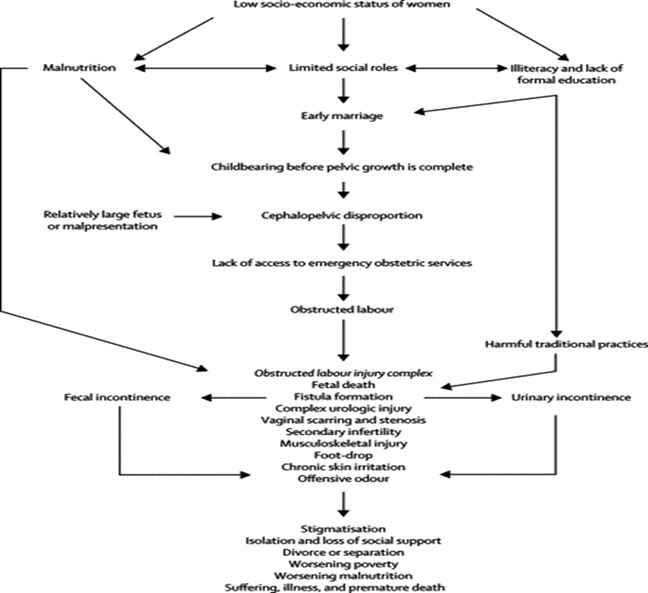
Obstetric fistula (OF) remain a source of public health concern and one of the most devastating maternal morbidities afflicting about two million women, mostly in developing countries. It is still prevalent in Nigeria due to the existence of socio-cultural beliefs/practices, socio-economic state and poor health facilities. The country's estimated annual 40,000 pregnancy-related deaths account for about 14% of the global maternal mortality, placing it among the top 10 most dangerous countries in the world for a woman to give birth. However, maternal morbidities including OF account for 20 to 30 times the number of maternal mortalities. This review substantiates why OF is yet to be eliminated in Nigeria as one of the countries with the largest burden of obstetric fistula. There is need for coordinated response to prevent and eliminate this morbidity via political commitment, implementation of evidence-based policy and execution of prevention programs.
产科瘘管病仍是公共卫生关注的焦点,也是最具破坏性的孕产妇发病情况之一,影响着约200万妇女,其中大多数在发展中国家。由于社会文化信仰/习俗、社会经济状况以及卫生设施匮乏,产科瘘管病在尼日利亚仍然很普遍。该国估计每年有4万例与妊娠相关的死亡,约占全球孕产妇死亡率的14%,使其成为世界上妇女分娩最危险的十大国家之一。然而,包括产科瘘管病在内的孕产妇发病数是孕产妇死亡数的20至30倍。本综述证实了为何尼日利亚作为产科瘘管病负担最重的国家之一,产科瘘管病仍未消除。需要通过政治承诺、实施循证政策和开展预防项目来进行协调应对,以预防和消除这种疾病。