Nicula Cristina Ariadna, Nicula Dorin, Rednik Anca Maria, Bulboacă Adriana Elena
Department of Ophthalmology, Iuliu Hațieganu University of Medicine and Pharmacy, Cluj-Napoca, Romania.
Oculens Clinic, Cluj-Napoca, Romania.
J Ophthalmol. 2020 Jul 22;2020:4745101. doi: 10.1155/2020/4745101. eCollection 2020.
The aim of our study was to compare the long-term efficacy and safety of "epi-off" conventional and "epi-off" accelerated corneal cross-linking (CXL) in patients with progressive keratoconus.
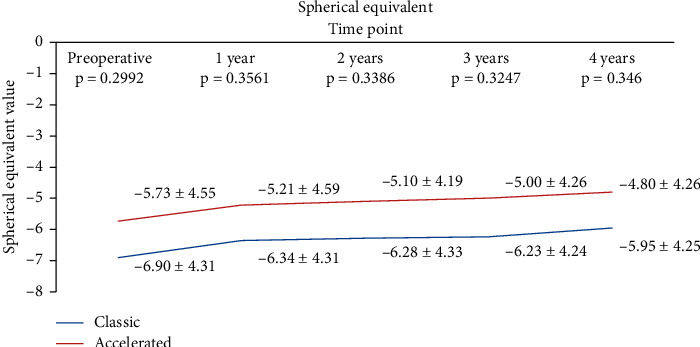
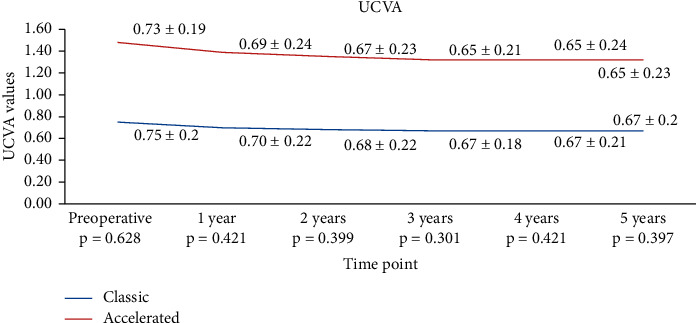
"Epithelial-off" ("Epi-off") CXL using the conventional technique (3 mW/cm, 30 minutes) was performed in 93 eyes of 93 patients (S-CXL group) and "epi-off" accelerated method (9 mW/cm, 10 minutes) in 76 eyes of 76 patients with progressive KCN (A-CXL group). Cases with different stages of keratoconus and topographic evidence of progression were included. Main outcomes comprised refraction, keratometry measurements, uncorrected (UCVA) and best-corrected visual acuity (BCVA), and topographical indices. Micromorphological analysis was assessed by anterior segment ocular coherence tomography (AS-OCT). The follow-up period was 5 years.
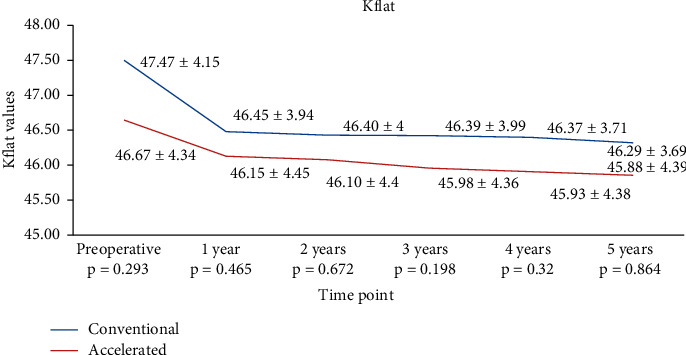
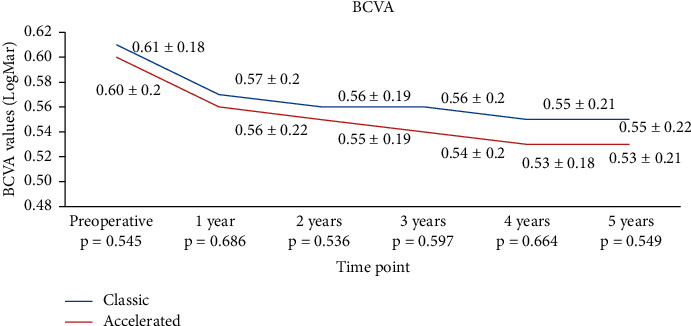
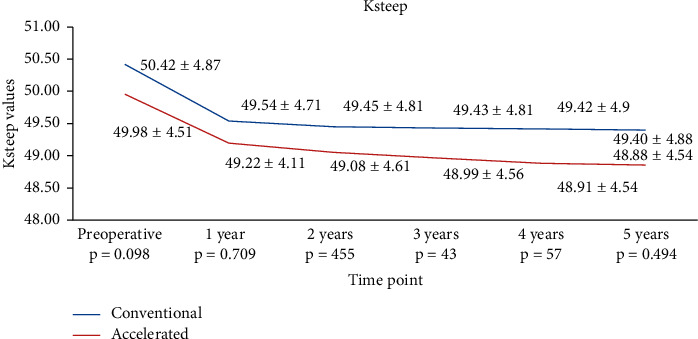
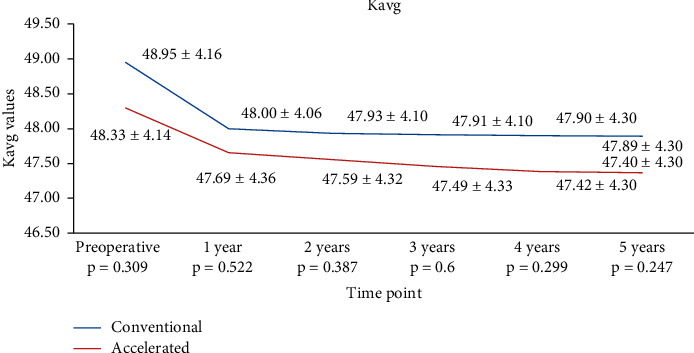
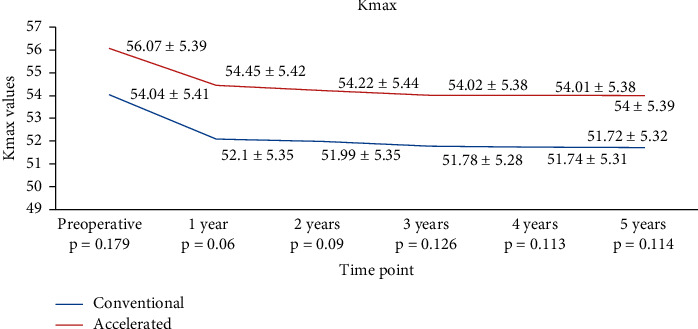
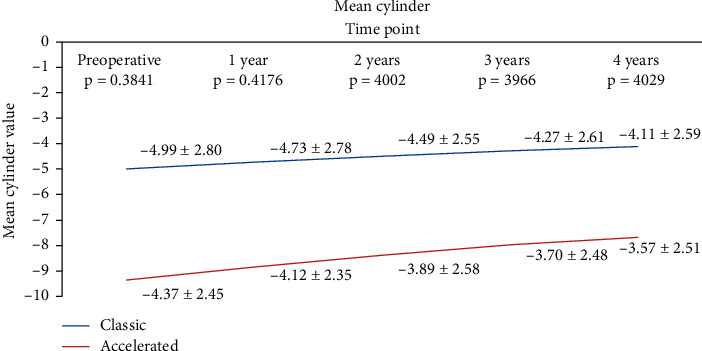
In both groups, Kflat presented similar results: decrease at 1 year (=0.465), at 2 years (=0.672), at 3 years (=0.198), at 4 years (=0.32), and at 5 years (=0.864). In both groups, Ksteep presented a similar decrease at 1 year (=0.709), at 2 years (=0.455), at 3 years (=0.43), at 4 years (=0.57), and at 5 years (=0.494), with no statistically significant difference. Decrease in Kavg was similar in both groups at all analyzed time points (=0.18 at 1 year, =0.093 at 2 years, =0.57 at 3 years, =0.154 at 4 years, and =0.247 at 5 years). Kmax had a similar decrease in both groups at 1 year (=0.06), at 2 years (=0.09), at 3 years (=0.126), at 4 years (=0.113), and at 5 years (=0.114). There was no statistically significant difference between the cylinder decrease in both groups (=0.349 at 1 year, =0.6782 at 2 years, =0.299 at 3 years, =0.0943 at 4 years, and =0.144 at 5 years). The BCVA values were statistically significantly higher than the preoperative values in both groups at all time points ( < 0.05). Topographical indices such as thinnest corneal point (TP), corneal volume (CV), index vertical asymmetry (IVA), index of vertical asymmetry (ISV), index of height asymmetry (IHA), index of height decentration (IHD), Belin/Ambrosio Enhanced Ectasia Display (BAD_D), and Ambrosio retinal thickness (ART Max) were significantly statistically decreased compared with baseline at all time points, in both groups.
"Epi-off" accelerated and conventional CXL have the same efficacy in terms of improvement in visual and topographic outcomes.
本研究旨在比较“去上皮”传统角膜交联术(CXL)与“去上皮”加速角膜交联术对圆锥角膜患者的长期疗效和安全性。
对93例患者的93只眼采用传统技术(3 mW/cm,30分钟)进行“去上皮”(“Epi-off”)CXL(S-CXL组),对76例圆锥角膜患者的76只眼采用“去上皮”加速方法(9 mW/cm,10分钟)(A-CXL组)。纳入不同阶段圆锥角膜且有地形图进展证据的病例。主要观察指标包括验光、角膜曲率测量、未矫正视力(UCVA)和最佳矫正视力(BCVA)以及地形图指数。通过眼前节光学相干断层扫描(AS-OCT)进行微观形态学分析。随访期为5年。
两组中,平坦角膜曲率(Kflat)呈现相似结果:1年时下降(=0.465),2年时下降(=0.672),3年时下降(=0.198),4年时下降(=0.32),5年时下降(=0.864)。两组中,陡峭角膜曲率(Ksteep)在1年时下降(=0.709),2年时下降(=0.455),3年时下降(=0.43),4年时下降(=0.57),5年时下降(=0.494),差异无统计学意义。在所有分析时间点,两组平均角膜曲率(Kavg)下降情况相似(1年时=0.18,2年时=0.093,3年时=0.57,4年时=0.154,5年时=0.247)。两组中最大角膜曲率(Kmax)在1年时下降(=0.06),2年时下降(=0.09),3年时下降(=0.126),4年时下降(=0.113),5年时下降(=0.114)。两组中柱镜度数下降情况差异无统计学意义(1年时=0.349,2年时=0.6782,3年时=0.299,4年时=0.0943,5年时=0.144)。在所有时间点,两组的BCVA值均显著高于术前值(<0.05)。在所有时间点,两组的角膜最薄点(TP)、角膜体积(CV)、垂直不对称指数(IVA)、垂直不对称指数(ISV)、高度不对称指数(IHA)、高度偏心指数(IHD)、贝林/安布罗西奥增强型圆锥角膜显示(BAD_D)和安布罗西奥视网膜厚度(ART Max)等地形图指数与基线相比均显著下降。
“去上皮”加速角膜交联术和传统角膜交联术在改善视力和地形图结果方面具有相同疗效。