Department of Geriatric Respiratory and Critical Care Medicine, The First Affiliated Hospital of Anhui Medical University, Hefei, China.
Department of Pulmonary, The Second People's Hospital of Hefei (The Affiliated Hefei Hospital of Anhui Medical University), Hefei, China.
Biomed Res Int. 2020 Jul 22;2020:7363712. doi: 10.1155/2020/7363712. eCollection 2020.
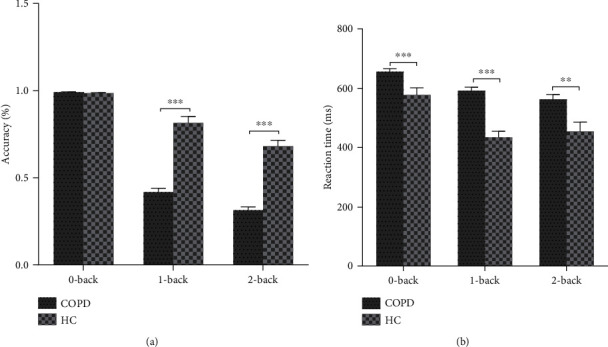
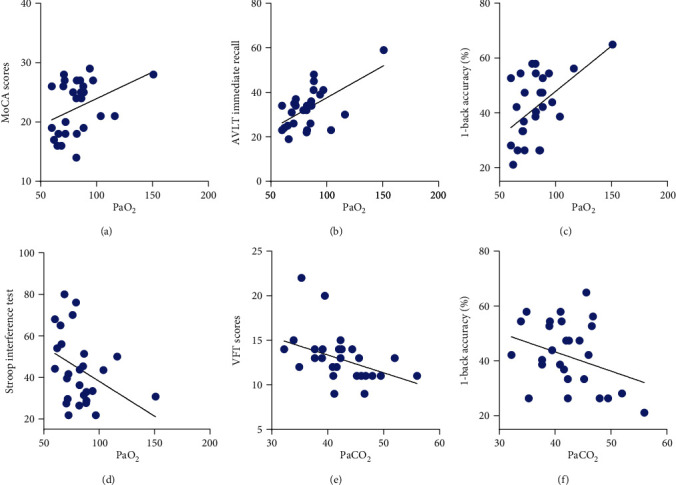
Chronic obstructive pulmonary disease (COPD) is characterized by irreversible airflow limitation and is often accompanied by cognitive impairment. Little is known about the working memory of COPD patients. The aim of the study is to evaluate the spatial working memory of COPD patients using the classical visuospatial working memory neuropsychological paradigms. This was a retrospective study of patients with COPD who were evaluated for neurocognitive functions between February and December 2018 at Hefei Second People's Hospital. Healthy controls (HC) were included. The neuropsychological tests included the Beijing Version of the Montreal Cognitive Assessment Test (MoCA), digit span test (DS), Chinese Auditory Verbal Learning Test (CAVLT), Stroop test, and Verbal Fluency Test (VFT). The COPD group performed worse in MoCA (22.3 ± 4.5 vs. 26.1 ± 2.9, < 0.001), Stroop interference test (44.2 ± 16.9 vs. 36.8 ± 10.3, = 0.038), and VFT (12.9 ± 2.8 vs. 15.3 ± 4.7, = 0.021) vs. the HC group. Compared with the HC group, COPD patients had statistically significant differences with respect to 0-back RT (657 ± 46 vs. 578 ± 107, = 0.001), 1-back accuracy (41.8 ± 12.1% vs. 81.5 ± 18.1%, < 0.001), 1-back RT (592 ± 75 vs. 431 ± 138, < 0.001), 2-back accuracy (31.4 ± 9.9% vs. 68.1 ± 16.6%, < 0.001), and 2-back RT (563 ± 79 vs. 455 ± 153, = 0.002). Only PaO was independently associated with 0-back RT ( = 0.992 ± 0.428, = 0.028) and 1-back ACC ( = 0.003 ± 0.001, = 0.004). COPD patients exhibit impairment in working memory and executive function, but not in short- or long-term memory. The impairment of working memory in a patient with COPD may be more due to integrate memory information rather than to memory information storage. COPD patients exhibit a frontal-type cognitive decline.
慢性阻塞性肺疾病(COPD)的特征是气流不可逆受限,常伴有认知障碍。目前对于 COPD 患者的工作记忆知之甚少。本研究旨在使用经典的视空间工作记忆神经心理范式评估 COPD 患者的空间工作记忆。这是一项回顾性研究,纳入了 2018 年 2 月至 12 月在合肥市第二人民医院接受神经认知功能评估的 COPD 患者。纳入了健康对照组(HC)。神经心理学测试包括北京版蒙特利尔认知评估测试(MoCA)、数字跨度测试(DS)、汉语听觉词语学习测试(CAVLT)、Stroop 测试和言语流畅性测试(VFT)。与 HC 组相比,COPD 组的 MoCA(22.3 ± 4.5 与 26.1 ± 2.9, <0.001)、Stroop 干扰测试(44.2 ± 16.9 与 36.8 ± 10.3, = 0.038)和 VFT(12.9 ± 2.8 与 15.3 ± 4.7, = 0.021)的得分较低。与 HC 组相比,COPD 患者在 0 回 RT(657 ± 46 与 578 ± 107, = 0.001)、1 回准确性(41.8 ± 12.1%与 81.5 ± 18.1%, <0.001)、1 回 RT(592 ± 75 与 431 ± 138, <0.001)、2 回准确性(31.4 ± 9.9%与 68.1 ± 16.6%, <0.001)和 2 回 RT(563 ± 79 与 455 ± 153, = 0.002)方面存在显著差异。仅 PaO 与 0 回 RT( = 0.992 ± 0.428, = 0.028)和 1 回 ACC( = 0.003 ± 0.001, = 0.004)独立相关。COPD 患者表现出工作记忆和执行功能受损,但未出现短期或长期记忆受损。COPD 患者的工作记忆受损可能更多地是由于整合记忆信息,而不是记忆信息存储。COPD 患者表现出额叶型认知下降。