Cleutjens Fiona Ahm, Franssen Frits Me, Spruit Martijn A, Vanfleteren Lowie Egw, Gijsen Candy, Dijkstra Jeanette B, Ponds Rudolf Whm, Wouters Emiel Fm, Janssen Daisy Ja
Department of Research and Education, CIRO, Centre of Expertise for Chronic Organ Failure, Horn.
Department of Medical Psychology, Maastricht UMC+/School for Mental Health and Neurosciences (MHeNS).
Int J Chron Obstruct Pulmon Dis. 2016 Dec 19;12:1-11. doi: 10.2147/COPD.S119633. eCollection 2017.
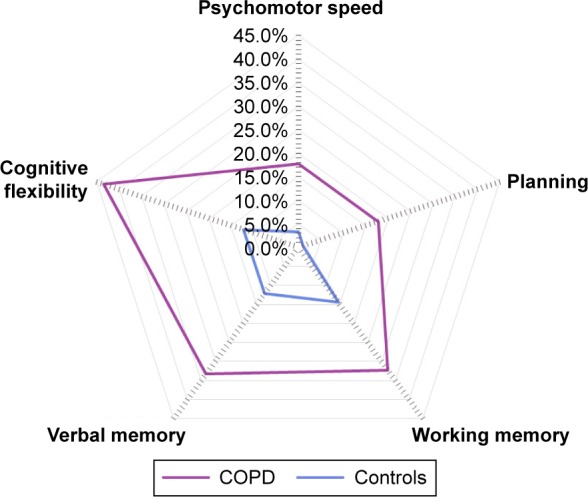
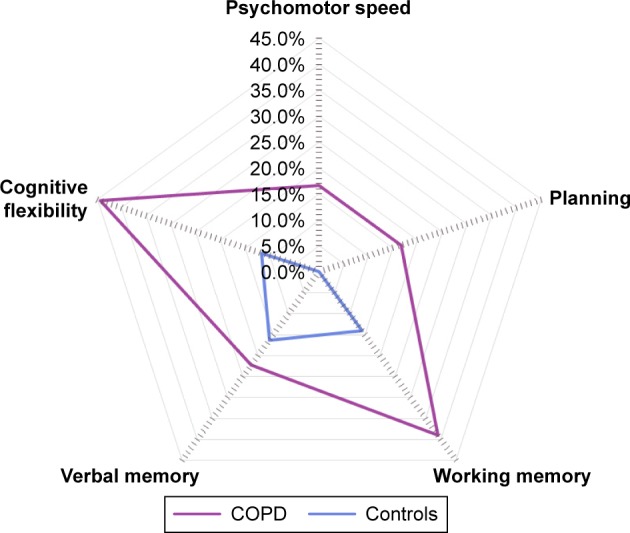
Impaired cognitive function is increasingly recognized in COPD. Yet, the prevalence of cognitive impairment in specific cognitive domains in COPD has been poorly studied. The aim of this cross-sectional observational study was to compare the prevalence of domain-specific cognitive impairment between patients with COPD and non-COPD controls. A neuropsychological assessment was administered in 90 stable COPD patients and 90 non-COPD controls with comparable smoking status, age, and level of education. Six core tests from the Maastricht Aging Study were used to assess general cognitive impairment. By using -scores, compound scores were constructed for the following domains: psychomotor speed, planning, working memory, verbal memory, and cognitive flexibility. General cognitive impairment and domain-specific cognitive impairment were compared between COPD patients and controls after correction for comorbidities using multivariate linear and logistic regression models. General cognitive impairment was found in 56.7% of patients with COPD and in 13.3% of controls. Deficits in the following domains were more often present in patients with COPD after correction for comorbidities: psychomotor speed (17.8% vs 3.3%; <0.001), planning (17.8% vs 1.1%; <0.001), and cognitive flexibility (43.3% vs 12.2%; <0.001). General cognitive impairment and impairments in the domains psychomotor speed, planning, and cognitive flexibility affect the COPD patients more than their matched controls.
慢性阻塞性肺疾病(COPD)患者的认知功能受损日益受到关注。然而,COPD患者在特定认知领域的认知障碍患病率却鲜有研究。本横断面观察性研究旨在比较COPD患者与非COPD对照者在特定领域认知障碍的患病率。对90例病情稳定的COPD患者和90例吸烟状况、年龄和教育程度相当的非COPD对照者进行了神经心理学评估。采用马斯特里赫特衰老研究中的六项核心测试评估总体认知障碍。通过使用Z分数,构建了以下领域的复合分数:心理运动速度、计划、工作记忆、言语记忆和认知灵活性。使用多变量线性和逻辑回归模型校正合并症后,比较COPD患者和对照者的总体认知障碍和特定领域认知障碍。结果发现,56.7%的COPD患者存在总体认知障碍,而对照者中这一比例为13.3%。校正合并症后,COPD患者在以下领域的缺陷更为常见:心理运动速度(17.8%对3.3%;P<0.001)、计划(17.8%对1.1%;P<0.001)和认知灵活性(43.3%对12.2%;P<0.001)。总体认知障碍以及心理运动速度、计划和认知灵活性领域的障碍对COPD患者的影响比对匹配对照者的影响更大。