National Institute of Pathology, Bucharest, Romania.
Medlife SA, Bucharest, Romania.
J Immunol Res. 2020 Jul 24;2020:9079083. doi: 10.1155/2020/9079083. eCollection 2020.
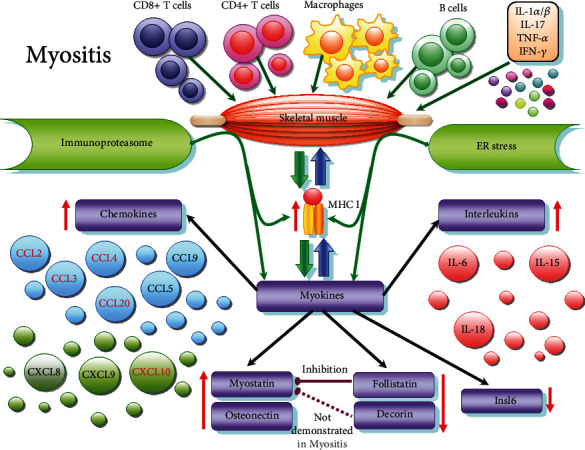
Idiopathic inflammatory myopathies (IIM) represent a heterogeneous group of autoimmune diseases whose treatment is often a challenge. Many patients, even after immunosuppressive therapy, do not respond to treatment, so new alternatives have been sought for this. Therefore, other signaling pathways that could contribute to the pathogenesis of myositis have been investigated, such as the expression of myokines in skeletal muscle in response to the inflammatory process. In this review, we will refer to these muscle cytokines that are overexpressed or downregulated in skeletal muscle in patients with various forms of IIM, thus being able to contribute to the maintenance of the autoimmune process. Some muscle cytokines, through their antagonistic action, may be a helpful contributor to the disease modulation, and thus, they could represent personalized treatment targets. Here, we consider the main myokines involved in the pathogenesis of myositis, expressing our view on the possibility of using them as potential therapeutic targets: interleukins IL-6, IL-15, and IL-18; chemokines CXCL10, CCL2, CCL3, CCL4, CCL5, and CCL20; myostatin; follistatin; decorin; osteonectin; and insulin-like 6. An interesting topic regarding the complex connection between myokines and noninflammatory pathways implied in IIM has also been briefly described, because it is an important scientific approach to the pathogenesis of IIM and can be a therapeutic alternative to be considered, especially for the patients who do not respond to immunosuppressive treatment.
特发性炎性肌病(IIM)代表了一组异质性自身免疫性疾病,其治疗常常具有挑战性。许多患者即使接受免疫抑制治疗后也无法对治疗产生反应,因此人们一直在寻找新的替代方法。因此,人们研究了其他可能有助于肌炎发病机制的信号通路,例如骨骼肌中肌细胞因子对炎症过程的反应。在这篇综述中,我们将提到在各种形式的 IIM 患者的骨骼肌中过度表达或下调的这些肌肉细胞因子,从而有助于维持自身免疫过程。一些肌肉细胞因子通过其拮抗作用可能有助于疾病的调节,因此,它们可能代表个性化治疗的靶点。在这里,我们考虑了参与肌炎发病机制的主要肌细胞因子,并就将它们用作潜在治疗靶点的可能性表达了我们的观点:白细胞介素 IL-6、IL-15 和 IL-18;趋化因子 CXCL10、CCL2、CCL3、CCL4、CCL5 和 CCL20;肌肉生长抑制素;卵泡抑素;核心蛋白聚糖;骨粘连蛋白;和胰岛素样 6。还简要描述了肌细胞因子与 IIM 中涉及的非炎症途径之间复杂联系的一个有趣的话题,因为这是 IIM 发病机制的一个重要科学方法,并且可以作为一种治疗选择来考虑,特别是对于那些对免疫抑制治疗没有反应的患者。