Tang Bor Luen
Department of Biochemistry, Yong Loo Lin School of Medicine, National University Health System, Singapore.
NUS Graduate School of Integrative Sciences and Engineering, National University of Singapore, Singapore.
Heliyon. 2020 Aug 1;6(8):e04600. doi: 10.1016/j.heliyon.2020.e04600. eCollection 2020 Aug.
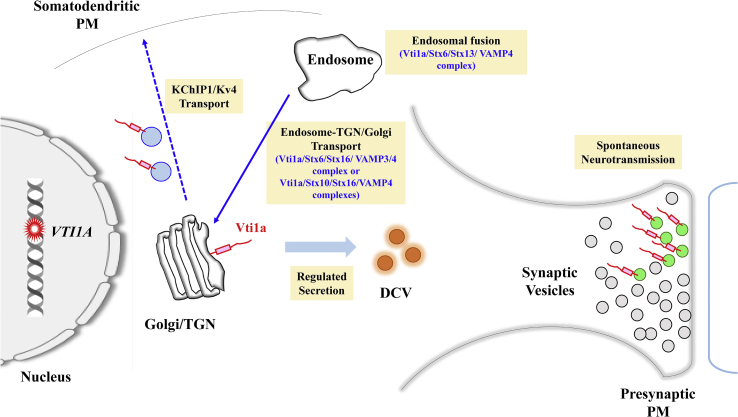
The Soluble N-ethylmaleimide-sensitive factor attachment protein receptor (SNARE) family mediates membrane fusion during membrane trafficking and autophagy in all eukaryotic cells, with a number of SNAREs having cell type-specific functions. The endosome--Golgi network (TGN) localized SNARE, Vesicle transport through interaction with t-SNAREs 1A (Vti1a), is unique among SNAREs in that it has numerous neuron-specific functions. These include neurite outgrowth, nervous system development, spontaneous neurotransmission, synaptic vesicle and dense core vesicle secretion, as well as a process of unconventional surface transport of the Kv4 potassium channel. Furthermore, the human gene is known to form fusion products with neighboring genes in cancer tissues, and variants are associated with risk in cancers, including glioma. In this review, I highlight VTI1A's known physio-pathological roles in brain neurons, as well as unanswered questions in these regards.
可溶性N - 乙基马来酰亚胺敏感因子附着蛋白受体(SNARE)家族在所有真核细胞的膜运输和自噬过程中介导膜融合,许多SNARE具有细胞类型特异性功能。定位于内体 - 高尔基体网络(TGN)的SNARE,即通过与t - SNAREs 1A相互作用进行囊泡运输(Vti1a),在SNARE中是独特的,因为它具有许多神经元特异性功能。这些功能包括神经突生长、神经系统发育、自发神经传递、突触小泡和致密核心小泡分泌,以及Kv4钾通道的非常规表面运输过程。此外,已知人类基因在癌症组织中与相邻基因形成融合产物,并且该基因的变体与包括胶质瘤在内的多种癌症风险相关。在这篇综述中,我重点介绍了VTI1A在脑神经元中已知的生理病理作用,以及这些方面尚未解答的问题。