Rabbitts Jennifer A, Groenewald Cornelius B
Department of Anesthesiology and Pain Medicine, University of Washington School of Medicine, Seattle, Washington, USA.
Center for Clinical and Translation Research, Seattle Children's Hospital, Seattle, Washington, USA.
Paediatr Anaesth. 2020 Oct;30(10):1083-1090. doi: 10.1111/pan.13993. Epub 2020 Aug 29.
The epidemiology of pediatric surgery in the United States and whether disparities in access to surgical care exist on a national level remain inadequately described.
We determined rates of surgical intervention and associations with sociodemographic factors among children 0-17 years of age in the United States.
Analysis of the 2005-2018 National Health Interview Survey samples included 155,064 children. Parents reported on whether their child had a surgery or surgical procedure either as an inpatient or outpatient over the past 12 months. Multivariate logistic regression models, adjusted for age, sex, race and ethnicity, income, language, parent education, region, having a usual source of care, and comorbid conditions, examined odds ratios for sociodemographic factors associated with surgery, analyzing the most recent data (2016-2018; 25 544 children).
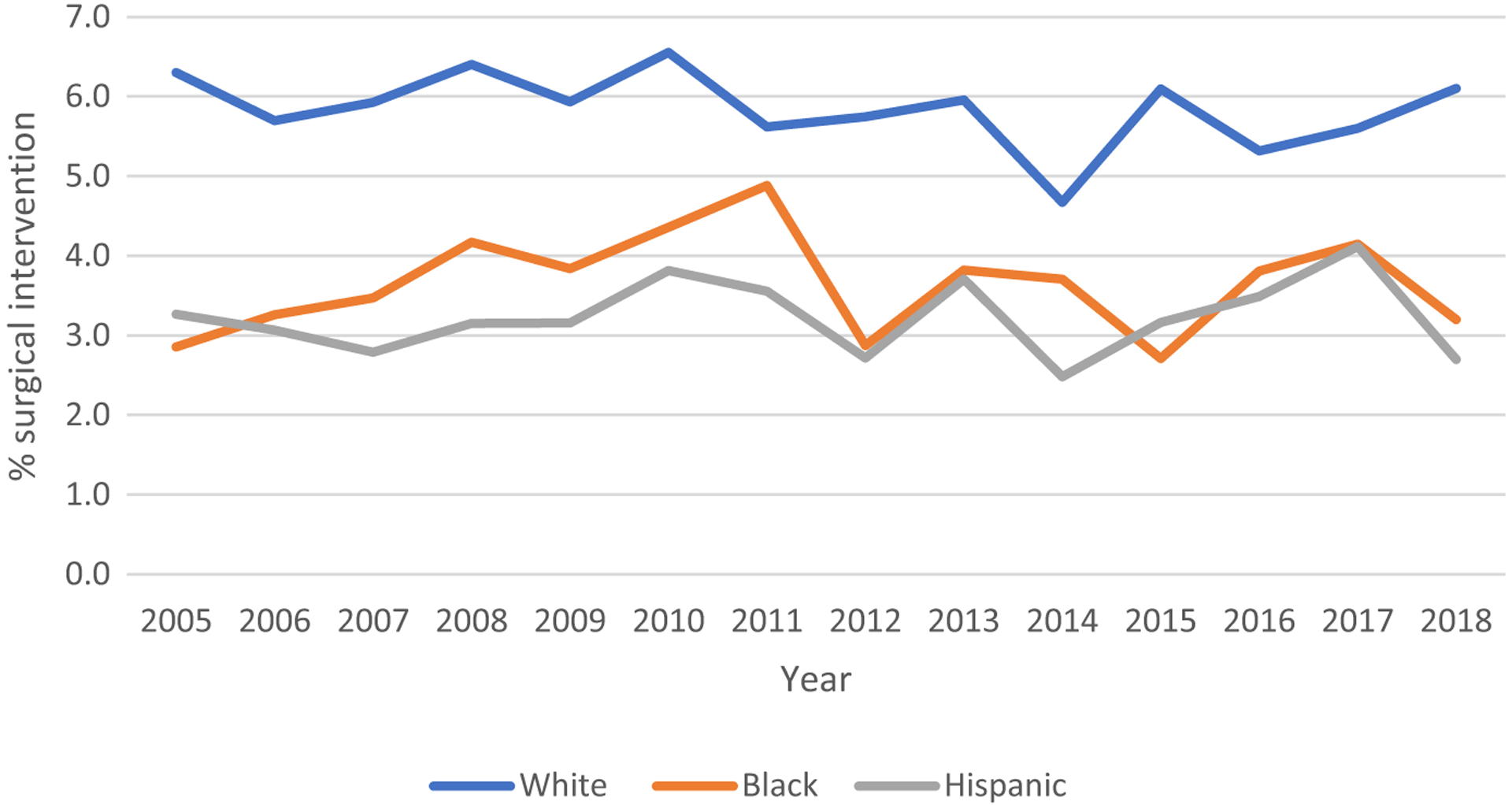
In the most recent data, 4.7% of children had surgical intervention each year, with an average of 3.9 million surgeries performed annually. Rates of surgery were stable between 2005 and 2018. Minority children had lower adjusted odds (aOR) of surgical intervention as compared to white, non-Hispanic children (aOR = 0.6, 95%CI = 0.5-0.8 for black children, and aOR = 0.7, 95%CI = 0.5-0.9 for Hispanic children). Other sociodemographic factors associated with a lower adjusted odd of surgical intervention included uninsured status (aOR = 0.5; 95%CI = 0.3-0.9), and primary language other than English (aOR = 0.5; 95%CI 0.3-0.9). Income was not associated with surgical intervention.
On average, 3.9 million surgeries are performed on children 0-17 years of age in the United States each year. Significant disparities exist in surgical care for children, with black and Hispanic children having lower rates of surgery over and above contribution of other disparity domains. These findings in a nationally representative sample highlight the need for national policies to eliminate disparity of care received by minority children.
美国儿科手术的流行病学情况以及全国范围内在获得手术治疗方面是否存在差异仍未得到充分描述。
我们确定了美国0至17岁儿童的手术干预率以及与社会人口学因素的关联。
对2005 - 2018年国家健康访谈调查样本进行分析,样本包括155,064名儿童。家长报告其孩子在过去12个月内是否作为住院患者或门诊患者接受过手术或外科手术。多变量逻辑回归模型在对年龄、性别、种族和族裔、收入、语言、家长教育程度、地区、是否有固定的医疗服务来源以及合并症进行调整后,检验与手术相关的社会人口学因素的比值比,分析最新数据(2016 - 2018年;25,544名儿童)。
在最新数据中,每年有4.7%的儿童接受手术干预,每年平均进行390万例手术。2005年至2018年期间手术率保持稳定。与非西班牙裔白人儿童相比,少数族裔儿童接受手术干预的调整后比值比(aOR)较低(黑人儿童的aOR = 0.6,95%置信区间 = 0.5 - 0.8;西班牙裔儿童的aOR = 0.7,95%置信区间 = 0.5 - 0.9)。与手术干预调整后比值比降低相关的其他社会人口学因素包括未参保状态(aOR = 0.5;95%置信区间 = 0.3 - 0.9)以及非英语母语(aOR = 0.5;95%置信区间0.3 - 0.9)。收入与手术干预无关。
在美国,每年平均有390万例手术是针对0至17岁儿童进行的。儿童手术治疗存在显著差异黑人及西班牙裔儿童的手术率低于其他差异领域的影响。在全国代表性样本中的这些发现凸显了制定国家政策以消除少数族裔儿童所接受医疗差异的必要性。